Google Surface
Google Merchant Center
Also known as: Merchant Center, Merchant Center Next
Google Merchant Center is the platform where retailers upload and manage product data for use across Google's shopping surfaces. It holds product feeds, business details, shipping and tax settings, and reports on how products are approved and performing. Merchant Center Next is Google's rebuilt version of the interface, designed to be simpler and more automated.
What it is
Merchant Center is the data layer behind Google's product experiences. Retailers submit a product feed, either as a file, via the Content API, or through a platform integration, and Google validates each item against its product data specification before it becomes eligible for Shopping ads and free product listings. It also stores account level settings such as shipping rates, return policies, and links to Google Ads and Search Console.
Why it matters
If a product is disapproved or missing required attributes, it cannot appear on Shopping surfaces at all, regardless of budget or brand strength. Feed quality directly affects which queries a product matches, since Google uses titles, descriptions, attributes, GTINs and images to understand and categorise items. As AI-assisted shopping experiences pull structured product data, accurate and complete feeds become a discovery asset rather than just an advertising requirement.
How it works
Practitioners set up a feed source, map fields to Google's specification, then work through the Diagnostics and Products reports to clear disapprovals and warnings. Ongoing work includes enriching titles with the attributes shoppers search on, keeping price and availability in sync with the site, supplying GTINs and brand where applicable, and using supplemental feeds for overrides without touching the primary source. Many teams add automated price and stock updates so Merchant Center data does not drift from the live store.
When it applies
It applies to any retailer selling physical products who wants paid or free visibility on Google Shopping, Search product results and related surfaces. It is also required for local inventory and promotions features.
Examples
- A fashion retailer clears 400 disapprovals caused by missing GTINs and sees those items become eligible for Shopping ads within a few days.
- A homeware brand rewrites product titles to include material, colour and size, then compares impressions for the affected items before and after.
- A multi-country merchant adds separate feeds and shipping settings per market so prices and delivery times match each destination site.
How it is measured
- Share of submitted products that are approved, versus disapproved or pending
- Count of feed errors and warnings in Diagnostics, tracked week on week
- Impressions and clicks from free product listings and Shopping ads in performance reports
- Price competitiveness and availability mismatch rates against the live site
Related terms in Google Surface
- AI ModeGoogle's standalone AI-first search experience inside Search itself, a conversational, multi-step interface for complex queries. Different ranking and citation logic from classical SERP.
- AI OverviewsGoogle's generative answer shown at the top of the SERP for eligible queries. Sourced from the open web, cites multiple pages, and increasingly replaces the traditional snippet for informational intent. Successor to the SGE experiment.
- AndroidAndroid is Google's mobile operating system, used on phones, tablets, televisions and other devices from many manufacturers. For marketers it is a discovery surface as well as a platform, because it ships with Chrome, the Google app, Google Play and Google's assistant features. Being visible on Android means being findable through those entry points, not only through a browser.
- DiscoverGoogle's personalised feed in the Google app and on Android. Algorithmically curated, no query needed, driven by topical interest signals and freshness. Material traffic source for publishers.
- Google Business ProfileGoogle Business Profile is the free Google tool that lets a business manage how it appears in Google Search, Google Maps and local results. It holds core details such as name, address, phone number, opening hours, categories, photos, products, services and reviews. Formerly called Google My Business, it is the main control panel for a business's local presence on Google.
- Google SearchGoogle Search is Google's web search engine, reached mainly through google.com and the Chrome and Android search bars. It crawls and indexes web pages, then ranks results for a query using automated ranking systems. It now blends traditional blue links with features such as AI Overviews, AI Mode, featured snippets, knowledge panels and local packs.
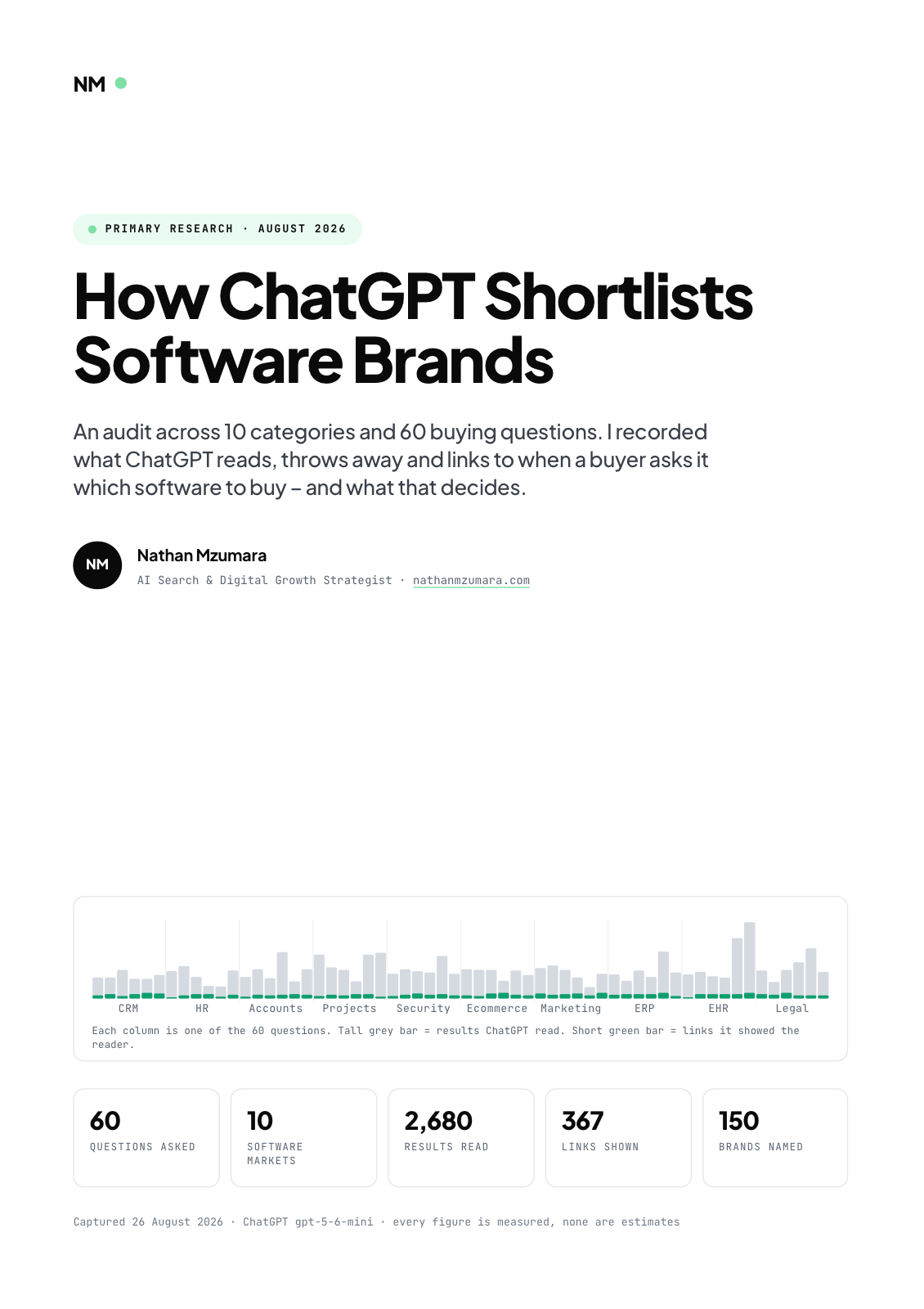
Primary research · August 2026
How ChatGPT Shortlists Software Brands
An audit across 10 categories and 60 buying questions. I recorded what ChatGPT reads, throws away and links to when a buyer asks it which software to buy, and what that decides.
- 60
- Questions asked
- 10
- Software markets
- 2,680
- Results read
- 367
- Links shown
Free download
Get the full report
35 pages · PDF · 536 KB. Enter your details and it downloads straight away.