Structured Data
Structured data
Markup (typically JSON-LD using Schema.org vocabulary) that tells search engines and LLMs what the entities and relationships on a page are. Increasingly important as both Google and generative systems converge on entity-level understanding.
What it is
Structured data is machine-readable markup, typically JSON-LD using Schema.org vocabulary, that states what entities a page describes and how they relate. It turns implicit meaning in prose into explicit, parsable assertions.
Why it matters
As Google and generative systems converge on entity-level understanding, structured data is a primary signal for disambiguating entities and for being cited accurately in AI-generated answers.
How it works
Identify the page's core entities and relationships, map them to appropriate types and properties, and emit them as JSON-LD that mirrors the visible content.
When it applies
It applies to any page whose meaning, entities, or relationships you want machines to interpret without inferring them from text alone.
Examples
- A recipe page exposing ingredients, steps, and cook time as Recipe properties
- An author page connecting a Person to their published Articles and sameAs profiles
- An events listing emitting Event nodes with dates, locations, and organisers
How it is measured
- Percentage of key entities on a page covered by markup
- Agreement between structured claims and rendered content
- Number of entities successfully resolved to known knowledge-graph nodes
- Validation pass rate across the site's templates
Insights on Structured data
- Google Guidance on Generative AI Content: What the Rules Say
- GPT‑6 and Intelligent UI: ChatGPT Now Renders the Answer
- Google Just Broke JSON-LD Escaping. Check Your Schema Now.
- ChatGPT Shifts From Asking to Doing. Intent Just Moved.
- Google Adds Sale Dates to Product Schema. Free Visibility Just Got Cheaper.
- Bing Just Turned Its Shopping Results Into the Storefront
Related terms in Structured Data
- Content provenanceContent provenance is verifiable information about where a piece of content came from, who created it and how it has been changed, carried with the file or published alongside it. The main open standard is C2PA, shown to people as Content Credentials, which uses cryptographic signing to record capture, edits and any AI involvement. It helps platforms, search systems and readers judge whether an image, video or audio clip is what it claims to be.
- Feed freshnessFeed freshness is how recently a product or data feed has been updated, and how closely the values in it match what is live on your site. A fresh feed reflects current prices, stock levels and product details within minutes or hours rather than days. Stale feeds cause disapprovals, mismatched listings and lost sales.
- JSON-LDThe recommended syntax for embedding Schema.org structured data on a page. Lightweight, decoupled from page HTML, and increasingly the format LLMs prefer when retrieving structured facts.
- Knowledge graph entityA node in Google's Knowledge Graph representing a real-world thing (person, place, organisation, work). Strong entity signals are prerequisite for Search Profile eligibility and consistent AI Overview attribution.
- Product feedA product feed is a structured file of product data, such as titles, descriptions, prices, availability, identifiers and image links, supplied to shopping channels and platforms. It gives retail surfaces a machine readable source of truth for what you sell. Feeds power Google Shopping listings, Meta catalogues, marketplaces and increasingly AI shopping answers.
- Retrieval-augmented generationA generation approach where an LLM pulls relevant documents at query time and uses them as the source for its answer. The pattern behind most enterprise AI search products and Perplexity-style answer engines.
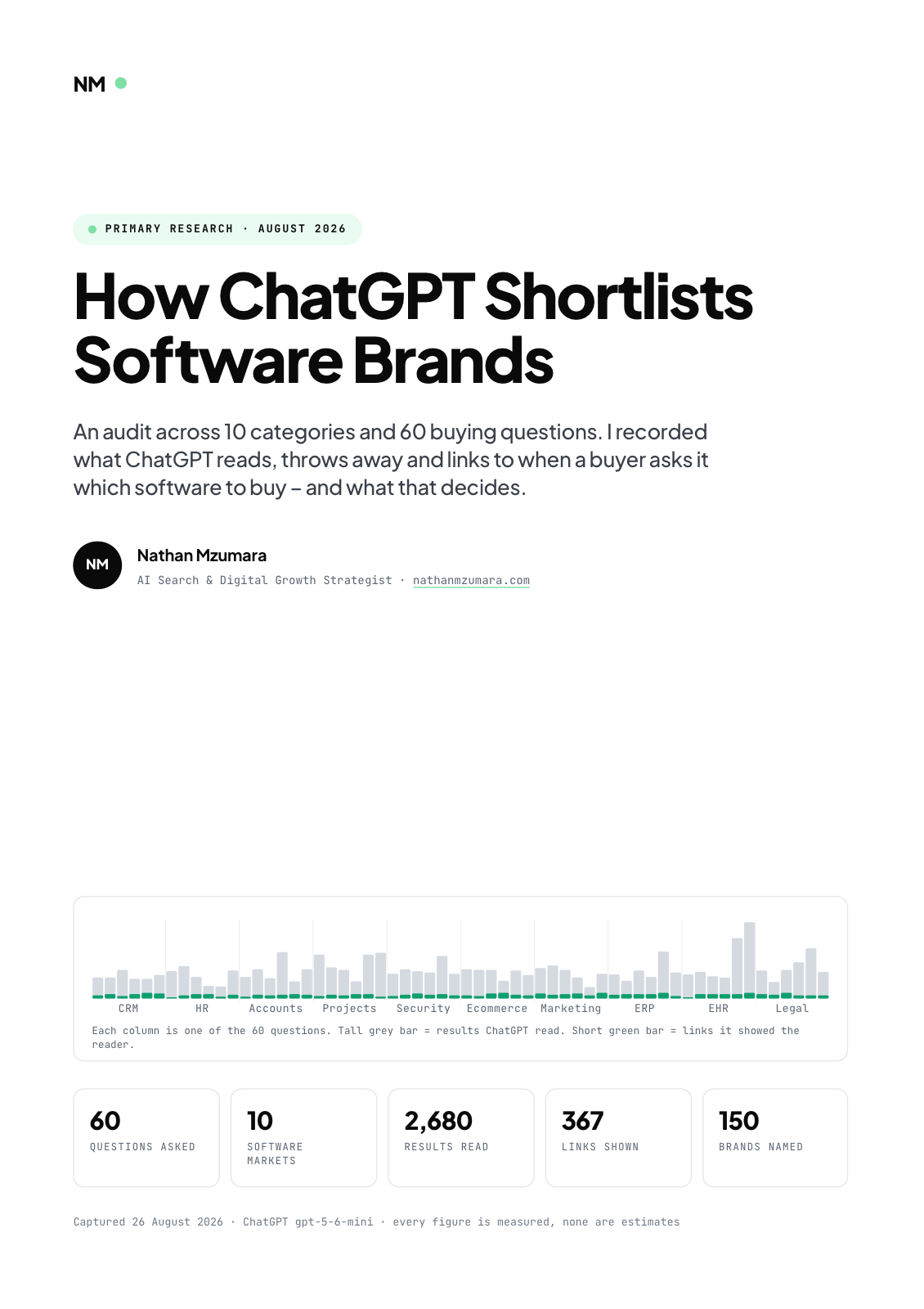
Primary research · August 2026
How ChatGPT Shortlists Software Brands
An audit across 10 categories and 60 buying questions. I recorded what ChatGPT reads, throws away and links to when a buyer asks it which software to buy, and what that decides.
- 60
- Questions asked
- 10
- Software markets
- 2,680
- Results read
- 367
- Links shown
Free download
Get the full report
35 pages · PDF · 536 KB. Enter your details and it downloads straight away.