Structured Data
JSON-LD
The recommended syntax for embedding Schema.org structured data on a page. Lightweight, decoupled from page HTML, and increasingly the format LLMs prefer when retrieving structured facts.
What it is
JSON-LD is a JSON-based serialisation for embedding Schema.org structured data, placed in a script block rather than woven into visible HTML. It expresses entities and their relationships as linked data that machines can parse independently of page layout.
Why it matters
Its separation from the rendered DOM makes facts easier and cheaper for crawlers and LLMs to extract reliably, and it is the format generative systems increasingly favour when retrieving structured facts.
How it works
You declare a context and type, then list properties as key value pairs, often linking nodes by @id so that entities reference one another across the same page or site.
When it applies
It applies to any page where you want structured facts represented cleanly and decoupled from presentation markup.
Examples
- A script type application ld plus json block in the head describing an Organisation
- Linking an Article node to its author Person node via a shared @id
- A FAQPage block listing question and answer pairs as structured nodes
How it is measured
- JSON-LD parses as valid JSON and as valid linked data
- Entities correctly cross-reference via @id without dangling references
- Consistency between JSON-LD claims and the visible on-page content
- Share of structured data delivered as JSON-LD versus microdata or RDFa
Insights on JSON-LD
Related terms in Structured Data
- Content provenanceContent provenance is verifiable information about where a piece of content came from, who created it and how it has been changed, carried with the file or published alongside it. The main open standard is C2PA, shown to people as Content Credentials, which uses cryptographic signing to record capture, edits and any AI involvement. It helps platforms, search systems and readers judge whether an image, video or audio clip is what it claims to be.
- Feed freshnessFeed freshness is how recently a product or data feed has been updated, and how closely the values in it match what is live on your site. A fresh feed reflects current prices, stock levels and product details within minutes or hours rather than days. Stale feeds cause disapprovals, mismatched listings and lost sales.
- Knowledge graph entityA node in Google's Knowledge Graph representing a real-world thing (person, place, organisation, work). Strong entity signals are prerequisite for Search Profile eligibility and consistent AI Overview attribution.
- Product feedA product feed is a structured file of product data, such as titles, descriptions, prices, availability, identifiers and image links, supplied to shopping channels and platforms. It gives retail surfaces a machine readable source of truth for what you sell. Feeds power Google Shopping listings, Meta catalogues, marketplaces and increasingly AI shopping answers.
- Retrieval-augmented generationA generation approach where an LLM pulls relevant documents at query time and uses them as the source for its answer. The pattern behind most enterprise AI search products and Perplexity-style answer engines.
- Schema.orgThe shared vocabulary for structured-data markup used by Google, Microsoft, and major search engines. As of June 2026, Schema.org publishes monthly aggregate adoption statistics by type.
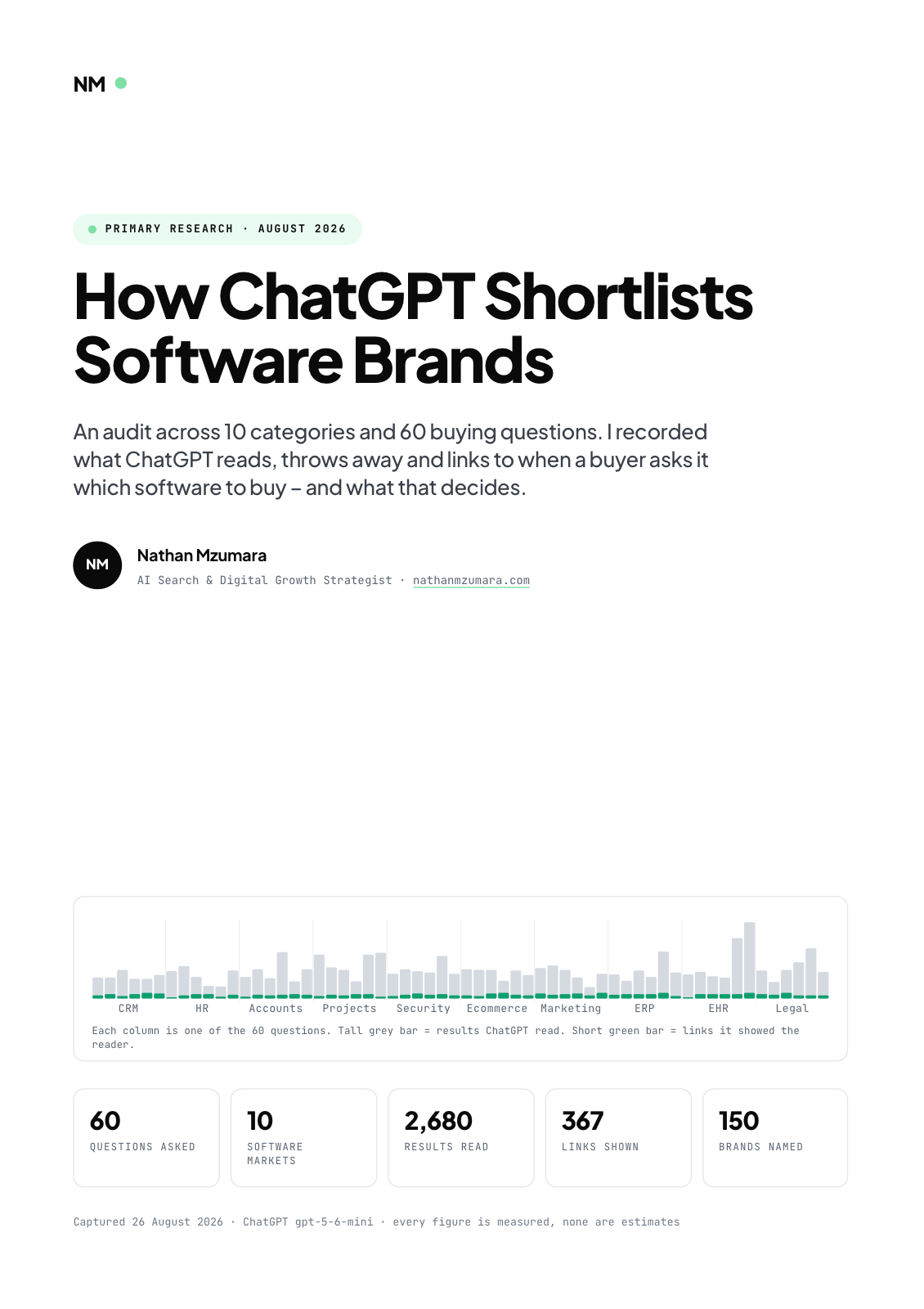
Primary research · August 2026
How ChatGPT Shortlists Software Brands
An audit across 10 categories and 60 buying questions. I recorded what ChatGPT reads, throws away and links to when a buyer asks it which software to buy, and what that decides.
- 60
- Questions asked
- 10
- Software markets
- 2,680
- Results read
- 367
- Links shown
Free download
Get the full report
35 pages · PDF · 536 KB. Enter your details and it downloads straight away.