Structured Data
Retrieval-augmented generation
Also known as: RAG
A generation approach where an LLM pulls relevant documents at query time and uses them as the source for its answer. The pattern behind most enterprise AI search products and Perplexity-style answer engines.
What it is
Retrieval-augmented generation is an approach where an LLM fetches relevant documents at query time and grounds its answer in that retrieved material rather than relying solely on its trained weights. It is the pattern behind most enterprise AI search products and Perplexity-style answer engines.
Why it matters
It determines whether and how your content is selected, quoted, and attributed in AI answers, making retrievability and clear, chunk-level structure as important as traditional ranking.
How it works
A system embeds and indexes source content, retrieves the closest passages to a query, and passes them as context so the model composes a grounded, often cited response.
When it applies
It applies wherever answers must reflect current, source-specific, or proprietary information rather than the model's static training data.
Examples
- An answer engine retrieving three articles and synthesising a cited summary
- An internal support bot grounding replies in a company's documentation index
- A site optimising self-contained sections so passages retrieve cleanly out of context
How it is measured
- Retrieval relevance of passages returned for a target query
- Faithfulness of generated answers to the retrieved sources
- Citation accuracy and frequency for your content in answers
- Coverage of expected queries by retrievable, well-structured passages
Related terms in Structured Data
- Content provenanceContent provenance is verifiable information about where a piece of content came from, who created it and how it has been changed, carried with the file or published alongside it. The main open standard is C2PA, shown to people as Content Credentials, which uses cryptographic signing to record capture, edits and any AI involvement. It helps platforms, search systems and readers judge whether an image, video or audio clip is what it claims to be.
- Feed freshnessFeed freshness is how recently a product or data feed has been updated, and how closely the values in it match what is live on your site. A fresh feed reflects current prices, stock levels and product details within minutes or hours rather than days. Stale feeds cause disapprovals, mismatched listings and lost sales.
- JSON-LDThe recommended syntax for embedding Schema.org structured data on a page. Lightweight, decoupled from page HTML, and increasingly the format LLMs prefer when retrieving structured facts.
- Knowledge graph entityA node in Google's Knowledge Graph representing a real-world thing (person, place, organisation, work). Strong entity signals are prerequisite for Search Profile eligibility and consistent AI Overview attribution.
- Product feedA product feed is a structured file of product data, such as titles, descriptions, prices, availability, identifiers and image links, supplied to shopping channels and platforms. It gives retail surfaces a machine readable source of truth for what you sell. Feeds power Google Shopping listings, Meta catalogues, marketplaces and increasingly AI shopping answers.
- Schema.orgThe shared vocabulary for structured-data markup used by Google, Microsoft, and major search engines. As of June 2026, Schema.org publishes monthly aggregate adoption statistics by type.
Primary research · August 2026
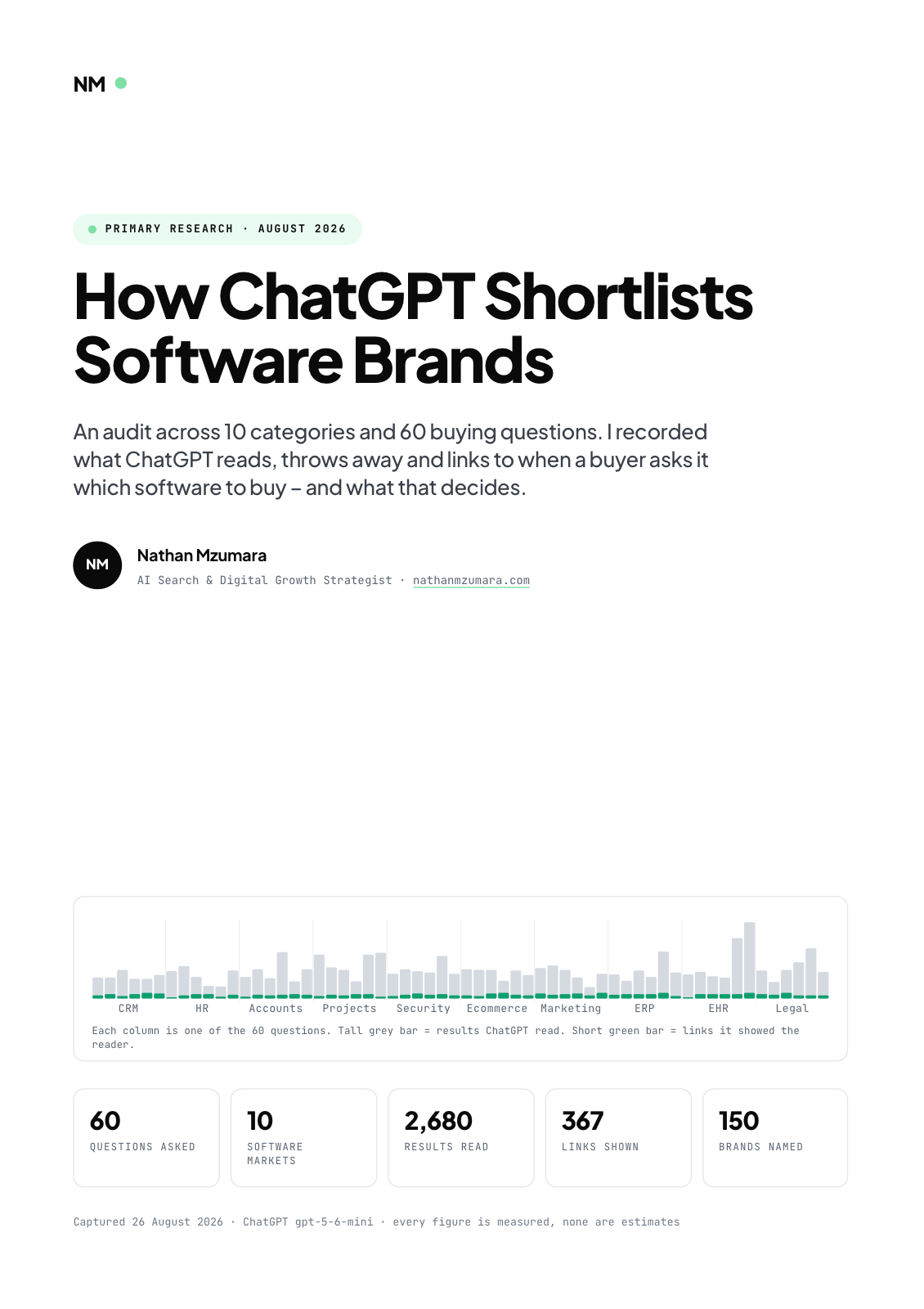
How ChatGPT Shortlists Software Brands
An audit across 10 categories and 60 buying questions. I recorded what ChatGPT reads, throws away and links to when a buyer asks it which software to buy, and what that decides.
- 60
- Questions asked
- 10
- Software markets
- 2,680
- Results read
- 367
- Links shown
Free download
Get the full report
35 pages · PDF · 536 KB. Enter your details and it downloads straight away.