Advertising & Paid Media
AI-generated creative
Also known as: AI creative, generative ad creative
AI-generated creative is ad and marketing creative produced or adapted using generative models, including images, video, voiceover, headlines and body copy. Teams use it to produce more variants, localise faster and test concepts that would be too costly to shoot. It still needs human direction, brand review and legal checks before it runs.
What it is
The term covers anything from a fully synthetic image to an AI-resized crop, an alternative headline or an automatically generated background. Ad platforms increasingly build these tools into the campaign setup flow, and standalone tools cover scripting, editing and voice. In practice most production is hybrid, with human assets extended or reversioned by models.
Why it matters
Creative volume is now a performance lever, because automated bidding and placement systems need many variants to test against different audiences and surfaces. AI production lowers the cost per variant, which makes broader testing and more localisation affordable. It also raises new risks around brand consistency, rights, disclosure and audience trust, so governance matters as much as output speed.
How it works
Teams define a brand system first, including tone, palette, product accuracy rules and prohibited depictions, then use prompts, style references or fine tuned assets to stay within it. Output goes through a human review gate covering factual claims, product truth, accessibility and platform policy, including any required AI disclosure. Winning variants are logged so prompts and templates improve rather than starting from scratch each time.
When it applies
It applies whenever creative demand outstrips production capacity, for example high volume paid social, many market localisations, or rapid concept testing before a full shoot. It is less appropriate where product depiction accuracy, regulated claims or human authenticity are central to the message.
Examples
- A retailer generates ten background variants for one product photo to test seasonal settings across paid social placements.
- A travel brand localises one video script into six languages with AI voiceover, with native speaker review before launch.
- A B2B team uses a model to draft twenty headline options, then a copywriter selects and rewrites five for testing.
How it is measured
- Cost and hours per approved asset compared with a pre-AI baseline
- Win rate of AI-assisted variants against human-only control creative
- Review rejection rate and reasons, tracked to improve prompts and guidelines
- Creative fatigue curve, measured as click through rate decay by impression volume
Insights on AI-generated creative
Related terms in Advertising & Paid Media
- Asset groupsAn asset group is the creative container inside a Google Performance Max or Demand Gen campaign, holding headlines, descriptions, images, logos, videos and audience signals. Google assembles ads from these assets and serves them across Search, Shopping, YouTube, Display, Discover, Gmail and Maps. Retail campaigns can tie an asset group to a specific set of products through listing groups.
- Brand safetyBrand safety is the practice of preventing advertising and brand content from appearing next to material that could damage reputation, such as violent, illegal or misleading content. Brand suitability is the related, narrower idea of matching placements to a specific brand's tolerance and values rather than a universal baseline. Both rely on exclusion lists, content classification and verification reporting.
- ChatGPT AdsChatGPT Ads refers to advertising placements inside OpenAI's ChatGPT. OpenAI has publicly signalled that advertising is part of its commercial plans and has been testing and building out ad capabilities, so the format details continue to change. For marketers it represents a possible new paid surface alongside organic visibility in AI assistants.
- ChatGPT Sponsored AgentsChatGPT Sponsored Agents is the name given to a paid placement format in which a brand's agent or assistant can be surfaced inside a ChatGPT conversation to help complete a task, such as booking, quoting or buying. It sits alongside other advertising formats OpenAI has discussed for ChatGPT, where commercial results are marked as sponsored rather than blended invisibly into answers. Availability, naming and mechanics are still moving, so treat any specification as provisional and check current OpenAI documentation before planning spend.
- Conversational advertisingConversational advertising is paid placement inside a dialogue, whether that is an AI assistant, a chatbot, a messaging app or a voice interface. Instead of a static creative next to content, the ad appears as a response, suggestion or handover at the point where the user has expressed intent. The defining features are turn-by-turn context, a disclosure label, and the option for the user to keep talking rather than click away.
- Demand Gen campaignsDemand Gen is a Google Ads campaign type built for visually led prospecting across YouTube, Discover, Gmail and other Google feeds. Advertisers supply image, video and text assets plus audience signals, and Google's systems assemble and place ads to create interest before someone actively searches. It replaced Discovery campaigns and sits between upper funnel video and lower funnel search or shopping activity.
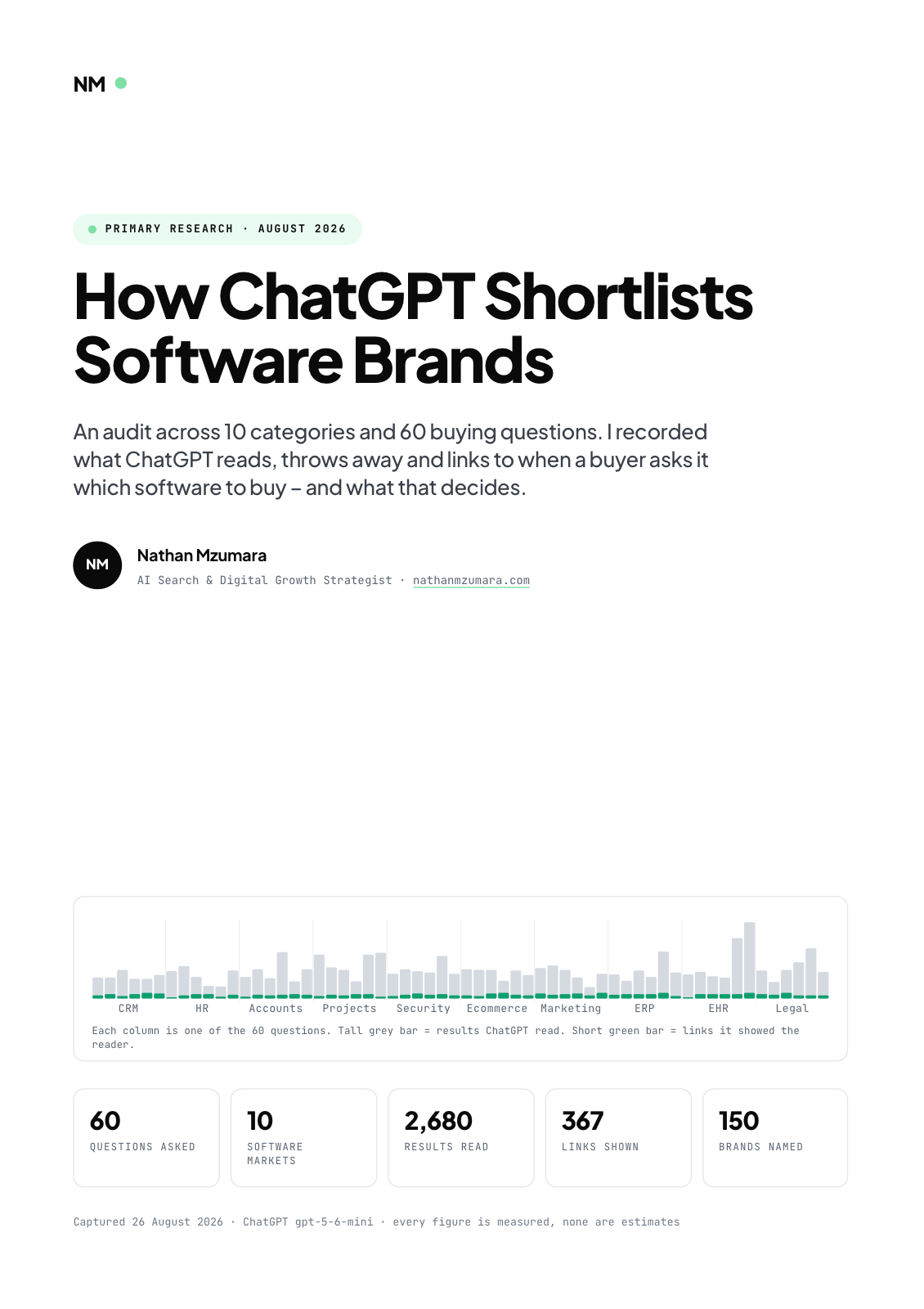
Primary research · August 2026
How ChatGPT Shortlists Software Brands
An audit across 10 categories and 60 buying questions. I recorded what ChatGPT reads, throws away and links to when a buyer asks it which software to buy, and what that decides.
- 60
- Questions asked
- 10
- Software markets
- 2,680
- Results read
- 367
- Links shown
Free download
Get the full report
35 pages · PDF · 536 KB. Enter your details and it downloads straight away.