Claude for Government Drops Seat Fees for Prepaid Usage

Anthropic has moved Claude for Government out of beta into general availability, and dropped seat fees as part of the change. Federal and state agencies now prepay for usage against a hard not-to-exceed cap. The source announcement states no date. Deployment sits inside a FedRAMP High authorized environment, covering the Claude desktop app, including Cowork and Claude Code.
What changed with Claude for Government
According to Anthropic's announcement, posted on LinkedIn with no stated date, the product has left beta and is generally available. Federal and state agencies can deploy the Claude desktop app, including Cowork and Claude Code, in a FedRAMP High authorized environment. FedRAMP is the US government programme that certifies cloud services for federal use, and High is its top impact tier.
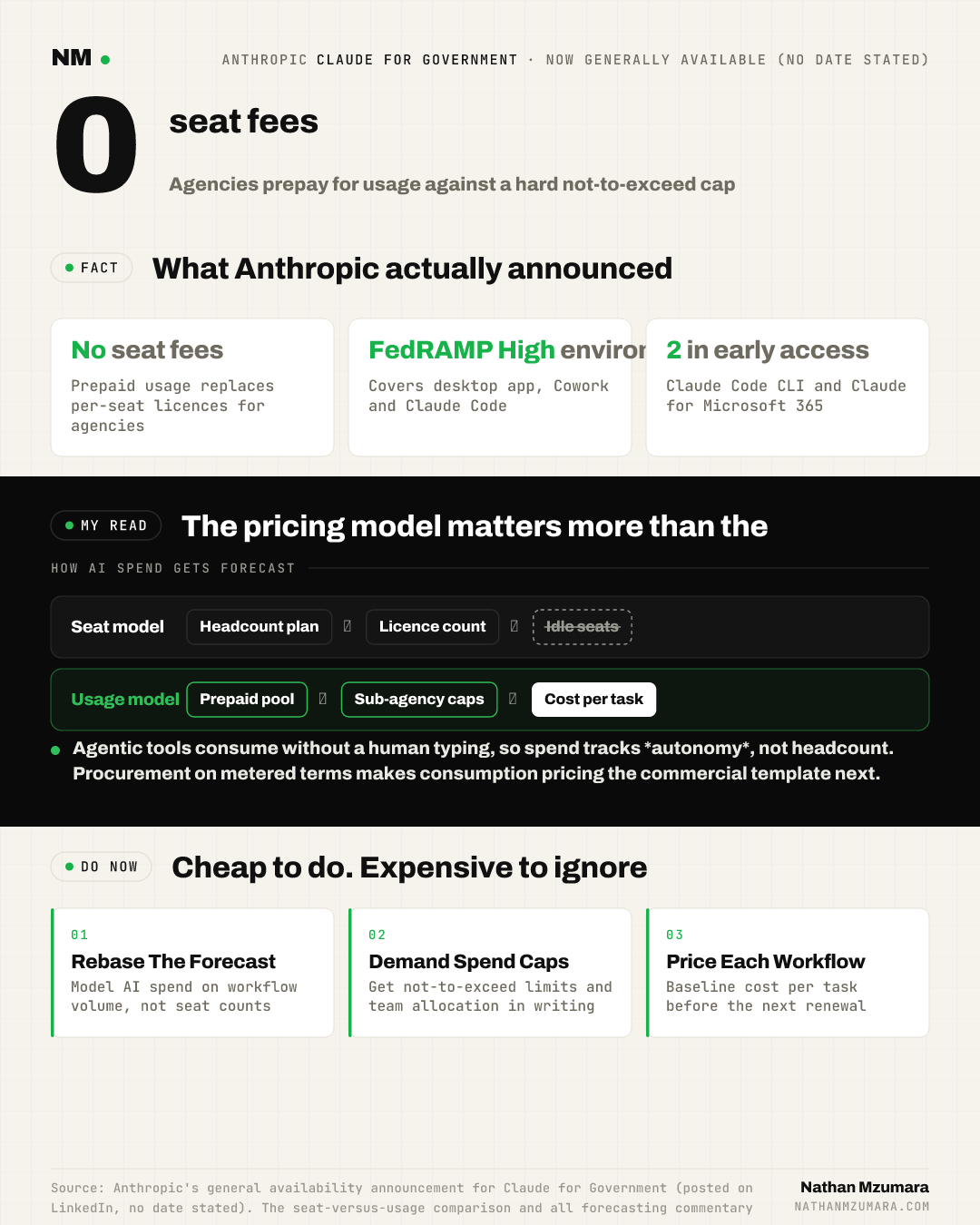
Three things are new with general availability. There are no seat fees, and agencies prepay for usage with a hard not-to-exceed cap. Department admins can allocate usage to sub-agencies and set limits by seat tier. Claude Code on the command line and Claude for Microsoft 365 are both in early access.
The table below lists exactly what ships, as stated in the announcement. Nothing beyond these points is confirmed by the source.
| Element | What the announcement states |
|---|---|
| Status | Out of beta, generally available |
| Who can deploy | Federal and state agencies |
| Environment | FedRAMP High authorized environment |
| What is covered | Claude desktop app, including Cowork and Claude Code |
| Pricing | No seat fees; agencies prepay for usage, with a hard not-to-exceed cap |
| Admin controls | Allocate usage to sub-agencies, set limits by seat tier |
| Early access | Claude Code on the command line, Claude for Microsoft 365 |
Table 1: Every confirmed detail of the general availability release. Source: Anthropic's general availability announcement for Claude for Government.
What is Claude for Government, in one sentence?
Claude for Government is Anthropic's deployment of Claude for federal and state agencies, running in a FedRAMP High authorized environment and now sold as prepaid usage rather than per-seat licences. The deployment includes the Claude desktop app, Cowork and Claude Code, with Claude Code on the command line and Claude for Microsoft 365 in early access.
Why the pricing model matters more than the compliance badge
The FedRAMP High authorisation is the part that makes deployment possible. The pricing is the part that signals where enterprise AI contracts are heading.
Removing seat fees breaks the link between cost and headcount. An agency with 5,000 staff and an agency with 500 staff pay for what they consume, not for how many badges they issue. The hard not-to-exceed cap puts a ceiling on that consumption, which is what makes the model safe to sign.
Then there is the allocation layer. Department admins can split usage across sub-agencies and set limits by seat tier. That is a budget control, not a technical feature. It lets a central owner fund a pool once and distribute it down the organisation chart with ceilings attached.
Government procurement is slow, conservative and heavily documented. When a frontier model vendor wins that kind of contract on metered terms, the terms stop being experimental. My read is that this is the clearest public signal yet that frontier AI is being sold as consumption, and the commercial template follows the federal one.
The precedent: cloud already ran this play
Software moved this way once before. On-premise licensing was priced per user and per server, and finance teams forecast it from a headcount plan. Metered cloud billing broke that habit, because spend tracked workloads rather than staff numbers.
The organisations that handled the shift well built cost observability early. They tagged workloads, attributed spend to teams and knew their unit costs before the first large invoice arrived. The ones that struggled discovered their consumption profile after the fact.
AI is at the same point, with one difference that makes it sharper. Agentic tools do not wait for a human to type. Cowork and Claude Code work through tasks, which means consumption scales with autonomy rather than with how many people are logged in.
What this means for marketers, growth leaders and CMOs
No marketing team is buying Claude for Government. The contract terms are the point, because they describe the pricing and control model that commercial buyers get offered next.
Three things change for in-house teams:
- Budgeting: If your AI line item is still seats multiplied by licence cost, the model breaks the day your vendor reprices to usage. Consumption follows agent activity, and an agent running a research task burns far more than a person typing into a chat window.
- Governance: A hard not-to-exceed cap plus allocation by sub-unit and seat tier is one of the first mainstream controls for runaway agent spend. Ask every AI vendor in your stack for the equivalent before the next renewal, in writing.
- Measurement: Usage-based pricing makes cost per task calculable at team level. You can finally attribute AI spend to content production, research or reporting, then defend or kill each workflow on its unit economics.
From my observation of client stacks, the AI line in most marketing budgets is still forecast from headcount, because that is how the first contracts were written. The forecast looks tidy and tells you nothing about what the work actually costs. A per-workflow baseline is harder to build and far more useful, which is the same argument I made about the widening spread in LLM API pricing.
| Question | Seat-based contract | Usage-based contract |
|---|---|---|
| What drives cost | Number of licensed people | Volume of work processed |
| How you forecast | Headcount plan | Workflow volume and agent autonomy |
| Main risk | Paying for idle seats | Spend running ahead of budget |
| Control needed | Licence audit | Spend cap and allocation by team |
| Unit you can report | Cost per user | Cost per task or workflow |
Table 2: My framing of the two forecasting models, drawn from the pricing change described in Anthropic's announcement rather than from vendor data.
The risks worth naming
Metered pricing moves the risk from waste to volatility. A team that automates aggressively can produce a bill nobody modelled, and a cap protects the budget by stopping the work, which lands as a service outage in the middle of a campaign.
Allocation creates a second problem. Splitting a pool across sub-units needs someone to own the split, revisit it and arbitrate when one team exhausts its share. Without that owner, the control becomes a queue.
There is also a measurement trap. Cost per task is only meaningful if you can define the task and count it. Teams that cannot describe their workflows precisely will produce unit costs that look rigorous and mean very little.
The counter-view
The honest objection is that public sector procurement is not commercial pricing. Agencies buy against appropriated funds, which rewards a prepaid pool with a fixed ceiling. A hard not-to-exceed cap solves a government accounting problem first, and a vendor pricing strategy second.
Seat pricing also has one thing going for it that usage pricing does not: it is predictable. Plenty of enterprise buyers will pay a premium for a number that does not move, and vendors know it. The likely outcome is both models sitting side by side, as happened when OpenAI began pricing speed separately.
What to do this week after the Claude for Government change
Four steps, in order:
- Pull every AI contract in your stack and mark which are seat-based and which are usage-based.
- Model what your current usage would cost if those seat-based contracts were metered tomorrow.
- Set a cost baseline for your three largest AI workflows, such as content production, research and reporting.
- Add two requirements to your next renewal brief: a hard spend cap and allocation controls by team.
Anthropic's full write-up of the Claude for Government release is worth reading for the exact wording on the cap and the admin controls. Claude for Government is built for federal and state agencies, so the terms are the takeaway, not the tool. Build the cost baseline now, while nobody is forcing you to, and the next pricing change arrives as a line in a spreadsheet rather than a surprise invoice.
This Claude for Government analysis was published 2026 and last updated 2026.
