Search Tactic
Prompt engineering
Also known as: prompting, prompt design, prompt writing
Prompt engineering is the practice of writing and structuring instructions so a language model produces reliable, useful output. It covers wording, context, examples, output format and constraints, and usually involves testing variations against a fixed set of cases. It is a working method rather than a guarantee, since models differ and outputs vary.
What it is
A prompt is the text and context sent to a model, including system instructions, user input, retrieved documents and any examples. Prompt engineering is the discipline of shaping those inputs so the response is accurate, on brief and in the right format. It overlaps with retrieval design, tool use and evaluation, because prompt quality alone cannot fix missing or wrong source data.
Why it matters
For marketing and search teams, prompts drive the quality of content drafts, classification tasks, data cleaning and internal research at scale. Good prompts reduce rework, hallucinated detail and inconsistent tone across a team. Prompts also shape how AI search features are tested, since the same question phrased differently can produce very different answers about your brand.
How it works
Practitioners state the role and task plainly, supply the source material rather than relying on model memory, give one or two worked examples, specify the output format, and set explicit limits such as word count or what not to include. They then run the prompt across a test set, score the outputs, and iterate, keeping successful prompts in a shared library with version notes. For production use, prompts are stored in code or a prompt management tool alongside evaluation cases.
When it applies
Applies whenever a team uses language models repeatedly for the same task, and whenever consistency, accuracy or brand tone matter more than a one off answer.
Examples
- A content team uses a prompt that supplies the approved product spec sheet and asks for a 60 word description in UK English with no superlatives.
- An SEO analyst prompts a model to classify 5,000 queries into intent buckets, with three labelled examples and a rule to return only the label.
- A brand tests ten phrasings of the question "who are the best providers of X" in an AI assistant to see which competitors appear and which sources are cited.
How it is measured
- Accuracy or acceptance rate of outputs against a human reviewed sample
- Edit distance or time to publish between first draft and final copy
- Format compliance rate, such as percentage of outputs returning valid JSON or the specified length
- Cost and token use per completed task across prompt versions
Insights on Prompt engineering
Related terms in Search Tactic
- Answer Engine OptimisationThe practice of structuring content so it can be lifted directly into AI answers. Close cousin of GEO; emphasises clean, parseable facts and unambiguous attribution.
- Citation-worthy contentContent with the qualities LLMs select for when synthesising an answer: a single, defensible claim per paragraph; named entities; first-hand evidence; and a clear authority signal.
- Content auditA content audit is a structured review of every page or asset in a content set, scored against performance, quality, accuracy and search intent. The output is a decision for each item: keep, improve, consolidate, redirect or remove. It turns a large and uneven content library into a prioritised action plan.
- Crawler policyA crawler policy is the set of rules a site publishes and enforces to decide which automated agents may access its content, how often, and for what purpose. It typically combines robots.txt directives, server side rules and terms of use, and increasingly distinguishes search crawlers from AI training and assistant crawlers. The policy defines both what is allowed and what happens when a bot ignores it.
- Digital discoveryThe full set of channels through which people find brands, products, and answers, search engines, AI assistants, social platforms, marketplaces, and agentic browsers. Replaces the narrower frame of just “SEO”.
- Ecommerce SEOEcommerce SEO is the practice of making an online store's category, product, brand and editorial pages discoverable in organic search. It combines technical work on crawling, indexing and site structure with commercial decisions about which queries each page should serve. The goal is qualified non-paid traffic that converts into orders.
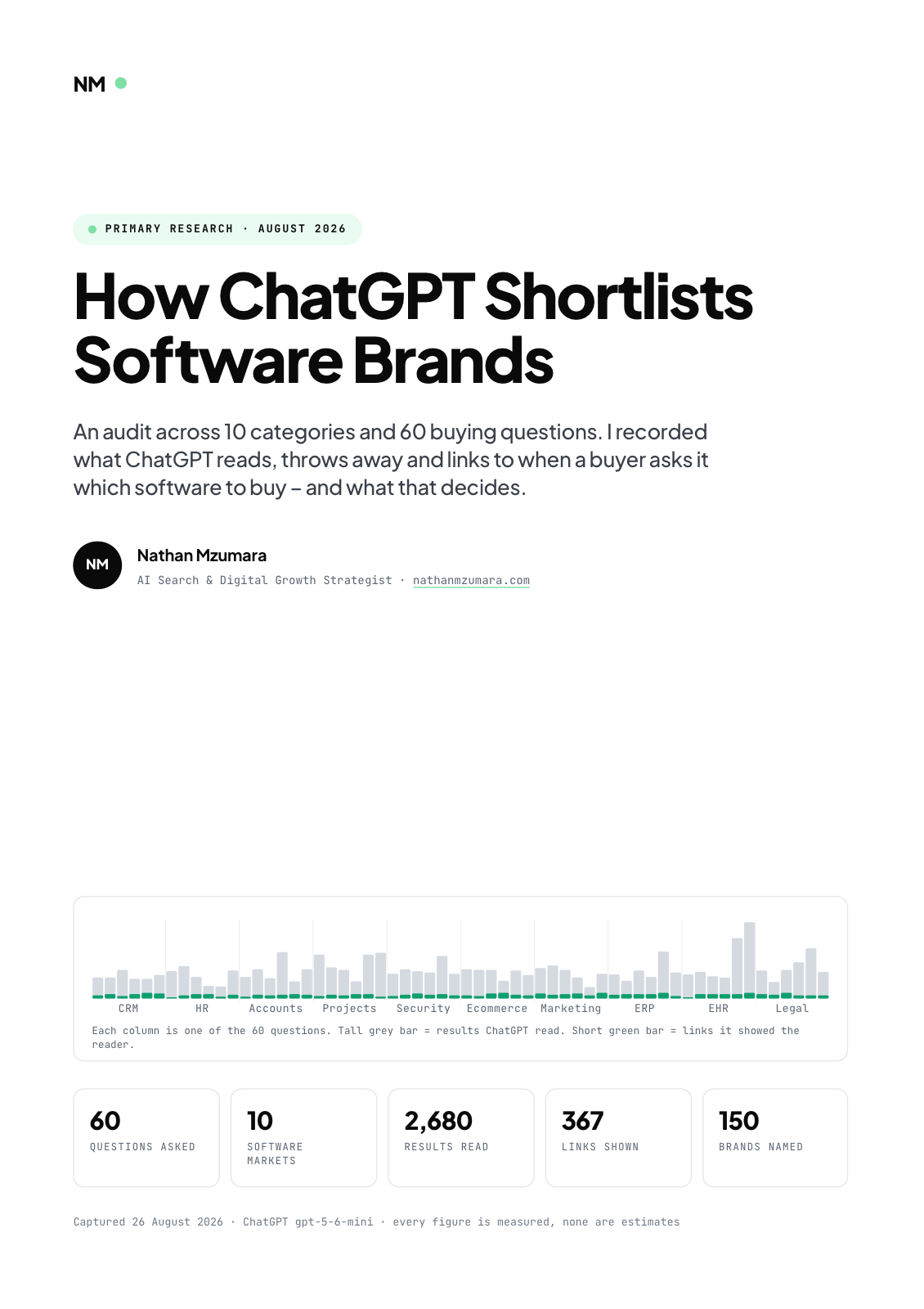
Primary research · August 2026
How ChatGPT Shortlists Software Brands
An audit across 10 categories and 60 buying questions. I recorded what ChatGPT reads, throws away and links to when a buyer asks it which software to buy, and what that decides.
- 60
- Questions asked
- 10
- Software markets
- 2,680
- Results read
- 367
- Links shown
Free download
Get the full report
35 pages · PDF · 536 KB. Enter your details and it downloads straight away.