GPT‑6 and Intelligent UI: ChatGPT Now Renders the Answer

OpenAI released GPT‑6 and Intelligent UI in ChatGPT on 7 October 2026, a new model paired with a capability that lets ChatGPT answer with fully interactive user interfaces. The model is built for the more than 1.2 billion people who use ChatGPT each week. For marketing leaders, the live question is no longer “is ChatGPT intelligent”, it is whether your data can be rendered.
What did OpenAI ship on 7 October 2026?
OpenAI announced GPT‑6 and Intelligent UI for everyone on 7 October 2026. The first GPT‑6 models were introduced last month for paid customers. Today OpenAI is bringing that next generation of intelligence to more people with a new GPT‑6 model built for more than 1.2 billion people who use ChatGPT each week. No pricing is stated in the announcement.
Intelligent UI is a new capability in GPT‑6 in ChatGPT that allows ChatGPT to answer quickly with fully interactive user interfaces. OpenAI says Intelligent UI makes everyday answers more visual, makes learning complex topics easier, and can quickly create a tool to solve a task right in the moment. The full detail sits in OpenAI's GPT‑6 and Intelligent UI announcement.
How does Intelligent UI compose an answer?
OpenAI says GPT‑6 has been trained to compose responses using text, visuals and interactive elements, choosing how they fit together based on the question asked. Responses can include graphics, tappable buttons, forms, charts and interactive experiences that can be used directly in the conversation. The shift here is not simply a more intelligent ChatGPT writing better prose. It is a change in what an answer physically is.
The format depends on the question. A comparison might work best side by side. An explanation might be easier to understand through an interactive diagram. When a simple text answer is the most useful response, ChatGPT can still give that.
The Sunday roast comparison OpenAI published
OpenAI illustrates the change by comparing GPT‑5.6 Instant and GPT‑6 Instant responses to the same prompt, a plan for a Sunday lamb roast with the guest count still undecided. The table below shows what shifts between the two answers.
| What the user asks for | GPT‑5.6 Instant | GPT‑6 Instant |
|---|---|---|
| Overall format | Text with headings | Text plus images and interactive elements |
| Scaling for guest numbers | A fixed table of guests, lamb and potato weights | An adjustable guest-count calculator that outputs shopping quantities |
| Following the steps | A written schedule to read through | An interactive cooking checklist |
The second answer is not a better article. It is a small application, assembled on the spot, inside the conversation.
What changes for marketers when the answer becomes a tool
In plain English: the surface your brand competes on has stopped being a block of text with citations and started being an interface. Benchmark questions like how intelligent is ChatGPT, or how intelligent is ChatGPT 4 set against its successors, were always a procurement curiosity rather than a growth input. When ChatGPT renders a calculator or a comparison panel, the source material is absorbed into the component. The user interacts with the widget, not with your page.
Four consequences follow for anyone running organic growth:
- Citation becomes absorption: a pricing table, a sizing guide or a cost calculator on your site is exactly the kind of content a generated interface can replace. The answer still uses the logic. It no longer needs the visit.
- Structure beats prose: rendering needs clean inputs, units, ranges and relationships. A beautifully argued 2,000-word guide is harder to turn into a form than a well-labelled dataset with the same facts in it.
- Reach arrives in one step: this is not a staged beta for enterprise accounts. OpenAI has built the new GPT‑6 model for the more than 1.2 billion weekly ChatGPT users, so the behaviour change hits a very large audience at once.
- Measurement gets thinner: an interaction inside a chat window is not a session, a scroll depth or a click. Teams already wrestling with attribution after ChatGPT's visual ad format and third-party attribution now have a second unmeasured surface to account for.
Who owns the budget line for machine-renderable data?
This is the decision the release forces. Do you keep funding written content in the hope of being cited, or start publishing structured, machine-readable data and tools that your category's buyers can be shown inside ChatGPT?
My read is that it is not a swap, it is a split, and the split needs an owner before the next planning cycle. Written content still serves demand that a rendered interface cannot: positioning, judgement, proof, point of view. What it no longer monopolises is the factual layer.
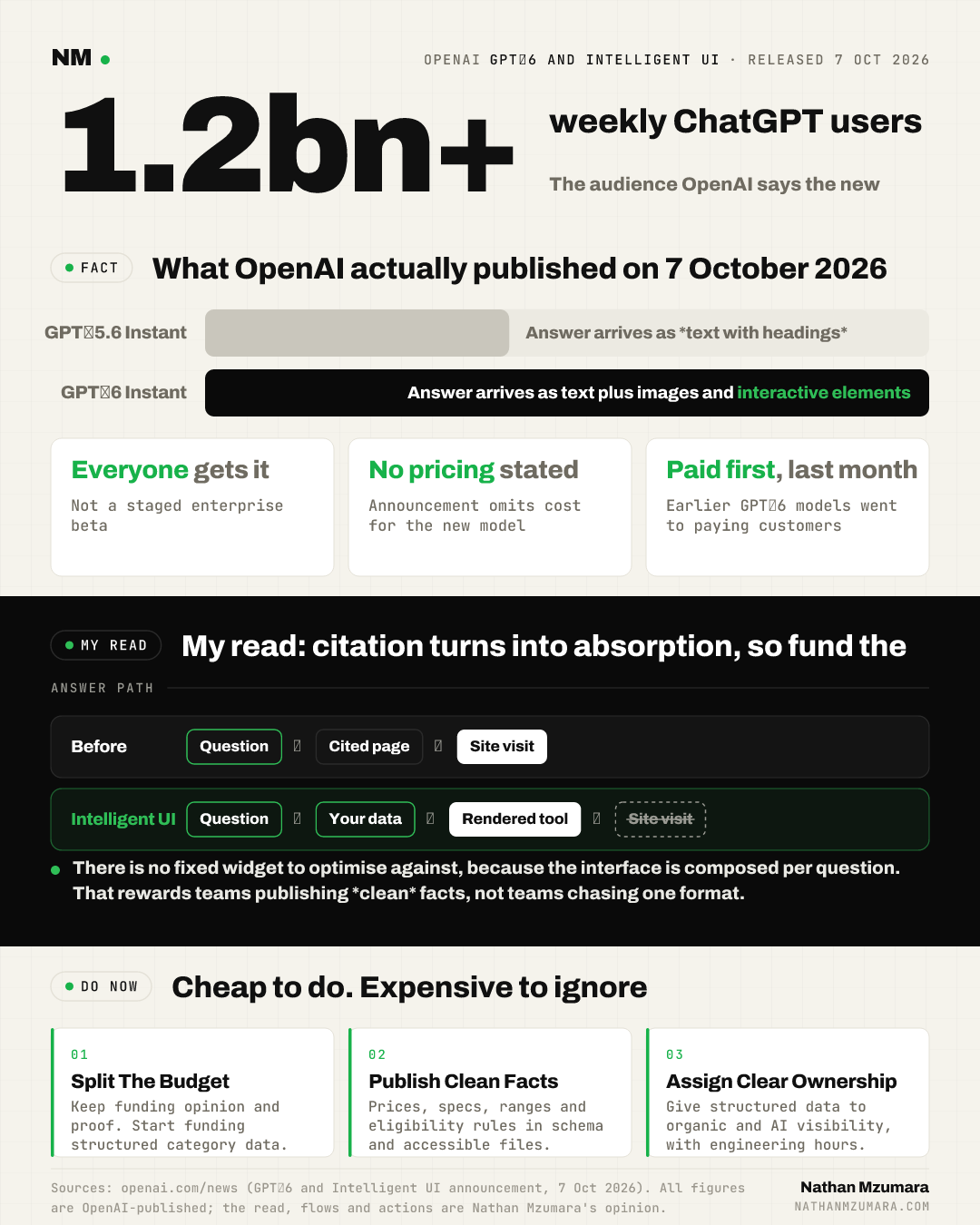
- Keep funding: opinion, original research, customer evidence and anything that carries a named expert. A model cannot synthesise a view you have not published.
- Start funding: clean public data about your category, in schema and in accessible files. Prices, specifications, ranges, eligibility rules, benchmarks, conversion factors.
- Assign ownership: put the structured-data line with whoever owns organic and AI visibility, not with the web team, and attach committed engineering hours to it. Content budgets that need a developer ticket to ship never ship.
Has search done this before?
Yes, in a smaller form. When Google began answering queries on the results page with snippets and built-in calculators, most publishers carried on producing the same articles and quietly lost the click. The pattern repeated with each surface that absorbed the answer.
Intelligent UI differs in one important way. There is no fixed widget to optimise against, because the interface is composed per question. From what I have seen building visibility programmes, that rewards teams who publish the underlying facts cleanly and consistently, rather than teams who chase a single format.
What could go wrong
OpenAI's announcement describes the capability, not a publisher programme. It states no pricing for the new GPT‑6 model and sets out no attribution rules for the content that feeds an interactive response. Plan on the facts given, not on an attribution model that has not been announced.
Two practical risks follow. First, you can spend a quarter structuring data with no confirmed route into a rendered answer. Second, you can over-correct and stop producing the opinion-led work that still wins deals. The sensible move is a contained pilot in one category, not a replatform.
There is also a reporting risk. If assistant-side interactions rise while sessions fall, your board sees a decline. Agree the narrative and the proxy metrics now, in the same way teams had to when always-on agents arrived on business plans.
The counter-view
The honest case against acting fast: OpenAI says ChatGPT can still give a simple text answer when that is the most useful response. Many commercial and B2B questions are reasoning questions, not calculator questions, and may stay in prose. Plenty of practitioners still argue ChatGPT is not intelligent in any strict sense, and that debate is beside the point commercially, because whether GPT‑6 is the most intelligent GPT model yet changes nothing about a long procurement cycle.
If that holds, the cost of waiting a quarter is low. I think the cost of waiting a year is not, because the consumer-facing categories hit first, retail, travel, finance and anything with a specification sheet, are exactly where structured data is cheapest to publish and slowest to approve internally.
Stop asking “is ChatGPT intelligent” and start asking what GPT‑6 and Intelligent UI will render
Five actions worth taking this week:
- Run your ten highest-intent queries through GPT‑6 in ChatGPT and screenshot which answers come back as interactive elements rather than text.
- List every calculator, comparison table and sizing tool on your site. These are the first assets a generated interface can replace.
- Audit whether the facts behind those tools exist as structured data a model can read, or only as page copy.
- Name the owner and the budget line for machine-renderable data, and book the engineering hours.
- Add an assistant-visibility line to your next board report, with the method stated, before the traffic conversation starts without you. Track OpenAI's product release notes for changes to how answers are composed.
The useful question was never “is ChatGPT intelligent”. It is whether, when GPT‑6 and Intelligent UI compose the answer for your category, the numbers inside that interface are yours.
Published 7 October 2026. Last updated 7 October 2026. This GPT‑6 and Intelligent UI analysis will be updated as OpenAI publishes further detail on pricing and attribution.
Tags
