OpenAI Adds College Planner to ChatGPT for Teens

OpenAI announced on 7 October 2026 that College Planner is coming soon to ChatGPT for Teens, the default experience automatically applied to accounts identified as under 18. It arrives alongside a new teen AI advisory council and new study tools, including flashcard decks and quizzes. The marketing consequence is simple: ChatGPT is now age-segmented by default.
What OpenAI announced on 7 October 2026
OpenAI published the update in a post titled Helping teens learn, plan, and shape the future of AI. Three things shipped or were announced: College Planner, a three-year partnership with Boston Children's Hospital's Digital Wellness Lab and its independent Student Advisory Council, and a set of study features.
College Planner has no stated launch date beyond "soon" and no stated pricing or plan requirement. Continuous, multi-photo capture is available now on iOS, with Android "in the works". The student council convenes for the 2026–27 school year.
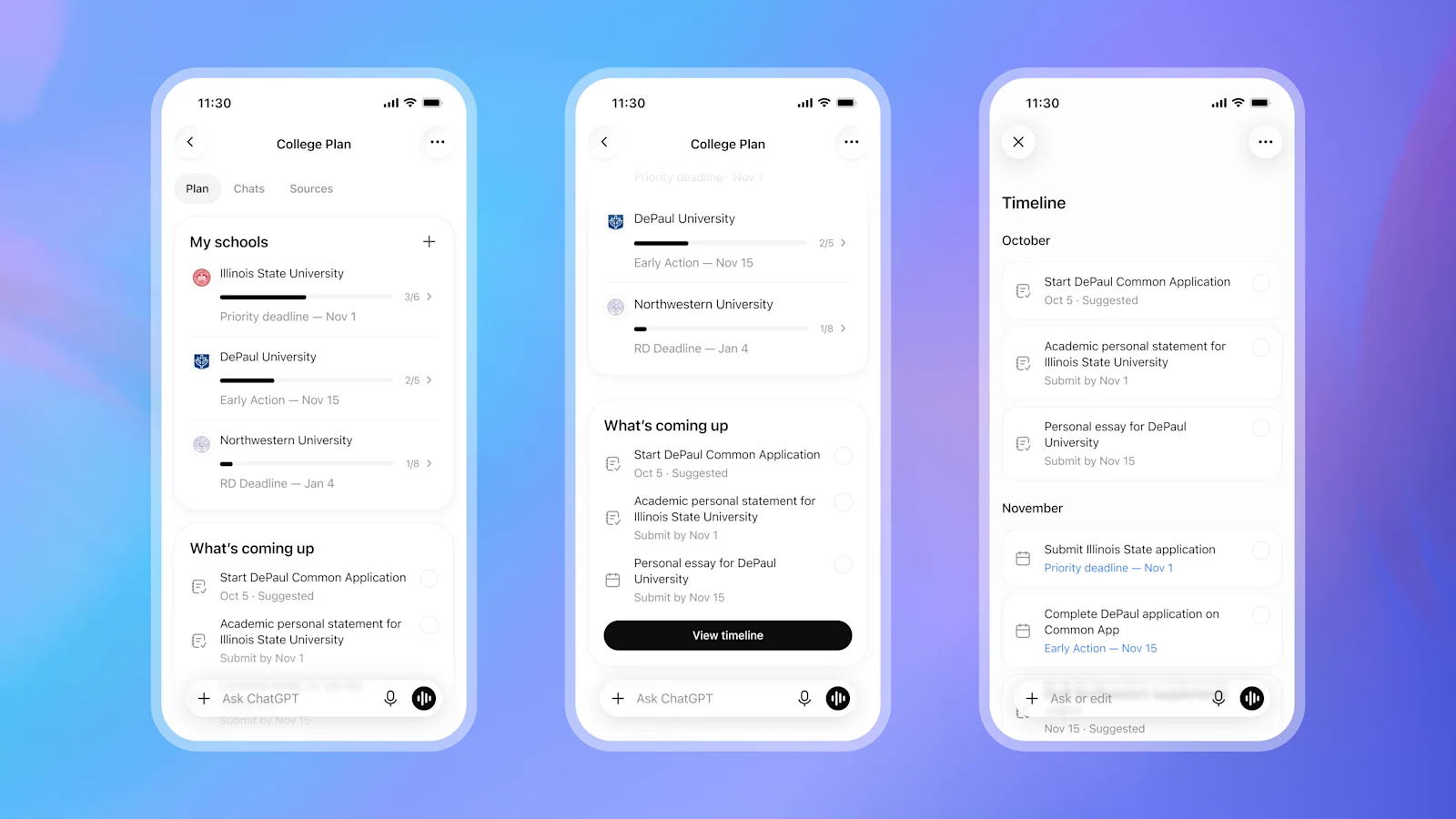
College Planner is a planning tool inside ChatGPT for Teens that brings a student's application requirements, deadlines, tasks and financial-aid steps for the schools on their list into a single plan with a timeline. OpenAI says it is designed to help students manage the practical steps of applying to college without taking over the personal work of figuring out where they want to apply.
How does College Planner work for US students in grades 10 to 12?
Application tracking
Students applying to several colleges can return to the plan to update their progress, use the timeline to plan ahead and see what is left to do. They can also ask ChatGPT questions along the way, from what a requirement means to how to get started.
Scope and expansion
OpenAI is designing the initial US experience for high-school students in grades 10–12 who are planning to attend a four-year college. The company plans to bring it to students in more countries and expand support to two-year colleges, technical colleges, trade schools and more over time.
Financial aid
College Planner also helps students work out how to pay. Students can get help understanding financial aid requirements, track each school's aid deadlines, and explore scholarships and fee waivers. OpenAI frames the goal as making help more accessible regardless of financial circumstances, alongside guidance from counsellors, advisers and families.
Study tools
Continuous multi-photo capture combines photographed pages of notes into a single PDF, on iOS only for now. Flashcard decks can be generated from notes or from a topic and saved in a teen's Library. Quizzes are now easier to create from uploaded notes directly in chat.
What do the teen usage numbers actually show?
OpenAI published usage data to argue that teen behaviour in ChatGPT looks different from teen behaviour on social platforms. Read it as a positioning document as much as a product note.
| Metric | What OpenAI reported on 7 October 2026 |
|---|---|
| Total ChatGPT users | 1.2 billion |
| US teens planning for college | Hundreds of thousands use ChatGPT each week |
| Learning messages | Teens with access sent about 2.7 million more learning-related messages on average than those without |
| Learning Visualizations | Nearly 1.2 million teens in one week |
| Study Mode | More than 180,000 teens in one week |
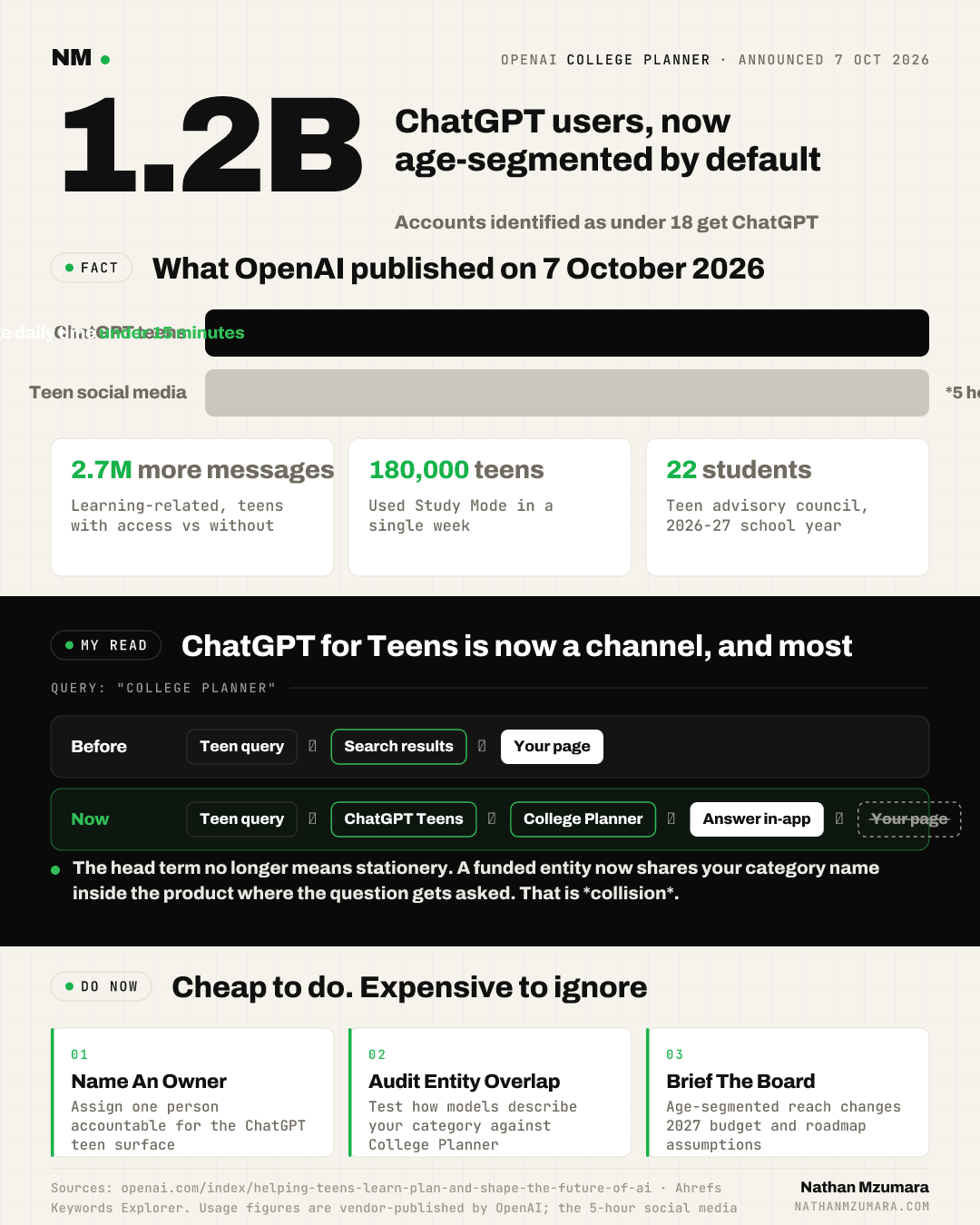
| Average daily time | Under 15 minutes |
| Long sessions | Less than 2% spend more than three consecutive hours |
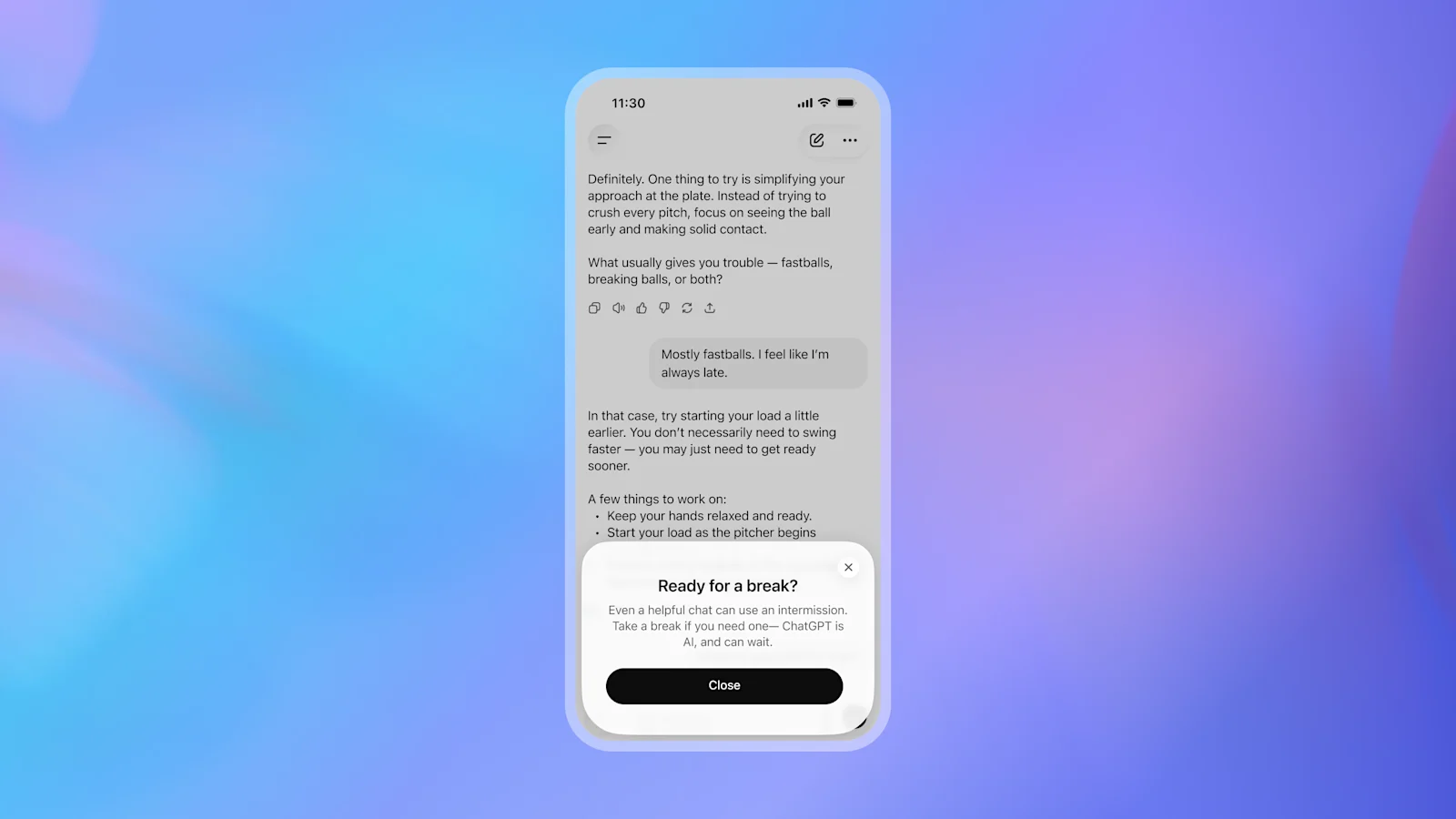
| Break reminders | In almost half of conversations with a reminder, teens took a break or ended the conversation within five minutes |
| Long-session content | Over 80% of teens with sessions over three consecutive hours had at least one learning-related prompt |
| Comparison point | Publicly reported average of 5 hours a day for teen social media use, cited by OpenAI from the American Psychological Association |
Who sits on the new teen advisory council?
OpenAI is supporting Boston Children's Hospital's Digital Wellness Lab and its independent Student Advisory Council for three years. For the 2026–27 school year the Lab will convene around 22 students across two tracks: roughly 12 students aged 14–18 working on digital wellbeing projects in their communities, and roughly 10 aged 16–20 focused on building AI chatbots and emerging technology.
OpenAI expects to seek feedback on teen safety defaults, parental controls and notifications, and AI literacy, and says it will bring recommendations into product and model decisions early and report back on what it changes and why. Translation for anyone planning a 2027 roadmap: the rules governing this slice of the audience will keep moving.
Why the query "college planner" has just changed meaning
Search demand for a college planner has historically pointed at stationery and timetabling. Ahrefs data for Great Britain shows the term at 40 searches a month and 2,100 globally, with the surrounding cluster made up of a college student planner, a college schedule planner, a day planner for college students, a college student day planner, a college year planner and software queries such as college planner pro.
OpenAI's College Planner is none of those things. It is an application and financial-aid workflow inside an assistant. If you sell planners, advising services, admissions software or student finance products, a well-funded new entity now shares your head term and sits inside the product where the question gets asked. That is entity collision, and it changes how models describe your category before anyone reaches a results page.
What ChatGPT for Teens changes for marketers and growth leaders
Here is the part that belongs in a board update rather than a channel review.
- Age-segmented reach: ChatGPT for Teens is applied automatically to accounts identified as under 18. A share of a 1.2 billion-user product now receives a different content and recommendation regime, and you cannot opt into or out of it.
- Misclassified adults: Classification is probabilistic. Any adult buyer wrongly placed in the teen default sees a restricted version of your category, and neither of you will know it happened.
- Visibility you do not control: A safety classifier, not your content quality, can decide whether your brand appears. Alcohol, gambling, finance, health, dating and some retail categories are filtered for reasons that have nothing to do with relevance.
- Workflow capture: College Planner is OpenAI building the decision workflow for a high-consideration purchase. My read is that the same pattern lands in B2B research next: shortlist, requirements, deadlines and budget steps assembled inside the assistant, with vendors reduced to inputs.
- Inherited obligations: Education, consumer and family-facing brands now carry age-assurance and advertising-to-minors exposure inside a channel they do not own, cannot measure cleanly and do not buy media in yet.
OpenAI's announcement says nothing about advertising inside ChatGPT for Teens. That silence is the point. Ad formats and attribution are maturing elsewhere in the product, as I covered when ChatGPT Ads added a visual format and third-party attribution, and the moment inventory and an under-18 population share a surface, someone in your business owns a compliance question.
The precedent: protected modes ship before the ad rules do
Default-on youth experiences are not new, and the sequence rarely varies. The platform ships the protected mode, publishes reassuring usage data, writes the advertising and content rules afterwards, and brands discover the consequences in their own reporting months later. OpenAI's choice to benchmark teen ChatGPT use against the publicly reported 5 hours a day of teen social media use shows it knows exactly which comparison it is being measured against.
The difference this time is the interface. Search gave you a page of options. An assistant that renders a plan, as I argued in this piece on ChatGPT rendering the answer itself, gives you one. Being absent from that plan is not a ranking drop. It is non-existence.
The counter-view: why this may matter less than it looks
The honest case against urgency is strong. College Planner is US-only at launch, limited to grades 10–12 and four-year colleges, and has no shipping date. Teens average under 15 minutes a day on ChatGPT. Under-18s are not the buyer in most B2B and high-ticket consumer categories, and OpenAI has deliberately positioned the tool as a supplement to counsellors, not a replacement for them.
If your category has no teen audience and no family-facing products, the correct response this quarter may be a single owner and a watching brief. What would make that wrong is misclassification volume. If adults are being routed into the restricted experience at any meaningful rate, this becomes a visibility problem for every brand, not a youth-marketing problem for a few.
What to do this week about the ChatGPT college planner shift
- Run a restricted-mode audit. Test your 20 highest-value category prompts in a teen-classified account and a standard one. Record where answers, brands or links differ.
- Name an owner. One person, named in writing, accountable for age-assurance and ad-policy risk in AI surfaces. In most companies today that owner does not exist.
- Check your entity. Confirm models describe your product using your official name and category, and not by confusing it with a college student planner, a college schedule planner or any other adjacent product.
- Brief legal and the board. Flag that a platform classifier can now suppress your brand, and that advertising-to-minors exposure may arrive inside a channel with no media buy attached.
Published 7 October 2026. Last updated 7 October 2026. College Planner is still "coming soon", but the segmentation underneath it is live now, and the leaders who treat assistants as a policy-governed channel this quarter will be the ones who can explain their visibility to a board next year.
