Regulation & Policy
Youth safety
Also known as: online youth safety, teen safety, child safety online, minor safety
Youth safety is the set of policies, product controls and legal duties that govern how under-18s experience online services, including search, social platforms and AI assistants. It covers age assurance, default protections for minors, restrictions on harmful or age-inappropriate content, and limits on data collection and ad targeting. For brands, it shapes which content and ads can reach younger audiences and how assistants describe products to them.
What it is
Youth safety refers to the rules and mechanisms designed to protect children and teenagers online, spanning content moderation, default privacy settings, age assurance and advertising limits. It sits across regulation such as the UK Online Safety Act and the ICO Children's Code, US laws such as COPPA, and platform policies set by search engines, social networks and AI providers. In AI search, it also covers how assistants respond to minors and which topics they refuse, soften or redirect.
Why it matters
Youth safety determines whether your content is eligible for discovery at all on surfaces that serve younger users, and whether ads can be targeted or personalised. Getting it wrong risks regulatory action, platform demotion or outright removal, while brands seen as careless with minors face reputational damage that outlasts any ranking loss. For AI assistants, safety classifiers may suppress a brand or category entirely in conversations judged to involve a minor, even when the underlying content is lawful.
How it works
Practitioners map which parts of a site or product are likely to attract under-18s, apply age assurance where duties require it, and set stricter defaults for accounts that may belong to minors. They tag or gate age-restricted content so crawlers and classifiers can recognise it, exclude minors from behavioural ad targeting, and document risk assessments and moderation processes. Many teams run periodic reviews with legal and trust and safety colleagues, and test how assistants describe their category in teen-mode or youth-focused contexts.
When it applies
Youth safety applies whenever a service is likely to be accessed by under-18s, not only when it is aimed at them, and whenever content touches age-restricted categories such as alcohol, gambling, cosmetic procedures, weight loss or adult material. It also applies at product launch, when entering new markets with different child protection laws, and when adding AI chat or user-generated features.
Examples
- A gambling operator blocks its promotional pages from appearing in assistant answers and search results shown to signed-in users flagged as under 18, and applies age verification before any account creation.
- An AI chat assistant used by a retailer routes questions about diet supplements from suspected teen users to general healthy eating guidance and a prompt to speak to a parent or GP, rather than recommending products.
- An ed-tech platform completes a children's risk assessment, turns off profiling by default for school accounts and publishes a child-friendly privacy summary alongside its standard policy.
How it is measured
- Share of youth-facing or age-restricted pages correctly labelled and gated in a quarterly content audit
- Age assurance completion and pass rates on restricted journeys, plus drop-off caused by the check
- Volume and resolution time of youth safety reports, escalations or regulator and platform notices
- Coverage of minor exclusions in ad campaigns, measured as the proportion of active campaigns with correct age targeting and personalisation settings
- Refusal or redirect rate in assistant responses about your category when the session is treated as a minor
Insights on Youth safety
Related terms in Regulation & Policy
- AI complianceAI compliance is the work of making sure AI systems meet the laws, regulations, standards and internal policies that apply to them. It spans data protection, transparency, risk classification, documentation, human oversight and record keeping across the life of a system. In practice it combines legal interpretation, engineering controls and ongoing evidence gathering.
- AI governanceAI governance is the set of policies, roles, controls and review processes an organisation uses to manage how AI systems are built, bought and used. It covers risk assessment, documentation, human oversight, data handling and accountability. It applies both to AI a company develops and to third-party AI tools used by staff.
- AI privacyAI privacy is the set of practices, rights and obligations that govern how personal data is collected, used, stored and exposed when building or using AI systems. It covers training data, prompts and outputs, retention by AI vendors, and the transparency and control offered to the people whose data is involved. For marketing teams it shapes what customer data can safely be put into AI tools and what must be disclosed.
- AI safetyAI safety is the practice of designing, testing and operating AI systems so they cause less harm, behave predictably and resist misuse. It covers alignment with intended behaviour, evaluation and red teaming, content guardrails, and monitoring once a system is live. For marketers it shapes what models will say, how assistants handle brands, and what compliance teams expect before AI tools go into production.
- AI transparencyAI transparency is the practice of making clear how an AI system works, what sits behind it, and when content or an interaction involves AI. It covers regulatory disclosure duties as well as voluntary explanations such as model cards, labels on synthetic media and citations in AI generated answers. For publishers and marketers it sets expectations about when AI involvement should be declared and how clearly.
- Competition and Markets AuthorityThe Competition and Markets Authority (CMA) is the United Kingdom's competition and consumer protection regulator. It investigates mergers, anti-competitive conduct and market practices, and it holds specific powers over large digital firms under the Digital Markets, Competition and Consumers Act 2024. Its decisions shape how search engines, app stores and AI assistants operate in the UK market.
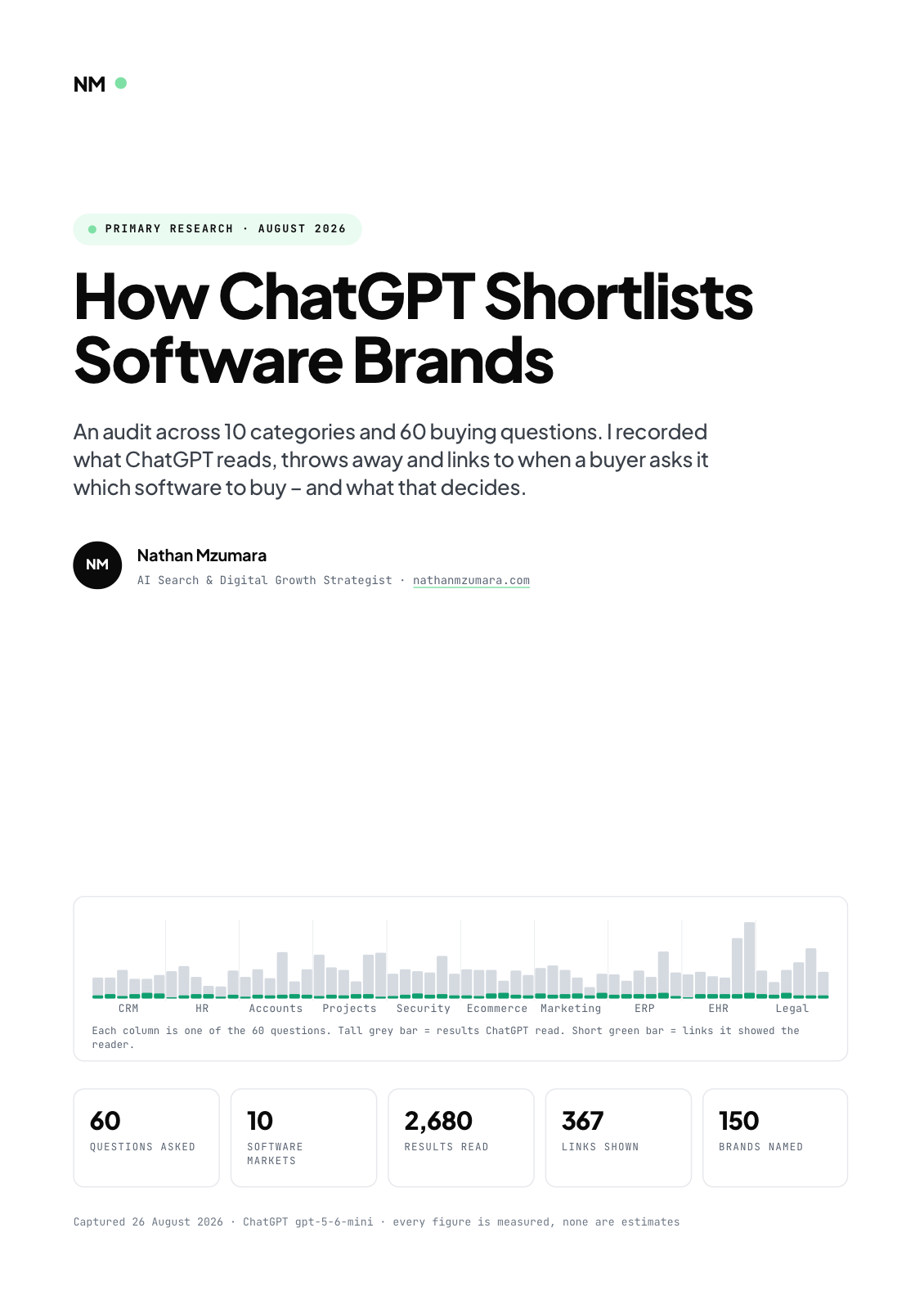
Primary research · August 2026
How ChatGPT Shortlists Software Brands
An audit across 10 categories and 60 buying questions. I recorded what ChatGPT reads, throws away and links to when a buyer asks it which software to buy, and what that decides.
- 60
- Questions asked
- 10
- Software markets
- 2,680
- Results read
- 367
- Links shown
Free download
Get the full report
35 pages · PDF · 536 KB. Enter your details and it downloads straight away.