Marketing Strategy
Brand voice
Also known as: tone of voice, brand tone of voice
Brand voice is the consistent personality and language a brand uses across every channel, covering vocabulary, tone, sentence rhythm and the things it will and will not say. It is documented in guidelines so different writers, agencies and AI tools produce work that sounds like the same organisation. Voice stays stable while tone flexes with context.
What it is
A brand voice definition usually includes personality traits, do and do not examples, preferred and banned words, reading level, and rules for formatting and claims. It is distinct from visual identity, though the two should align. The useful version is specific enough that an outside writer could pass a blind test.
Why it matters
Consistency makes a brand recognisable and easier to trust, which affects click through, conversion and repeat engagement. It also matters for AI-assisted discovery, because assistants summarise and quote your published language, so clear consistent phrasing about what you do and who you serve is more likely to be reproduced accurately. Where voice drifts, sales, support and marketing describe the same product differently and buyers notice.
How it works
Teams define voice from customer research and existing high performing content, write a short guide with real before and after examples, then embed it in briefs, templates and editorial review. With generative tools, the guide becomes a system prompt or style file, supported by an approved example library and a human editing pass. Periodic audits sample live content across channels and score adherence.
When it applies
Brand voice matters most when many people or tools create content on your behalf, during a rebrand or repositioning, and when entering new markets or channels. It is also the first control to put in place before scaling AI-assisted content production.
Examples
- A healthcare provider sets a plain English reading level and bans jargon, then applies it to letters, web copy and chatbot replies.
- A challenger bank writes a one page voice guide with banned phrases and uses it as the system prompt for AI-drafted help centre articles.
- An agency runs a quarterly audit scoring fifty live pages against voice criteria and reports the worst offenders to content owners.
How it is measured
- Voice adherence score from a sampled content audit against the guidelines
- Editorial rejection or rewrite rate for first drafts, including AI-assisted drafts
- Consistency of how your positioning is described in AI assistant answers and third party mentions
- Engagement and conversion differences between on-voice and off-voice content variants
Insights on Brand voice
Related terms in Marketing Strategy
- Agentic marketingAgentic marketing is the use of AI agents that can plan multi-step work and take actions across marketing tools, rather than only generating text on request. It also covers designing marketing for a world where buyers delegate research and purchasing to their own agents. In practice it is a mix of workflow automation, tool permissions and human review.
- AI searchAI search is the use of large language models to answer a query directly, usually with a written summary rather than a list of links. It covers AI overviews inside traditional search engines and assistants such as ChatGPT, Perplexity, Copilot and Gemini. The visible outcome for a brand is being described and cited inside an answer rather than ranked on a results page.
- AI-generated contentAI-generated content is text, images, audio, video or code produced wholly or mainly by a generative model rather than written or made by a person. It ranges from fully automated output to drafts that a human edits and approves. Its value in marketing depends on editorial control, accuracy and whether it adds anything a reader cannot get elsewhere.
- Audience intelligenceAudience intelligence is the practice of gathering and analysing data about who your audience is, what they care about, and how they search and buy, then turning that into decisions. It combines first party behavioural data with research, search data, social listening, and customer conversations. The output is usually segments, messaging guidance, and content priorities rather than a single report.
- B2B marketingB2B marketing is the practice of promoting products and services to other organisations rather than to individual consumers. It typically involves longer sales cycles, multiple decision makers, higher contract values and a heavier reliance on content, sales enablement and relationships. Success is usually measured through pipeline and revenue contribution rather than immediate transactions.
- Content automationContent automation is the use of software, templates, data feeds and AI models to produce, update or distribute content with less manual effort at each step. It ranges from automatically refreshing prices and stock levels on a page to generating full drafts for human editing. The aim is consistency and scale, not the removal of editorial judgement.
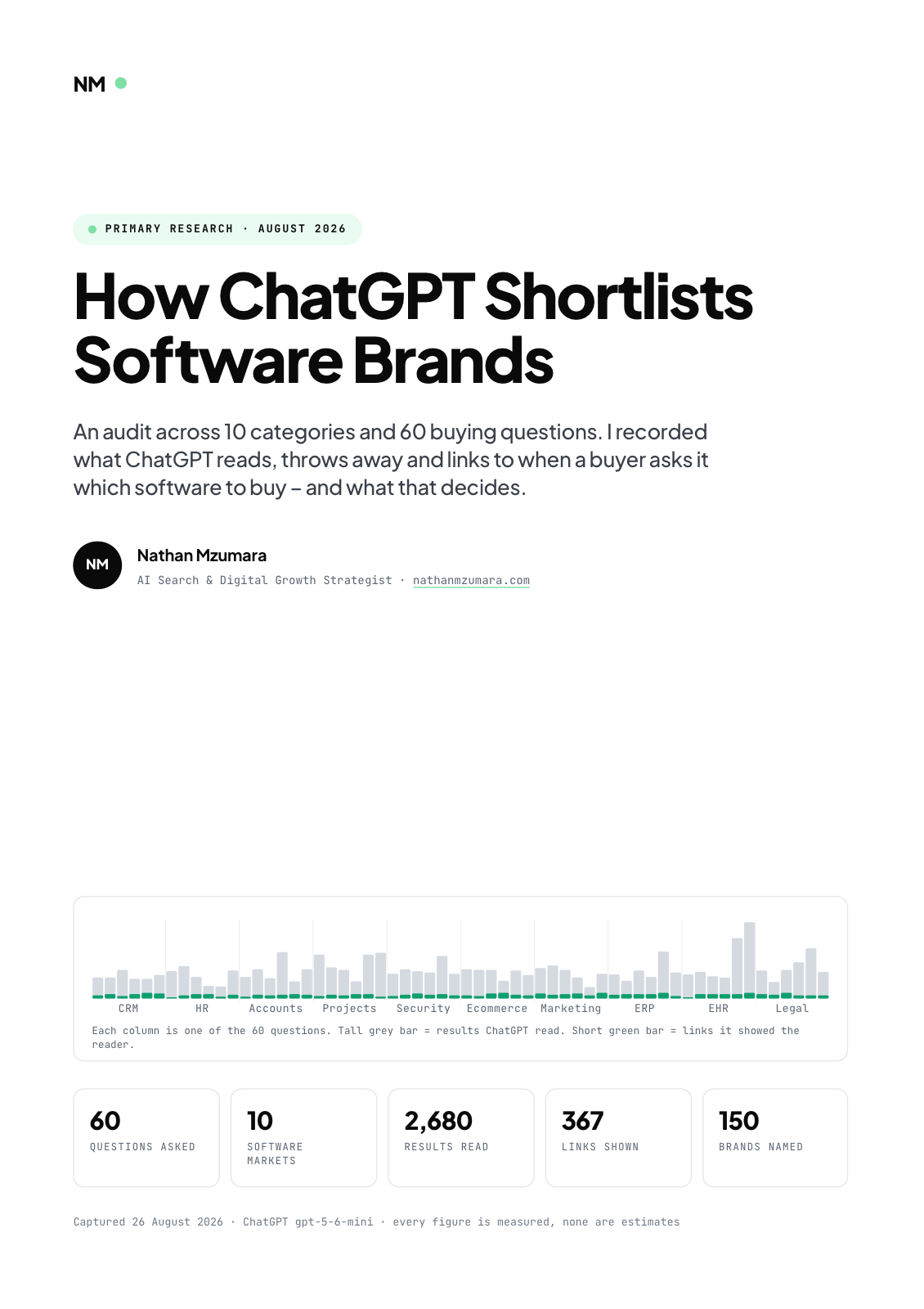
Primary research · August 2026
How ChatGPT Shortlists Software Brands
An audit across 10 categories and 60 buying questions. I recorded what ChatGPT reads, throws away and links to when a buyer asks it which software to buy, and what that decides.
- 60
- Questions asked
- 10
- Software markets
- 2,680
- Results read
- 367
- Links shown
Free download
Get the full report
35 pages · PDF · 536 KB. Enter your details and it downloads straight away.