Marketing Strategy
Content automation
Also known as: AI content pipelines, AI content automation, automated content production
Content automation is the use of software, templates, data feeds and AI models to produce, update or distribute content with less manual effort at each step. It ranges from automatically refreshing prices and stock levels on a page to generating full drafts for human editing. The aim is consistency and scale, not the removal of editorial judgement.
What it is
Content automation covers any pipeline where part of the content lifecycle runs without a person doing the work by hand. That might be template driven pages built from a product database, programmatic translation, scheduled republishing of updated data, or model generated drafts routed to editors. The automated share can be small, such as auto generating FAQ markup, or large, such as building thousands of location pages.
Why it matters
Automation lets small teams cover long tail topics, keep large catalogues current and publish in more languages, all of which affect whether content is available to be retrieved and cited. It also creates risk. Search engines act against scaled content produced mainly to manipulate rankings rather than to help people, and AI assistants tend to surface sources that are specific, current and verifiable rather than generic.
How it works
Practitioners define a data source, a template or prompt, a quality gate and a publishing route. Good pipelines include human review on anything opinionated or factual, a way to trace every published claim back to its source, and monitoring that flags pages which stop performing. Many teams automate updates and structure first, since that carries lower risk than automating original argument and analysis.
When it applies
It applies when content volume, update frequency or language coverage exceeds what the team can handle manually, and where the underlying data is reliable. It is a poor fit for thought leadership, original research and anything where a distinct point of view is the value.
Examples
- An ecommerce brand auto generates size and materials tables on product pages from its PIM, with copywriters handling the intro paragraph.
- A software company uses a model to draft release note summaries from its changelog, with a product manager approving each one.
- A recruitment marketplace builds city and role landing pages from live vacancy data and removes any page that falls below a minimum listing count.
How it is measured
- Share of published pages that passed human review before going live
- Indexation rate and organic entrances for automated pages versus manually written pages
- Editing time per piece, before and after the pipeline was introduced
- Correction and takedown rate for factual errors traced to automated output
Insights on Content automation
- Google's June 2026 Spam Update Is Live. Here's What 'Normal' Actually Means.
- Plaud Hit $250M on $5M Raised. The Wearable AI Recorder Rewriting Content Workflows
- Anthropic Drops Version Numbers. What Fable 5 and Mythos 5 Mean for Your AI Stack
- OpenAI Models Are Now on Amazon Bedrock: What Enterprise Growth Teams Should Do Next
Related terms in Marketing Strategy
- Agentic marketingAgentic marketing is the use of AI agents that can plan multi-step work and take actions across marketing tools, rather than only generating text on request. It also covers designing marketing for a world where buyers delegate research and purchasing to their own agents. In practice it is a mix of workflow automation, tool permissions and human review.
- AI searchAI search is the use of large language models to answer a query directly, usually with a written summary rather than a list of links. It covers AI overviews inside traditional search engines and assistants such as ChatGPT, Perplexity, Copilot and Gemini. The visible outcome for a brand is being described and cited inside an answer rather than ranked on a results page.
- AI-generated contentAI-generated content is text, images, audio, video or code produced wholly or mainly by a generative model rather than written or made by a person. It ranges from fully automated output to drafts that a human edits and approves. Its value in marketing depends on editorial control, accuracy and whether it adds anything a reader cannot get elsewhere.
- Audience intelligenceAudience intelligence is the practice of gathering and analysing data about who your audience is, what they care about, and how they search and buy, then turning that into decisions. It combines first party behavioural data with research, search data, social listening, and customer conversations. The output is usually segments, messaging guidance, and content priorities rather than a single report.
- B2B marketingB2B marketing is the practice of promoting products and services to other organisations rather than to individual consumers. It typically involves longer sales cycles, multiple decision makers, higher contract values and a heavier reliance on content, sales enablement and relationships. Success is usually measured through pipeline and revenue contribution rather than immediate transactions.
- Brand voiceBrand voice is the consistent personality and language a brand uses across every channel, covering vocabulary, tone, sentence rhythm and the things it will and will not say. It is documented in guidelines so different writers, agencies and AI tools produce work that sounds like the same organisation. Voice stays stable while tone flexes with context.
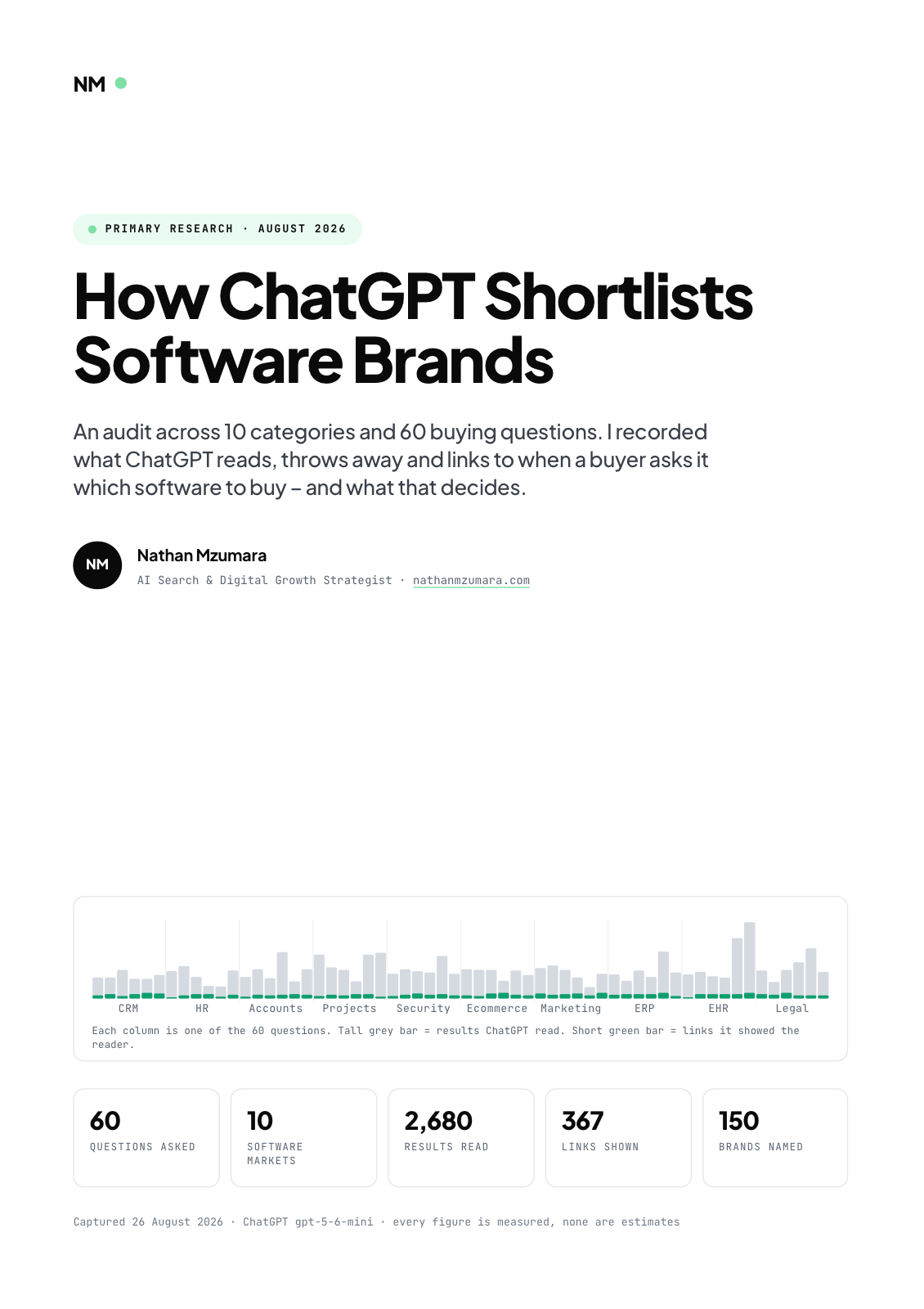
Primary research · August 2026
How ChatGPT Shortlists Software Brands
An audit across 10 categories and 60 buying questions. I recorded what ChatGPT reads, throws away and links to when a buyer asks it which software to buy, and what that decides.
- 60
- Questions asked
- 10
- Software markets
- 2,680
- Results read
- 367
- Links shown
Free download
Get the full report
35 pages · PDF · 536 KB. Enter your details and it downloads straight away.