GA4 Just Made AI Traffic Countable. Here's How.

Google Analytics has quietly shipped one of the most consequential reporting changes of the year. On 28 July 2026 it launched a new Source Group dimension and hostname filters, and together they finally make AI-referral traffic legible in GA4.
If you have been squinting at a dozen versions of "chatgpt.com", "chat.openai.com" and "perplexity.ai" scattered across your acquisition reports, this is the fix. Source Groups roll those fragmented values up into clean, platform-level categories, and hostname filters strip out the spam and unauthorised domains that quietly distort your conversion data.
What actually changed
Two things landed at once. First, a dimension that consolidates messy source values into unified groups so you can read traffic at the platform level rather than the URL level. Second, filters that let you exclude hostnames you did not authorise, which is where most referral spam lives.
The important part, in my opinion, is that this is the first native GA4 signal built with emerging AI traffic in mind. Google says the update lets you "view unified data across platforms, unlock retroactive insights, and future-proof your tracking for emerging AI traffic" in its official Google Analytics announcement.
When it happened
The rollout was announced on 28 July 2026. Crucially it applies retroactively, so you are not starting from zero. That single detail matters more than the feature itself, and I will explain why below.
Why this matters for AI discovery
Referral traffic from ChatGPT, Perplexity, Gemini and Copilot has been growing, but it has been almost impossible to measure cleanly. The referrers arrive under different hostnames and inconsistent labels, so the signal gets buried and undercounted. From my observation, most teams have been treating AI traffic as noise inside "referral" or "direct" simply because they could not isolate it.
Source Groups change that. You can now see AI-assistant traffic as a coherent category and compare it against organic, paid and social on equal terms. That is the foundation for real budget decisions, and it pairs directly with how AI is becoming the default discovery layer for a growing share of buyers.
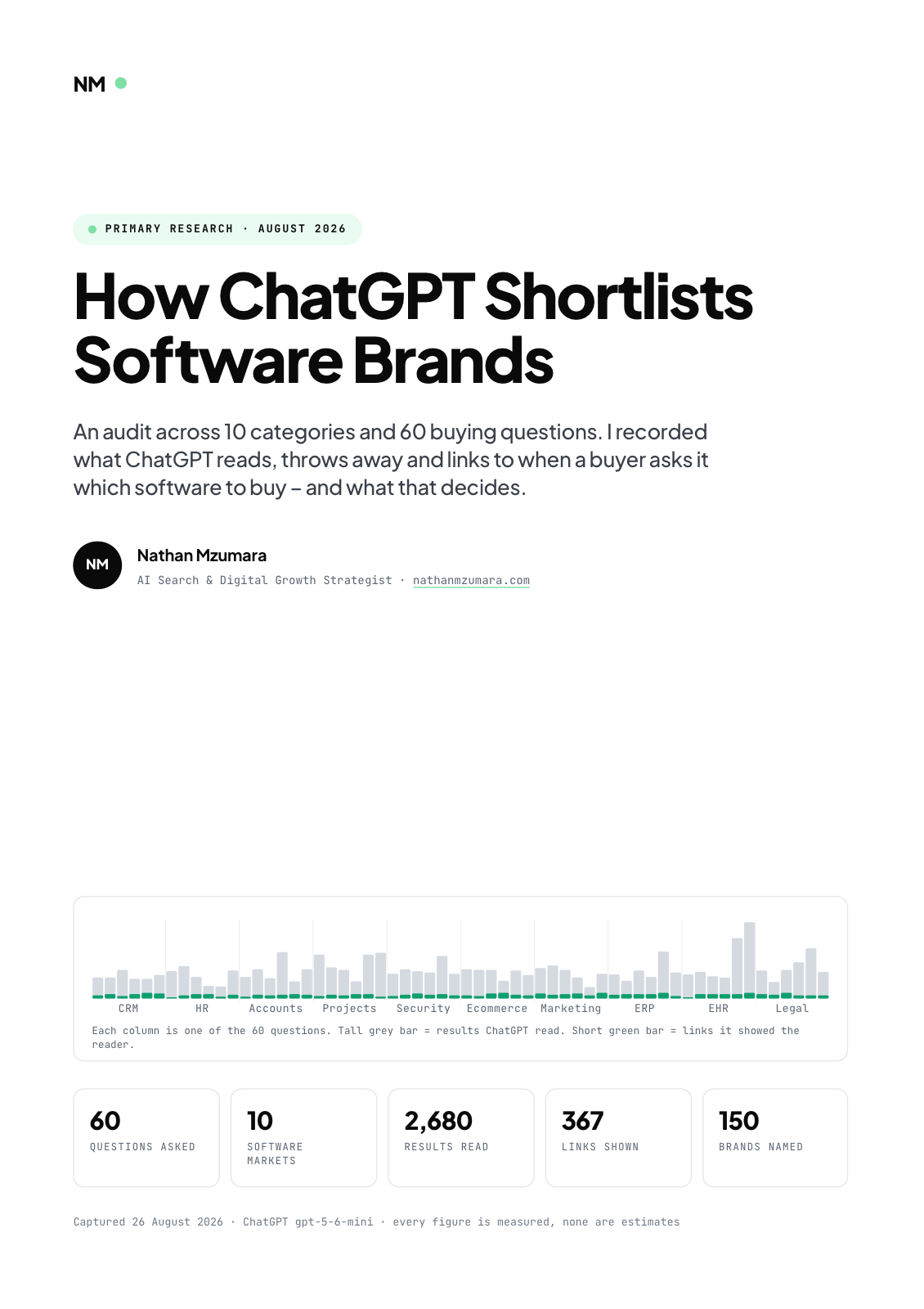
Counting the traffic is only half the job. The other half is knowing what the assistant read before it sent anyone: across 60 software buying questions, ChatGPT dropped 446 of the 564 websites it consulted without naming one of them, so citation-only tracking misses most of what actually shaped the answer.
How to use it, in practice
- Audit your Source Groups. Check how GA4 has mapped existing sources and confirm AI assistants land in the right categories before you report anything upward.
- Apply hostname filters. Whitelist your legitimate domains and exclude the spam hostnames inflating your sessions and conversions.
- Re-run historical reports. Because the change is retroactive, pull the last 6 to 12 months and see how much of your "direct" or "referral" was actually AI discovery all along.
- Rebase your attribution. Feed the cleaner numbers into channel-level budget calls so you stop under-investing in a channel you could not previously see.
Before and after
| Signal | Before | After Source Groups |
|---|---|---|
| ChatGPT and Perplexity referrals | Split across many hostnames, buried in referral or direct | Rolled into a unified AI-platform group |
| Spam hostnames | Inflate sessions and conversions | Excluded via hostname filters |
| Historical data | Locked and inconsistent | Retroactively reclassified for accurate trend reads |
Table: how the GA4 update changes what you can see. Source: Google Analytics.

Image: Unsplash.
The wider point
Measurement has always lagged behind behaviour, and AI search is the sharpest example yet. This update does not solve generative engine optimisation, but it does give you the counting infrastructure to prove it is working. If you want the strategy side, read my take on why content quality still drives discovery.
For the technical detail, Google documents the dimension in its Analytics Help Centre. I think this could be the moment AI referral traffic stops being a rounding error and starts being a line item.
The concrete action: before your next budget cycle, apply hostname filters, audit your Source Groups, and re-run 12 months of history. You may find you have been under-reporting AI discovery all along.