Algorithm
SERP volatility
The rate of change in search result rankings over a time window. High volatility usually signals a core update or major spam action in progress.
What it is
The rate at which search result rankings change across a time window, measured as the magnitude of position movement for tracked queries. Sustained high volatility usually signals a core update or a major spam action in progress.
Why it matters
It is an early indicator that the ranking environment is shifting, so monitoring it tells SEO professionals when to expect visibility gains or losses. Distinguishing real algorithmic movement from routine noise prevents overreacting to ordinary fluctuation.
How it works
It is detected by tracking aggregate position changes across a query set and comparing them against a normal baseline, so the response is to confirm the cause before acting and let an update settle before drawing conclusions. Reactive changes mid-rollout often muddy the diagnosis.
When it applies
It occurs continuously at a low baseline level and spikes during update rollouts and large spam actions.
Examples
- A tracking tool flashing high turbulence as an unconfirmed update rolls out.
- A single page swinging across several positions daily during a deployment window.
- Rankings stabilising into a new order once a core update finishes deploying.
How it is measured
- Average daily position change across a tracked query set
- Number of queries crossing page-one or top-three thresholds
- Deviation of current movement from the normal baseline
- Share of tracked URLs entering or exiting the index
Related terms in Algorithm
- Core updateA broad Google algorithm update affecting search rankings sitewide rather than a single feature. Recent core updates (e.g. May 2026) have increasingly favoured intent-aligned content over keyword-optimised content.
- EEATGoogle's quality framework: Experience, Expertise, Authoritativeness, Trustworthiness. EEAT signals are increasingly weighted in both classical ranking and AI Overview source selection.
- Entity salienceEntity salience is a measure of how central an entity is to a piece of content, as opposed to merely being mentioned in it. Natural language processing systems assign a salience score based on signals such as position, frequency, grammatical role and surrounding context. It helps a system decide what a document is actually about.
- Google Search algorithmThe Google Search algorithm is the collection of ranking and retrieval systems Google uses to find, order and present results for a query. It is not a single formula but many interacting systems that assess content, links, query intent, context and user signals. Google updates these systems continuously, with larger changes announced as core updates.
- Google Spam UpdateA Google Spam Update is a rollout of changes to the systems Google uses to detect and demote content that breaks its spam policies. These updates target things like scaled content abuse, cloaking, hacked pages, link schemes and site reputation abuse rather than general content quality. Sites hit by a spam update usually need to remove the offending practices before they can recover.
- Helpful Content UpdateGoogle's quality-focused update class targeting low-value, AI-generated, or thin content. Successive HCUs have favoured first-hand experience and named expertise over comprehensive but shallow coverage.
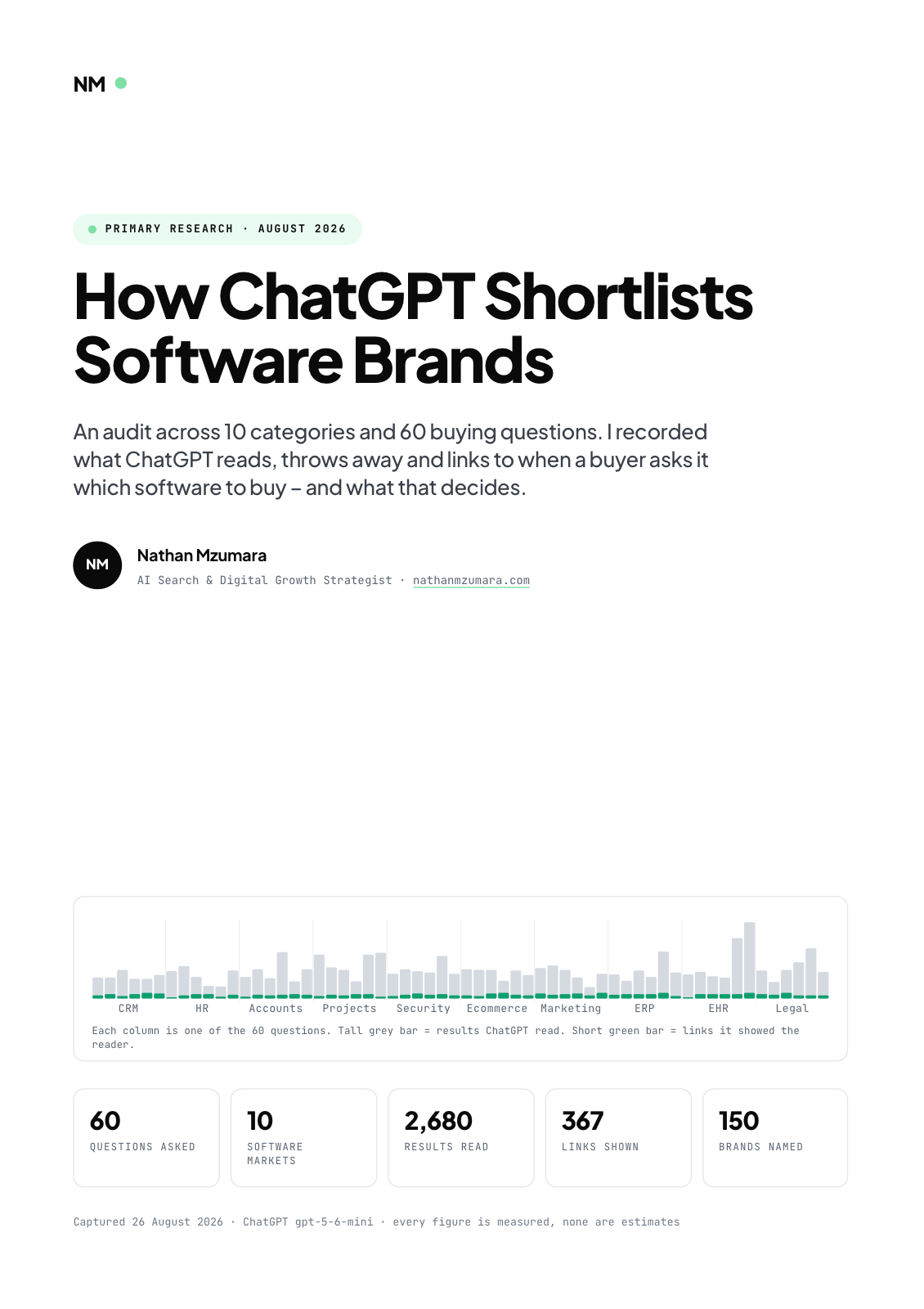
Primary research · August 2026
How ChatGPT Shortlists Software Brands
An audit across 10 categories and 60 buying questions. I recorded what ChatGPT reads, throws away and links to when a buyer asks it which software to buy, and what that decides.
- 60
- Questions asked
- 10
- Software markets
- 2,680
- Results read
- 367
- Links shown
Free download
Get the full report
35 pages · PDF · 536 KB. Enter your details and it downloads straight away.