Algorithm
Core update
A broad Google algorithm update affecting search rankings sitewide rather than a single feature. Recent core updates (e.g. May 2026) have increasingly favoured intent-aligned content over keyword-optimised content.
What it is
A broad Google algorithm update that recalibrates how relevance and quality are assessed across the whole index rather than tuning one feature or content type. Recent core updates have shifted weight towards intent-aligned content over content that is merely keyword-optimised.
Why it matters
Core updates can reorder rankings sitewide overnight, so they directly determine which pages remain discoverable and which sources AI Overviews draw from. A single update can erase or multiply organic visibility without any change to the page itself.
How it works
Google reassesses the relative quality and intent fit of pages against refreshed signals, so the response is to improve genuine helpfulness and intent coverage rather than chase the update with quick tweaks. Recovery typically arrives only at a later update once the underlying quality has lifted.
When it applies
They roll out roughly three to four times a year and take two to three weeks to fully deploy.
Examples
- A thin comparison page outranked by a slimmer guide that answers the searcher's actual question more directly.
- A site built for keyword density losing ground to one organised around user tasks and intents.
- Rankings shifting during the rollout window then settling into a new order once deployment completes.
How it is measured
- Sitewide change in average position before and after the rollout window
- Share of impressions and clicks by intent cluster
- Number of queries gained versus lost across the catalogue
- Proportion of ranking pages cited in AI Overviews post-update
Insights on Core update
- Google's June 2026 Spam Update Is Live. Here's What 'Normal' Actually Means.
- May 2026 Core Update Is Done: Intent Alignment Is Now Your Most Urgent Priority
- May 2026 Core Update Is Done: Intent Alignment Is Now Your Most Urgent Priority
- Google's May 2026 Core Update Proves Intent Has Won the Algorithm War
Related terms in Algorithm
- EEATGoogle's quality framework: Experience, Expertise, Authoritativeness, Trustworthiness. EEAT signals are increasingly weighted in both classical ranking and AI Overview source selection.
- Entity salienceEntity salience is a measure of how central an entity is to a piece of content, as opposed to merely being mentioned in it. Natural language processing systems assign a salience score based on signals such as position, frequency, grammatical role and surrounding context. It helps a system decide what a document is actually about.
- Google Search algorithmThe Google Search algorithm is the collection of ranking and retrieval systems Google uses to find, order and present results for a query. It is not a single formula but many interacting systems that assess content, links, query intent, context and user signals. Google updates these systems continuously, with larger changes announced as core updates.
- Google Spam UpdateA Google Spam Update is a rollout of changes to the systems Google uses to detect and demote content that breaks its spam policies. These updates target things like scaled content abuse, cloaking, hacked pages, link schemes and site reputation abuse rather than general content quality. Sites hit by a spam update usually need to remove the offending practices before they can recover.
- Helpful Content UpdateGoogle's quality-focused update class targeting low-value, AI-generated, or thin content. Successive HCUs have favoured first-hand experience and named expertise over comprehensive but shallow coverage.
- Ranking signalsRanking signals are the inputs a search system uses to decide which results to show and in what order. They include relevance signals from the page and query, quality and authority signals, and context such as location, device and language. Search engines do not publish the full list or the weightings, so practitioners work from documented signals, patents, testing and observed patterns.
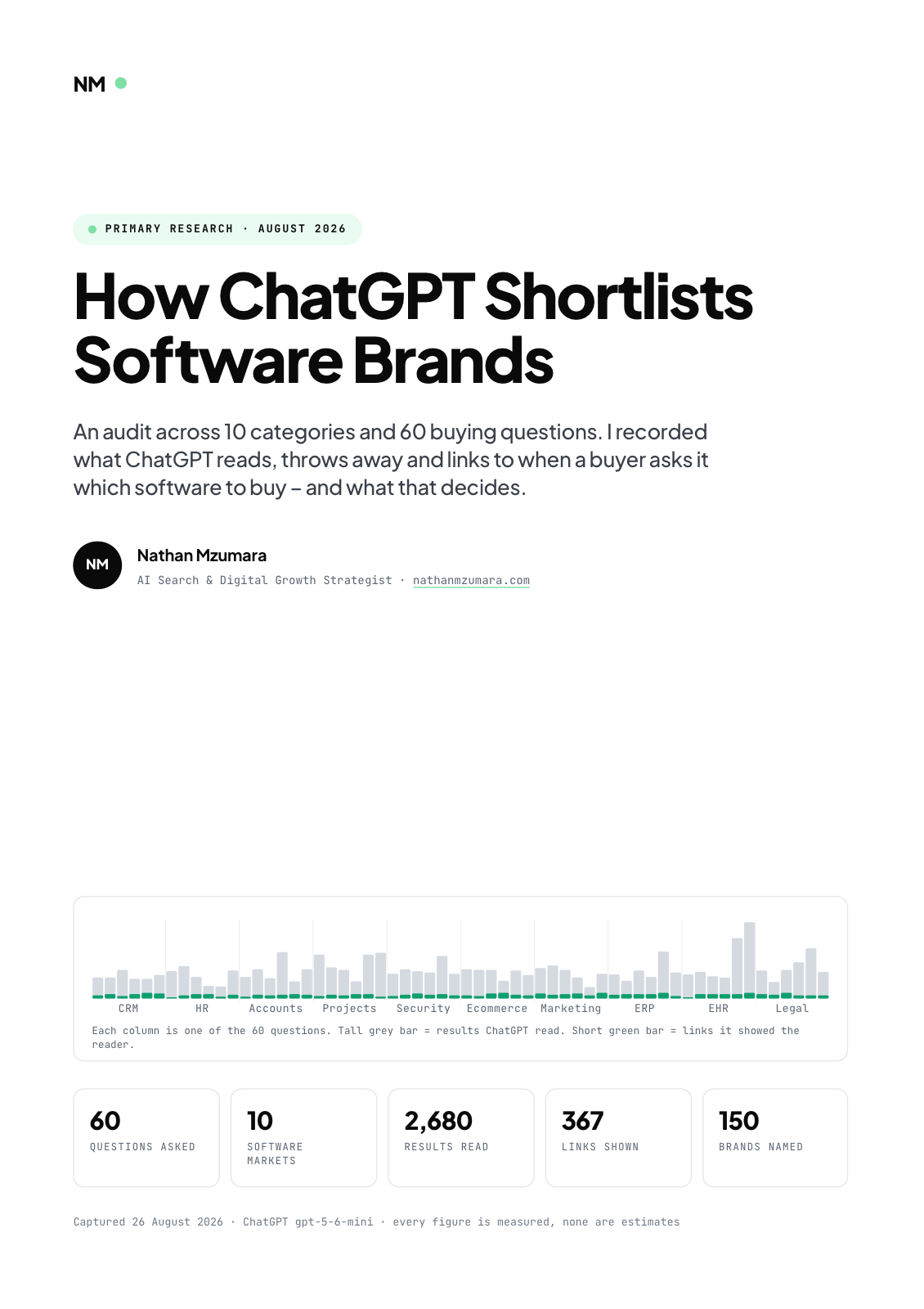
Primary research · August 2026
How ChatGPT Shortlists Software Brands
An audit across 10 categories and 60 buying questions. I recorded what ChatGPT reads, throws away and links to when a buyer asks it which software to buy, and what that decides.
- 60
- Questions asked
- 10
- Software markets
- 2,680
- Results read
- 367
- Links shown
Free download
Get the full report
35 pages · PDF · 536 KB. Enter your details and it downloads straight away.