Tooling
SISTRIX
SEO visibility platform widely used for post-core-update analysis. Source of the analysis that showed Google's May 2026 update favoured intent-aligned pages and the GPT-5.5 citation-pattern shift.
What it is
SISTRIX is an SEO visibility platform used widely to analyse search performance, especially after Google core updates. It published analysis showing the May 2026 update favoured intent-aligned pages.
Why it matters
Understanding which content characteristics win after an update guides how you structure pages so they remain visible across both classic search and AI answer engines.
How it works
Practitioners track the visibility index for domains and keyword sets before and after an update, then compare winners and losers to infer what the algorithm rewarded.
When it applies
Reach for it when diagnosing ranking movement around a core update or benchmarking domain visibility over time.
Examples
- Charting a domain's visibility index drop following a core update.
- Comparing winning and losing pages to identify intent alignment patterns.
- Benchmarking a client's visibility against category competitors.
How it is measured
- Visibility index over time
- Keyword ranking distribution
- Winner and loser domain movement
- Intent alignment of ranking pages
Related terms in Tooling
- Ahrefs Brand RadarAhrefs' AI-visibility module tracking brand mentions and impressions inside AI answers. Surfaces shifts in how brands appear across ChatGPT, Gemini, and other LLM surfaces.
- AI content detectionAI content detection is the use of software to estimate whether a piece of text, image, audio or video was generated by an AI model. Detectors return a probability or classification rather than proof, and accuracy varies with length, language, editing and model used. Because of that uncertainty, results are treated as a signal for review, not a verdict.
- AI watermarkingAI watermarking is the practice of embedding a signal into AI generated text, images, audio or video so the output can later be identified as machine produced. The signal is usually designed to be imperceptible to people but detectable by software that holds the matching key or detector. It is one of several provenance approaches used alongside metadata standards and content credentials.
- Bot detectionBot detection is the practice of identifying automated traffic to a website or API and separating it from human visitors. It distinguishes wanted automation, such as search engine and AI crawlers, from unwanted activity like scraping, credential stuffing and click fraud. Detection results feed decisions about what to allow, challenge, rate limit or block.
- Brave BrowserBrave is a Chromium based web browser from Brave Software that blocks third party trackers and most ads by default. It bundles privacy controls, Brave Search as the default engine, and an AI assistant called Leo. Because it strips tracking scripts, visits from Brave users are often harder to attribute in analytics.
- Brave SearchBrave Search is a search engine from Brave Software that serves results from its own web index rather than reselling another engine's results. It is the default engine in the Brave browser, offers AI generated answer summaries, and is sold to developers as the Brave Search API. That API makes it a grounding source for other search and AI products.
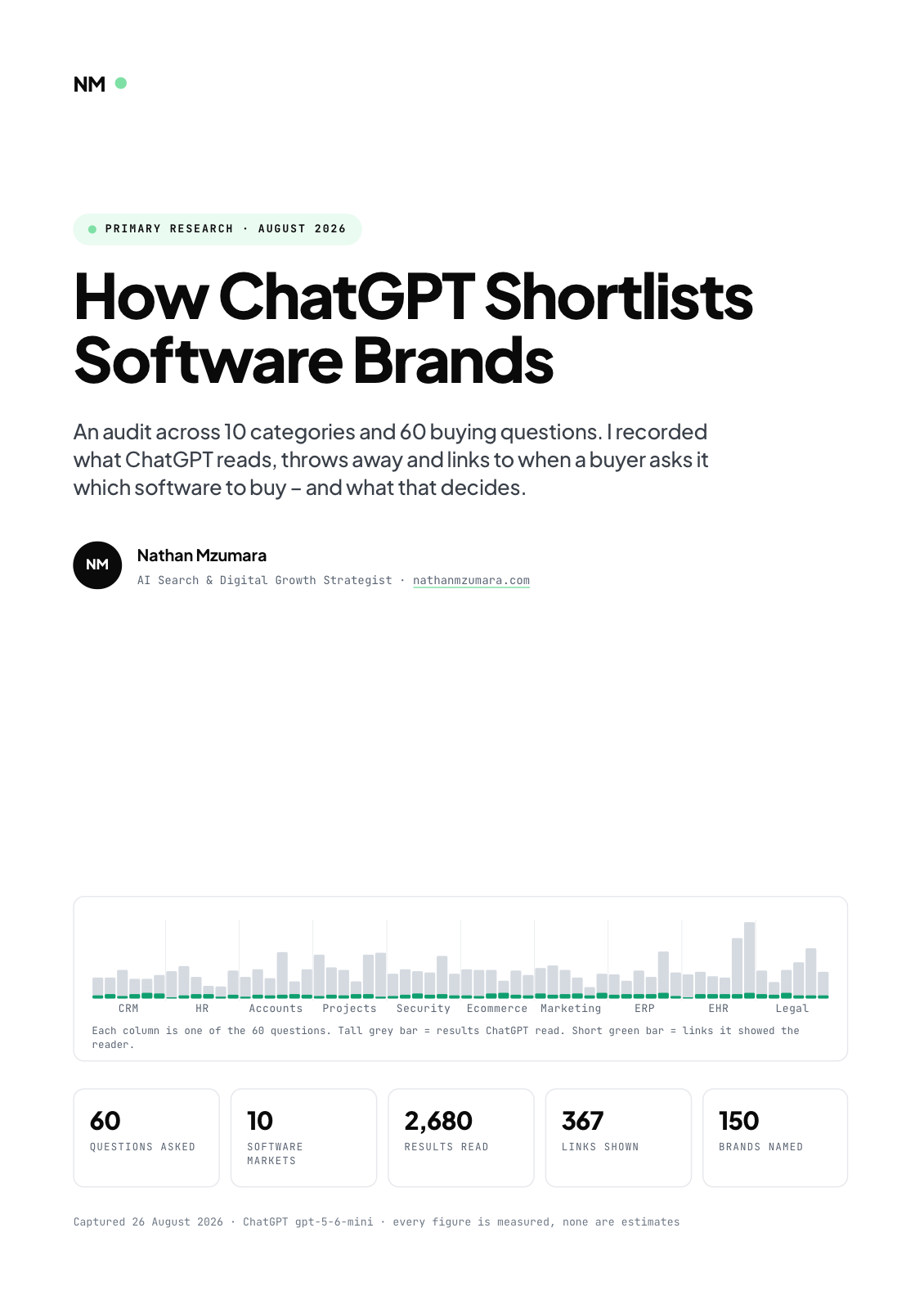
Primary research · August 2026
How ChatGPT Shortlists Software Brands
An audit across 10 categories and 60 buying questions. I recorded what ChatGPT reads, throws away and links to when a buyer asks it which software to buy, and what that decides.
- 60
- Questions asked
- 10
- Software markets
- 2,680
- Results read
- 367
- Links shown
Free download
Get the full report
35 pages · PDF · 536 KB. Enter your details and it downloads straight away.