Enterprise SEO Consultant for Growth at Scale
I'm Nathan Mzumara, an enterprise SEO consultant working with global brands on large-scale organic growth. My enterprise SEO consultancy covers technical SEO, strategy, international search, and e-commerce across sites running from a thousand to several million URLs. Twelve years in search, available as a fixed-scope project or an ongoing consulting retainer.
- 12+
- Years in search
- 177
- Published analyses
- 17
- Original studies
- 10
- AI surfaces tracked
10 AI search platforms tracked weekly
ChatGPT
Google AI Overviews
Gemini
Perplexity
Microsoft Copilot
Claude
Grok
DeepSeek
Meta AI
What Is Enterprise SEO Consulting?
Enterprise SEO consulting is strategic search advice for large organisations running complex websites, multiple stakeholders, and significant technical infrastructure. What separates an enterprise SEO consultancy from ordinary SEO support is that every solution has to scale: it is designed once at template, system, or taxonomy level, then applied programmatically across thousands or millions of pages rather than one page at a time.
An agency sells delivery capacity. An enterprise SEO consultant sells senior judgement: the strategy, the prioritisation, the technical direction, and the business case that funds it. That makes consulting services for enterprise SEO the right fit when you already have developers, content teams, or an in-house SEO function and need direction rather than extra hands. SEO consulting for enterprise companies typically starts with an audit and roadmap, then continues as a retainer once the work is in flight.
If you are still mapping the territory, the SEO glossary defines the terms used throughout this page, and the insights archive covers how AI search is reshaping enterprise discovery.
- Site scale
- 1,000 to 10M+ URLs
- Engagement
- Project or monthly retainer
- Coverage
- UK based, global brands
Why Enterprise SEO Programmes Stall
Enterprise SEO rarely fails on the analysis. It fails somewhere between the analysis and the release. These are the four failure modes worth naming before anyone commissions more research.
The audit nobody shipped
The most common artefact in enterprise SEO is a 200-page audit that was read once. Findings that are not translated into ticket-sized briefs, sized against developer effort, and sponsored by someone with budget do not become releases.
Nobody owns it
SEO sits between product, engineering, content, and brand, which in practice means it belongs to none of them. Without an explicit owner and a standing forum, every recommendation competes for attention as a favour rather than a commitment.
Fixes that do not scale
Hand-optimising pages is meaningless across a million URLs. If a recommendation cannot be expressed as a template change, a taxonomy rule, or a feed transformation, it will never reach enough of the site to move revenue.
Metrics the board ignores
Rankings and sessions do not survive contact with a finance review. Until organic performance is expressed as pipeline, revenue, or cost displaced from paid, enterprise SEO stays a line item that is easy to cut.
Enterprise Search Is Now Two Systems
Your buyers now reach you through two different retrieval systems with two different sets of rules. Most enterprise SEO strategies are still built for one of them. This is the distinction the rest of my work is organised around.
The classic index
Googlebot crawls, renders, and indexes. Ranking is positional, traffic is measurable in Search Console, and the levers are the familiar ones: architecture, crawl budget, internal links, page experience, authority.
- Ranks pages
- Positional and measurable
- Rewards site-level authority
The AI answer layer
Assistants and AI Overviews retrieve passages, synthesise an answer, and cite a handful of sources. There is no position to hold. You are either in the retrieved set and named in the answer, or you are invisible to that buyer entirely.
- Retrieves passages
- Cited or absent, no gradient
- Rewards specificity and recency
The two systems share a foundation. Crawlability, clean templates, structured data, and a coherent taxonomy serve both. They diverge at the content layer, where the index rewards comprehensive pages holding a position and the answer layer rewards specific, current, quotable passages it can lift. An enterprise SEO strategy written for only one of them leaves the other to chance.
Enterprise SEO Consulting Services
Seven pillars of enterprise SEO consultancy, from technical foundations through to training your in-house team. Most engagements combine two or three rather than all of them.
Enterprise Technical SEO Consultancy
- Large-Scale Technical Audits (10k+ pages)
- Enterprise CMS Migration Strategy
- JavaScript Framework SEO (React, Angular, Vue)
- International SEO Architecture
- Site Speed & Core Web Vitals at Scale
- Enterprise Schema Implementation
- API-Driven Content Optimisation
- Log File Analysis & Crawl Budget Optimisation
Enterprise SEO Strategy Consulting
- Multi-Brand SEO Strategy Development
- Global Market Entry Planning
- Enterprise Keyword Strategy & Taxonomies
- Stakeholder Alignment & Executive Reporting
- SEO Roadmap & Resource Planning
- ROI Forecasting & Business Case Development
- Competitive Intelligence at Enterprise Scale
- Cross-Functional SEO Integration
Enterprise Content Strategy
- Content Architecture for Large Sites
- Programmatic SEO Strategy
- Enterprise Content Gap Analysis
- Multi-Language Content Strategy
- Internal Linking Strategy at Scale
- Content Consolidation & Pruning
- AI-Powered Content Workflows
- Editorial Calendar & Governance
International SEO Consulting
- Global SEO Strategy & Planning
- Hreflang Implementation & Auditing
- Multi-Regional Website Architecture
- Local Market Research & Analysis
- ccTLD vs Subdomain Strategy
- International Link Building Strategy
- Cultural Content Adaptation
- Multi-Currency & Multi-Language Optimisation
Enterprise E-commerce SEO
- Large-Scale Product SEO Strategy
- Category & Faceted Navigation Optimisation
- Product Data Feed Optimisation
- Enterprise Platform SEO (Shopify Plus, Magento, etc.)
- Inventory-Based Content Strategy
- User-Generated Content Optimisation
- Conversion Rate Optimisation for Organic Traffic
- Multi-Brand E-commerce SEO
Enterprise Platform & Magento SEO
- Magento & Adobe Commerce SEO Consulting
- Shopify Plus & Salesforce Commerce Cloud SEO
- Faceted & Layered Navigation Control
- Enterprise CMS SEO (AEM, Sitecore, Contentful)
- Headless & Composable Commerce Rendering
- Crawl Budget Control on Large Catalogues
- Template-Level Structured Data Rollout
- Replatform & Migration Risk Planning
Enterprise SEO Training & Enablement
- In-House SEO Team Development
- Executive SEO Education Workshops
- Developer & Engineering SEO Training
- Content Team SEO Best Practices
- SEO Process Documentation
- Tool Implementation & Training
- Ongoing Advisory & Support
- SEO Centre of Excellence Development
Enterprise SEO Judgement, Shown Not Claimed
Anyone can list services. Below is 177 published analyses and original studies, grouped by the problems enterprise teams actually bring me. Read a few before you get in touch: it is a faster way to judge whether I think about this the way you need someone to.
How AI assistants pick enterprise vendors
Original 2026 research into what ChatGPT actually reads, and what it goes on to cite, when a buyer asks it to shortlist software.
- Vendor Pages Take 65.9% of ChatGPT's Citations. G2 Takes 4.1%.
- Forty-Five Reads, Six Links: How ChatGPT Actually Cites Software Brands
- Your AI Visibility Tool Is Blind to 79% of the Web ChatGPT Reads
- Recency Is Close to a Filter: 86.3% of What ChatGPT Read Carried a 2026 Date
- Publish Your Prices: Why Gated Pricing Costs You 30 Points of AI Citation Share
Category research by vertical
The same study run category by category, across the regulated and high-consideration markets most enterprise SEO programmes sell into.
- ERP in ChatGPT: Twelve Vendors Named, Zero Sources, One Comparison Site Deciding the Shortlist
- CRM and Marketing Automation in ChatGPT: HubSpot Owns the Category, and the Citations
- Cybersecurity in ChatGPT: When the Buyer Names the Vendors, Your Own Site Becomes the Whole Evidence Base
- Healthcare EHR in ChatGPT: 120 Results Read, 9 Links Shown, 14 Vendors Unsourced
- Legal Practice Software in ChatGPT: Clio Wins 67% of Prompts, and a Funeral Home Made the Shortlist
Technical SEO and algorithm change
Reading algorithm updates and specification changes the way an enterprise team has to: what breaks, what to audit, and what is noise.
- Google Just Broke JSON-LD Escaping. Check Your Schema Now.
- Google's August 2026 Spam Update Is Live. Read This First.
- Google's June 2026 Spam Update Is Live. Here's What 'Normal' Actually Means.
- May 2026 Core Update Is Done: Intent Alignment Is Now Your Most Urgent Priority
- Google Adds Sale Dates to Product Schema. Free Visibility Just Got Cheaper.
Measurement and executive reporting
Getting organic and AI-assistant performance into numbers a board will accept, and knowing which of those numbers actually mean anything.
- Citation Share Is Not Traffic: How AI Search Engines Actually Differ, and What That Means for B2B
- GA4 Now Tracks ChatGPT and Perplexity Traffic Automatically
- Google Analytics Just Unified Paid and Organic Conversions in the Data API. 'De-Duplicated' Is the Word That Matters.
- GSC's AI Overview Report: Read It Wrong and You'll Strategy Wrong
- Google Search Console Now Reports AI Feature Performance: What Growth Teams Must Do First
Governance, compliance and regulated markets
Where search strategy meets legal sign-off: disclosure duties, crawler access, data retention, and the regulatory decisions reshaping discovery.
Enterprise buying behaviour
How B2B discovery is moving into assistants and agents, and what that does to the top of a long, committee-led enterprise funnel.
- ChatGPT Picks Winners Before It Searches. Here's the Proof.
- OpenAI Just Hired a Sales Machine. ChatGPT Is Now a B2B Channel.
- OpenAI Models Are Now on Amazon Bedrock: What Enterprise Growth Teams Should Do Next
- OpenAI Just Built an Enterprise Channel Layer. Who Owns Your AI Relationship Now?
- Same Buyer, Same Category, Different Shortlist: Prompt Shape Rewrites the Answer
Enterprise SEO Consulting Retainers & Projects
Three ways to buy enterprise SEO consultancy. Global brands running multi-market sites usually start with an audit and strategy project, then move onto a retainer once the roadmap is live.
Consulting Retainer
For global brands
A standing block of strategic time each month: roadmap ownership, technical review of releases before they ship, market-by-market reporting, algorithm and AI search monitoring, and direct access between sessions. Rolling quarterly terms so scope flexes with your markets.
Best for: Multi-market brands with in-house delivery teams
Audit & Strategy Project
Fixed scope
A defined engagement covering a large-scale technical audit, competitive and keyword opportunity analysis, and a prioritised roadmap with forecast and business case. Delivered as briefs your engineering and content teams can ship against.
Best for: Organisations needing direction and a funded business case
Advisory & Interim Leadership
Senior cover
Fractional enterprise SEO strategy consultant support: a second opinion on major initiatives, migration oversight, upskilling your team, or holding the SEO director seat while you recruit.
Best for: Teams in transition, migration, or hiring
How I Drive Enterprise SEO Success
Strategic Foundation
Enterprise SEO begins with a comprehensive understanding of your business objectives, technical infrastructure, and organisational structure. I conduct deep-dive audits across technical, content, and competitive dimensions to identify high-impact opportunities that align with your revenue goals and resources.
Stakeholder Collaboration
Success at enterprise scale requires alignment across development, product, content, and executive teams. I facilitate cross-functional collaboration, translating SEO requirements into actionable briefs for technical teams whilst ensuring executive stakeholders understand the business impact and resource requirements of strategic initiatives.
Data-Driven Prioritisation
With thousands of potential optimisations across large websites, prioritisation is critical. I employ advanced analytics, forecasting models, and ROI analysis to build roadmaps that deliver measurable business impact. Every recommendation is backed by data and tied directly to revenue or strategic objectives.
Scalable Implementation
Enterprise SEO solutions must work at scale. Rather than page-by-page optimisations, I design systematic approaches using automation, templating, and programmatic methods that can be deployed across thousands of pages. This includes API integrations, database-level optimisations, and CMS template modifications.
Continuous Optimisation
Enterprise SEO is not a one-time project but an ongoing strategic function. I establish monitoring frameworks, reporting dashboards, and iterative testing protocols that enable continuous improvement. Regular performance reviews ensure strategies evolve with algorithm updates, competitive landscapes, and business priorities.
Enterprise Organisations I Support
I provide enterprise SEO consulting to organisations facing the unique challenges of large-scale search optimisation, across the UK, Europe, and North America.
Multi-National Corporations
Global brands operating across multiple countries, languages, and markets requiring coordinated international SEO strategies.
E-commerce Platforms
Large-scale online retailers with extensive product catalogues, complex filtering systems, and multi-brand portfolios.
SaaS & Technology Companies
B2B and B2C software companies with sophisticated product offerings requiring technical SEO expertise and strategic content approaches.
Media & Publishing Organisations
News outlets, content platforms, and digital publishers managing thousands of articles and requiring ongoing content optimisation strategies.
Financial Services & Healthcare
Regulated industries requiring SEO strategies that balance compliance requirements with organic growth objectives.
Private Equity Portfolio Companies
Investment-backed organisations seeking rapid organic growth and measurable ROI from SEO initiatives to support valuation growth.
Complex Problems I Solve
Technical Complexity
Enterprise websites often involve complex technical architectures including JavaScript frameworks, CDNs, multi-region hosting, and legacy systems. I navigate these technical challenges to implement SEO best practices without compromising site performance or user experience.
Organisational Silos
Large organisations often struggle with SEO ownership spanning multiple departments. I establish governance frameworks, create cross-functional workflows, and build internal consensus to ensure SEO is integrated into all relevant digital initiatives.
Invisibility in AI Answers
Brands that rank well can still be absent from the shortlists ChatGPT, Gemini, and AI Overviews hand to buyers, because retrieval rewards specific, current, quotable passages rather than positional authority. I diagnose where you are being read but not cited, and restructure content so it survives retrieval.
Migration Risk Management
Platform migrations, redesigns, and consolidations pose significant SEO risks at enterprise scale. I provide comprehensive migration planning, execution oversight, and post-migration monitoring to protect and enhance organic visibility through major technical changes.
International Expansion
Entering new markets introduces linguistic, cultural, and technical SEO challenges. I develop international SEO strategies that account for local search behaviours, technical implementation requirements, and content localisation needs across multiple regions.
ROI Justification
Enterprise SEO requires significant investment and stakeholder buy-in. I build detailed business cases with forecasted ROI, establish KPIs tied to business objectives, and create executive reporting frameworks that demonstrate tangible value from SEO initiatives.
How We Work Together
- 01
Discovery & Audit
Comprehensive assessment of your current SEO performance, technical infrastructure, content strategy, and competitive landscape. I analyse your website architecture, keyword rankings, backlink profile, and business objectives to identify opportunities and constraints.
- 02
Strategy Development
Based on audit findings, I develop a prioritised SEO roadmap aligned with your business goals and resources. This includes technical recommendations, content strategies, and resource requirements with clear timelines and expected outcomes.
- 03
Stakeholder Alignment
I present strategies to key stakeholders across technical, content, and executive teams, ensuring everyone understands their role in SEO success. This includes creating implementation briefs, training materials, and governance frameworks.
- 04
Implementation Support
I provide hands-on guidance during implementation, working with your development teams to ensure technical changes are properly executed, content guidelines are followed, and optimisations are deployed correctly at scale.
- 05
Monitoring & Optimisation
Post-implementation, I establish monitoring dashboards, conduct regular performance reviews, and identify new optimisation opportunities. This includes tracking rankings, traffic, conversions, and technical health metrics.
- 06
Ongoing Advisory
Enterprise SEO is an ongoing discipline. I provide continuous strategic guidance, stay ahead of algorithm updates, conduct competitive analysis, and ensure your SEO strategy evolves with your business and the search landscape.
Enterprise SEO Consulting FAQ
Enterprise SEO consulting is strategic search engine optimisation advice for large organisations running complex websites, multiple stakeholders, and significant technical infrastructure. An enterprise SEO consultancy differs from ordinary SEO support because the work has to scale: solutions are designed once and applied programmatically across thousands or millions of pages, rather than page by page. In practice an enterprise SEO consultant combines technical SEO expertise, content and taxonomy strategy, cross-functional governance, and executive reporting to drive organic growth at scale.
An enterprise SEO consultant audits your site architecture and organic performance, builds a prioritised roadmap tied to revenue, translates that roadmap into briefs your engineering and content teams can ship, and then governs delivery and measurement. Day to day that means large-scale technical audits, migration planning, keyword and taxonomy strategy, internal linking design, structured data specification, stakeholder alignment, and board-level reporting. The consultant is accountable for the strategy and the business case; your internal teams, or the consultant's specialists, handle implementation.
Enterprise SEO differs from traditional SEO in scale, complexity, and approach. Enterprise sites typically have thousands or millions of pages, complex technical architectures (JavaScript frameworks, CDNs, multi-region hosting), multiple stakeholder groups, and sophisticated business requirements. Enterprise SEO requires programmatic and systematic solutions rather than page-by-page optimisation, extensive stakeholder management, technical expertise with enterprise platforms, and the ability to demonstrate ROI to executive stakeholders.
An enterprise SEO agency sells a team and a delivery capacity: account managers, executives, and specialists who execute a scope of work each month. An enterprise SEO consultant sells senior judgement: strategy, prioritisation, technical direction, and the business case, delivered directly by the person doing the thinking. Consulting suits organisations that already have in-house developers, content teams, or an SEO function and need direction rather than hands. Many enterprises run both, using consulting services for enterprise SEO strategy and governance while an agency or in-house team executes.
Organisations that benefit most from enterprise SEO consulting include multi-national corporations operating across multiple countries and languages, large e-commerce platforms with extensive product catalogues, SaaS and technology companies with complex offerings, media and publishing organisations, regulated industries like finance and healthcare, and private equity-backed companies seeking rapid growth. Generally, if your website has over 1,000 pages, operates in multiple markets, or requires cross-functional coordination for SEO implementation, you likely need enterprise-level expertise.
Enterprise technical SEO consultancy covers the infrastructure layer that determines whether your content can be crawled, rendered, indexed, and retrieved at all. That includes large-scale technical audits across 10,000 or more URLs, log file analysis and crawl budget allocation, JavaScript rendering strategy for React, Angular, and Vue applications, Core Web Vitals at scale, hreflang and multi-regional architecture, structured data implementation across templates, and CMS or platform migration planning. On enterprise sites these are template and system decisions, so a single fix typically propagates across entire site sections.
Yes. Enterprise e-commerce SEO is platform-specific, and I work across Adobe Commerce and Magento, Shopify Plus, Salesforce Commerce Cloud, SAP Commerce, BigCommerce Enterprise, and bespoke headless stacks. As a Magento SEO consultant the recurring issues are faceted navigation generating near-infinite crawlable URL combinations, layered navigation and sort parameters diluting crawl budget, thin or duplicated category pages, slow server response on large catalogues, and product pages that disappear when inventory changes. Each of those is solved at the template and configuration level rather than product by product.
Enterprise SEO is a medium to long-term investment. Initial technical improvements may show results within 3-6 months, whilst comprehensive strategy implementation typically requires 6-12 months to demonstrate significant impact. The timeline depends on several factors including current site health, competitive landscape, technical complexity, resource availability, and implementation speed. Unlike smaller sites, enterprise SEO often involves lengthy development cycles and stakeholder approval processes that can extend timelines. However, the scale of enterprise sites means that improvements, once implemented, can drive substantial organic growth.
Enterprise SEO typically delivers strong ROI, though exact figures vary by industry, competitive landscape, and current SEO maturity. Well-executed enterprise SEO strategies commonly generate 300-500% ROI within 12-18 months through increased organic traffic, improved conversion rates, and reduced dependency on paid channels. For e-commerce sites, we often see 20-40% year-over-year organic revenue growth. The key is strategic prioritisation focusing on high-value opportunities aligned with business objectives rather than attempting to optimise everything simultaneously.
Yes. A retainer is the usual model for global brands, because multi-market SEO is a standing function rather than a finite project. A typical enterprise SEO consulting retainer covers a fixed block of strategic time each month, ownership of the roadmap and its prioritisation, technical review of releases before they ship, market-by-market performance reporting, algorithm and AI search monitoring, and direct access between sessions for decisions that cannot wait. Retainers usually run on rolling quarterly terms after an initial audit and strategy phase, so the scope can flex as markets and priorities change.
I offer both project-based enterprise SEO consulting and ongoing advisory retainers. Project work typically involves comprehensive audits, strategy development, migration planning, or specific initiative support. Ongoing retainers provide continuous strategic guidance, performance monitoring, competitive intelligence, algorithm update response, and regular optimisation recommendations. Many enterprise clients benefit most from a hybrid approach: intensive project work for initial strategy development and implementation, followed by ongoing advisory support to maintain momentum and adapt to changing search landscapes.
Absolutely. I frequently work alongside existing in-house SEO teams, providing strategic guidance, technical expertise, and senior-level advisory support. This collaboration can take several forms including providing specialised expertise your team lacks (such as international SEO or JavaScript SEO), offering a second opinion on major initiatives, supporting during peak periods or major projects, training and upskilling team members, or acting as an interim SEO director during recruitment. My goal is to augment your team's capabilities and help them succeed, not replace them.
As a second retrieval system with its own rules, not as a bolt-on. Assistants retrieve passages and cite a handful of sources rather than ranking pages, so a brand can hold position one and still be absent from the shortlist a buyer is handed. I run original research into this: across software categories, vendor-owned pages take roughly two thirds of ChatGPT's citations while review aggregators take a low single-digit share, recency behaves close to a hard filter, and gating your pricing measurably costs citation share. Practically, that means auditing what assistants actually read on your domain, restructuring key pages into specific and quotable passages, publishing the facts buyers ask for rather than hiding them behind forms, and measuring citation share separately from traffic because the two move independently.
For recruitment and careers growth the framework that works at enterprise level is a programmatic job taxonomy layered over a technical foundation. Build indexable landing pages for each role, location, and skill combination that has genuine search demand, generate them from your ATS feed so they stay current, and apply JobPosting structured data so roles are eligible for Google Jobs. Underneath that, use canonical rules and expiry handling to stop closed vacancies decaying into soft 404s, keep crawl budget pointed at live roles, and support the taxonomy with employer brand content covering pay, progression, and culture queries. The same enterprise SEO strategy discipline applies as with commercial pages: build once at template level, measure by cohort, and prune what does not earn its crawl.
I am based in the United Kingdom and work with enterprise clients worldwide, remotely by default. Most engagements are with global brands running multi-market sites, so the work is already distributed across time zones and I hold regular hours that overlap with North American and European teams. If you are searching for an enterprise SEO consultant in a specific city, whether that is London, New York, or St Louis, the practical question at enterprise scale is not proximity but whether the consultant has run sites of your size and complexity. On-site workshops and stakeholder sessions can be arranged where they add value.
Still have questions?
Contact Me DirectlyLatest SEO News & Insights
ChatGPT UTM tracking disappears: AI referrals now look like direct traffic
16 October 2026
Read morexAI just shipped Grok Voice 3.0 at the same $0.08 per minute as the previous version
15 October 2026
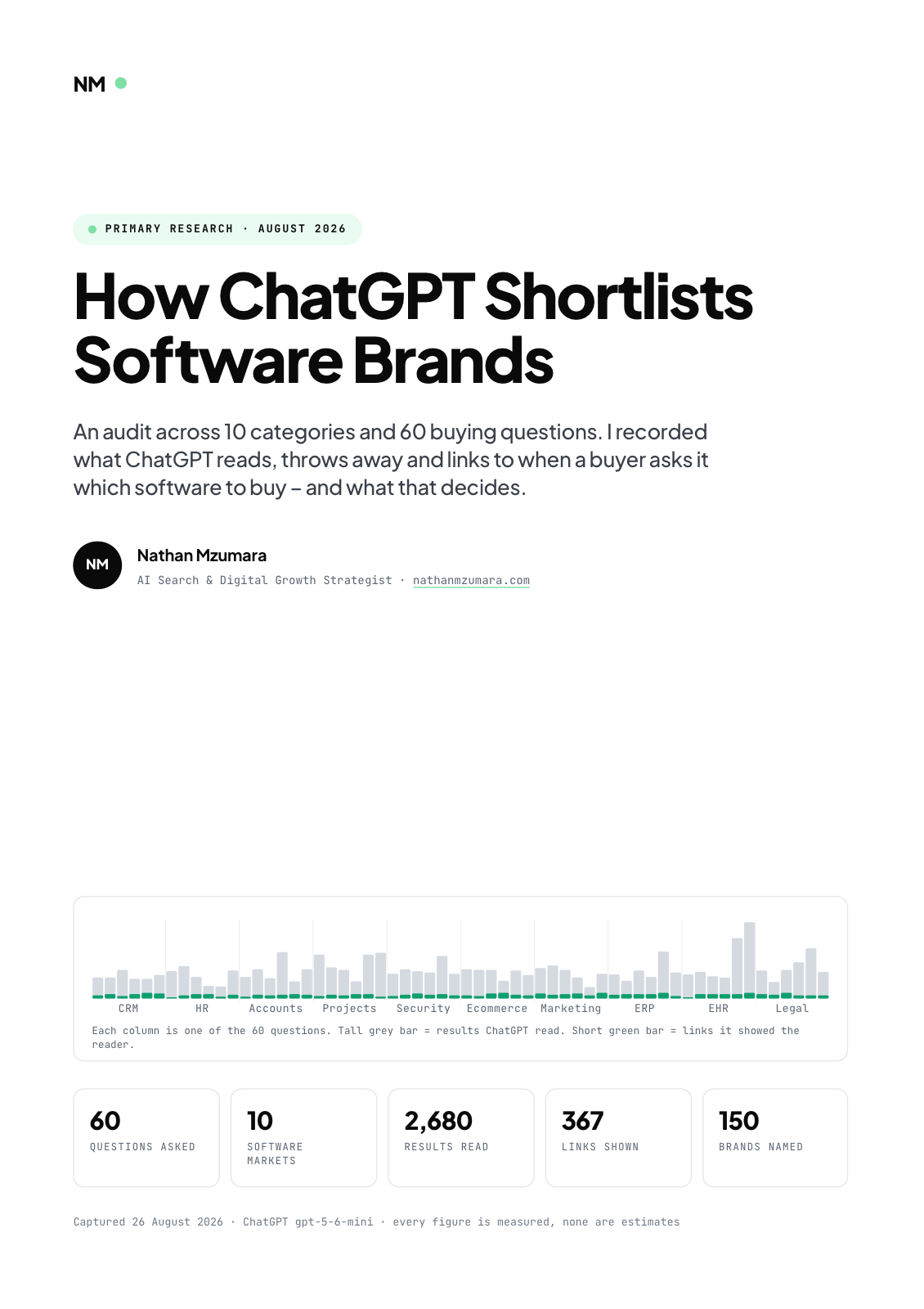
Read morePrimary research · August 2026
How ChatGPT Shortlists Software Brands
An audit across 10 categories and 60 buying questions. I recorded what ChatGPT reads, throws away and links to when a buyer asks it which software to buy, and what that decides.
- 60
- Questions asked
- 10
- Software markets
- 2,680
- Results read
- 367
- Links shown
Free download
Get the full report
35 pages · PDF · 536 KB. Enter your details and it downloads straight away.