Publish Your Prices: Why Gated Pricing Costs You 30 Points of AI Citation Share

How much of a ChatGPT answer is your marketing versus somebody else's analysis depends heavily on one thing: whether your category publishes its prices. Categories with clear public pricing gave vendors 80–91% of citations. Categories where pricing is gated behind "contact sales" gave vendors 48–55%, with the difference going to analysts, trade press and specialist comparison sites. Hiding your price does not remove you from the answer. It just means someone else's estimate of your price is what gets cited.
Vendor citation share, by category
| Category | Vendor-owned share of citations |
|---|---|
| Accounting | 90.9% |
| Project management | 87.5% |
| Ecommerce platforms | 83.8% |
| Cybersecurity | 66.7% |
| HR & payroll | 63.3% |
| Marketing automation | 60.5% |
| CRM | 60.0% |
| Legal practice management | 54.1% |
| ERP / manufacturing | 52.5% |
| Healthcare EHR | 48.7% |
Accounting at 90.9%, project management at 87.5% and ecommerce at 83.8% are near-monocultures: a handful of vendors with clear public pricing, and the model simply reads their pricing pages. Healthcare EHR at 48.7% and ERP at 52.5% are the opposite – enterprise categories where pricing is gated, so the model has to lean on analysts, trade press and specialist comparison sites.
The rule of thumb that falls out: where a category publishes its prices, the vendors own the citation surface. Where it does not, third parties do.
The full category picture
Vendor share is not the only thing that moves with category structure. Retrieval volume, brand count and citation concentration move with it too.
| Category | Results read | Citations | Cited domains | Brands seen | Vendor % | Citation HHI | Most-named brand |
|---|---|---|---|---|---|---|---|
| Accounting | 43.0 | 5.5 | 9 | 10 | 90.9% | 2,213 | QuickBooks |
| Project management | 55.2 | 5.3 | 8 | 14 | 87.5% | 2,070 | Asana |
| Ecommerce platforms | 40.8 | 6.2 | 11 | 14 | 83.8% | 2,213 | Shopify |
| Cybersecurity | 45.8 | 6.0 | 10 | 12 | 66.7% | 1,358 | CrowdStrike |
| HR & payroll | 35.2 | 5.0 | 13 | 19 | 63.3% | 1,000 | Rippling |
| Marketing automation | 39.2 | 7.2 | 20 | 22 | 60.5% | 1,044 | HubSpot |
| CRM | 35.0 | 6.7 | 16 | 9 | 60.0% | 1,038 | HubSpot |
| Legal practice management | 48.8 | 6.2 | 16 | 17 | 54.1% | 1,161 | Clio |
| ERP / manufacturing | 43.2 | 6.7 | 13 | 17 | 52.5% | 1,312 | SAP S/4HANA |
| Healthcare EHR | 60.5 | 6.5 | 19 | 19 | 48.7% | 796 | eClinicalWorks |
Three patterns are worth pulling out.
Vendor share and citation concentration move together. Accounting and ecommerce both sit at a citation HHI of 2,213 – highly concentrated, a handful of domains carrying the answer. Healthcare EHR sits at 796, the most fragmented in the corpus, with 19 distinct cited domains. When vendors do not supply the evidence, the citation surface spreads across many third parties, and no single one of them can be managed.
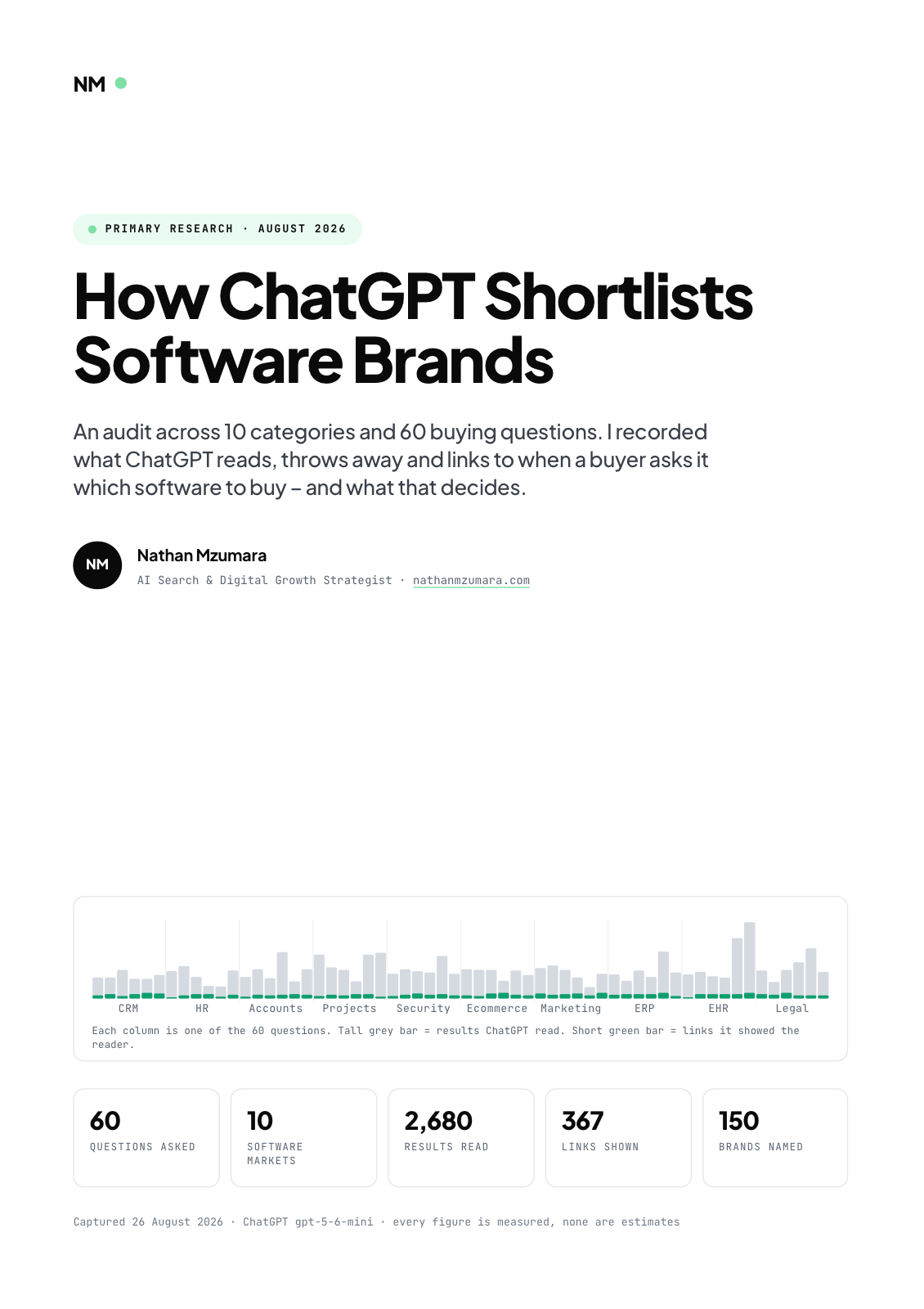
Retrieval volume rises where evidence is scarce. Healthcare EHR drew the heaviest retrieval in the corpus at 60.5 results per answer, and project management at 55.2. Contested, fragmented categories drive enormous fan-out that the user never sees. The heaviest single retrieval in the study was 120 results for one healthcare practice-management question, producing nine citations.
Brand count rises with fragmentation. Marketing automation surfaced 22 distinct brands across six prompts and healthcare EHR 19, against nine for CRM and ten for accounting. In fragmented categories the buyer is handed a much longer list with much thinner evidence behind each name.
What gating your price actually costs you
Set out the causal chain plainly.
Citations bind to checkable claims. Price is the most checkable claim in software, and the vendor is its only primary source. Pricing pages alone accounted for 278 of the 2,680 results retrieved in this corpus. Where the vendor publishes, the vendor is cited. Where the vendor does not, the model still needs a number, so it takes one from whoever will supply it – an analyst note, a trade article, or a comparison site with no ownership disclosure and an affiliate link.
That is the whole cost. Not absence from the answer. Loss of control over what the answer says about your price, plus the loss of the single highest-converting citation hook you own.
The clearest illustration in the corpus is a budget-constrained accounting question: "I need accounting software under $40 a month that handles multi-currency invoicing and US sales tax." ChatGPT read 27 results from five domains and rendered seven citations, all seven from zoho.com – the one vendor it recommended. Xero and QuickBooks were named with no citation at all. The answer even flagged a caveat about annual-versus-monthly billing, which is precisely the kind of detail only a public pricing page can supply.
Compare that to the ERP case. "What are the best alternatives to NetSuite?" produced twelve named brands – Oracle, NetSuite, Microsoft Dynamics 365 Business Central, Acumatica, SAP Business One, Odoo, Microsoft Dynamics 365, Sage X3, Epicor, IFS, Oracle Fusion and SAP S/4HANA – and zero citations to any of their own sites. Five of the seven citations came from a single comparison site, erpresearch.com. Every one of those vendors gates pricing.
The objection, and the honest answer to it
The standard objection is that enterprise pricing is genuinely variable, so publishing a number is either misleading or commercially damaging.

That objection has force, and this data does not overturn it. But the choice is not between publishing a price and publishing nothing. Several intermediate positions supply a citable, checkable artefact without committing to a single number:
Publish the pricing model. Per-user, per-module, per-transaction, tiered by volume. That is a structural fact, it is stable, and it is citable.
Publish a starting point or a band. "From £X per user per month" or "typical mid-market implementations range £X–£Y" is more useful to the model than silence, and more accurate than a comparison site's guess.
Publish everything adjacent that is not negotiable. Tier names, what each tier includes, seat minimums, implementation scope, supported integrations, supported platforms. These are the other claims citations bind to, and they are the ones enterprise vendors most often bury in a gated PDF.
Make it a page, not a form. A pricing page that is a lead-capture form has no extractable content. The retrieval layer cannot cite a form.
What to do next
Work out which side of the line your category sits on, using the table above as a starting point. If you are in a public-pricing category with vendor share above 80%, your citation performance is almost entirely a function of your own pages, and the fix is structural: clean pricing, feature availability and integration pages, dated and extractable.
If you are in a gated-pricing category below 60%, half your citation surface currently belongs to publishers you do not control. Two jobs follow. First, publish enough structured, checkable detail to reclaim some of it. Second, audit what the third parties currently cited in your category actually say about your pricing, because in the absence of your own page, theirs is the number the buyer sees.
FAQ
Does publishing pricing improve AI search visibility?
In this corpus it strongly correlates with it. Software categories with clear public pricing gave vendors 80-91% of ChatGPT's citations, while categories with gated "contact sales" pricing gave vendors 48-55%. The difference went to analysts, trade press and comparison sites.
Which software categories have the highest vendor citation share in ChatGPT?
Accounting at 90.9%, project management at 87.5% and ecommerce platforms at 83.8%. All three are categories with a small number of vendors publishing clear public pricing. Healthcare EHR is lowest at 48.7%, followed by ERP and manufacturing at 52.5%.
What happens if my company hides its pricing from ChatGPT?
You are not removed from the answer, but you lose control of it. The model still needs a price and takes one from whoever supplies it - an analyst note, trade article or comparison site. You also forfeit the highest-value citation hook you own, since pricing pages accounted for 278 of 2,680 retrieved results.
Can enterprise vendors publish pricing without publishing a fixed number?
Yes. Publishing the pricing model, a starting point or a band, tier names and inclusions, seat minimums, integrations and supported platforms all give the retrieval layer citable, checkable artefacts without committing to one number. A pricing page that is only a lead-capture form has nothing extractable.
Why do enterprise software categories have more fragmented AI citations?
Because vendors do not supply the evidence, so the citation surface spreads across third parties. Healthcare EHR had a citation Herfindahl-Hirschman index of 796 across 19 cited domains, against 2,213 for accounting. It also drew the heaviest retrieval at 60.5 results per answer.
Related in this series
- How ChatGPT Shortlists Software Brands, the full report as a PDF
- Forty-Five Reads, Six Links: How ChatGPT Actually Cites Software Brands
- Accounting Software in ChatGPT: 90.9% of Citations Go to the Vendors Themselves
- ERP in ChatGPT: Twelve Vendors Named, Zero Sources, One Comparison Site Deciding the Shortlist
- Healthcare EHR in ChatGPT: 120 Results Read, 9 Links Shown, 14 Vendors Unsourced
About the research. Nathan Mzumara is an organic growth and AI search practitioner. Category figures rest on six observations each and should be read as directional. Method and limitations are stated in the pillar report.
Tags