Healthcare EHR in ChatGPT: 120 Results Read, 9 Links Shown, 14 Vendors Unsourced

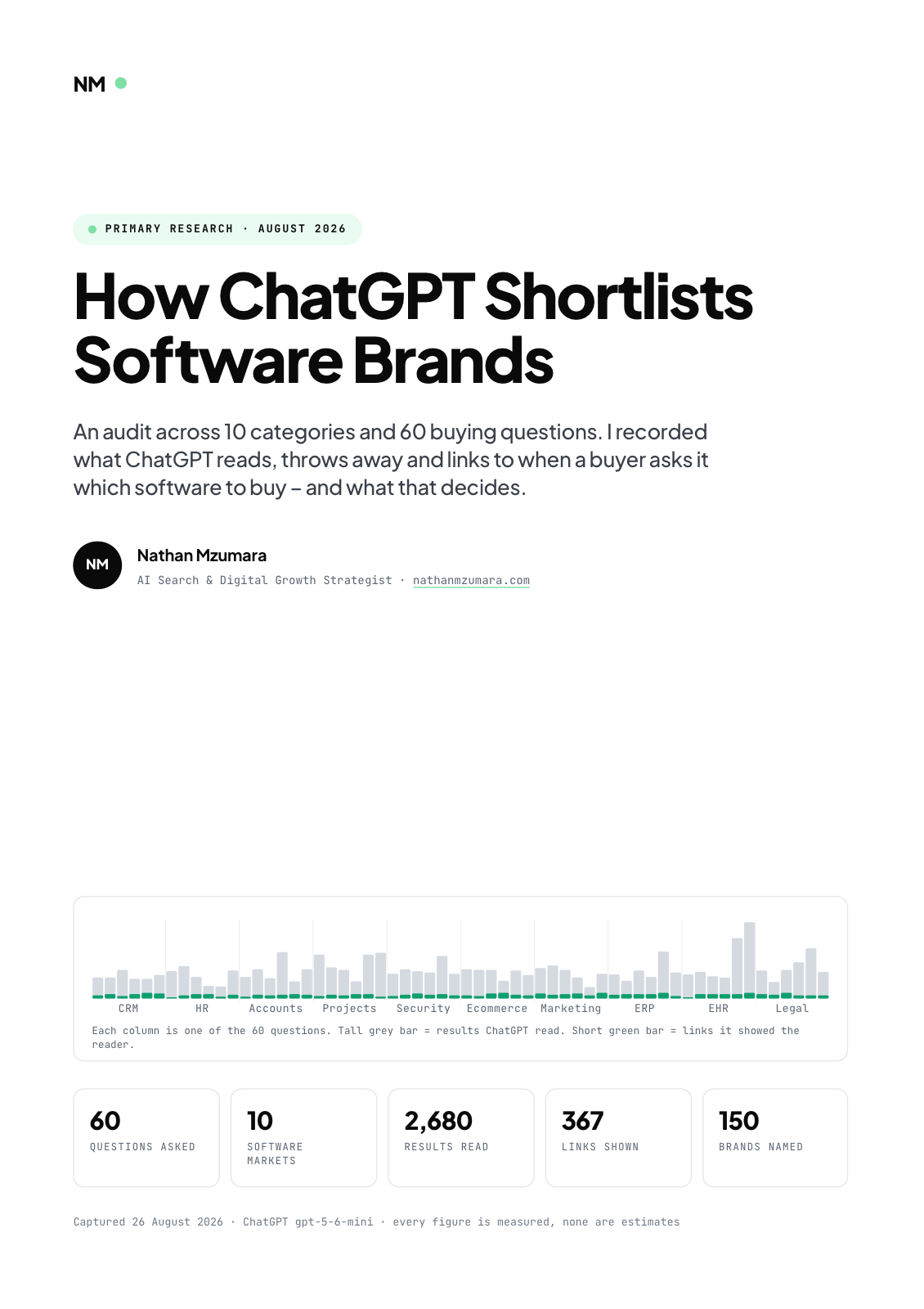
Healthcare EHR and practice management is the hardest category in this study. It drew the heaviest retrieval of any category at a mean of 60.5 results per answer, produced the lowest vendor citation share at 48.7%, and had the most fragmented citation surface with 19 distinct cited domains and a Herfindahl–Hirschman index of 796. In one capture, ChatGPT read 120 results across 46 domains, showed nine links, named fifteen vendors and sourced exactly one of them.
The category at a glance
| Measure | Healthcare EHR | Corpus average |
|---|---|---|
| Mean results read per answer | 60.5 | 44.7 |
| Mean citations per answer | 6.5 | 6.1 |
| Distinct cited domains (6 prompts) | 19 | – |
| Distinct brands surfaced | 19 | – |
| Vendor-owned citation share | 48.7% | 65.9% |
| Citation concentration (HHI) | 796 | – |
| Most-named brand | eClinicalWorks | – |
| Shortlist stability (Jaccard) | 0.247 | 0.338 |
| Distinct leaders across 6 prompts | 3 | 3.8 |
Every structural indicator points the same way. Heaviest retrieval. Lowest vendor share. Most fragmented citations. Third-lowest shortlist stability at 0.247, behind HR and payroll at 0.185 and marketing automation at 0.216.
The heaviest retrieval in the corpus
Prompt (P54, category + vendor landscape): "What is practice management software in healthcare and who are the leading vendors in 2026?"
ChatGPT read 120 results across 46 domains – the single heaviest retrieval in the entire sixty-prompt study – and rendered nine citations from five domains: athenahealth.com four times, softwareadvice.com twice, plus practiceehr.com, nhs.uk and gppracticeresources.co.uk. Answer latency: 18.4 seconds, also the slowest in the corpus.
Fifteen brands were named. Athenahealth was backed by a source. The other fourteen were not: Tebra, AdvancedMD, NextGen, eClinicalWorks, Veradigm, ModMed, DrChrono, SimplePractice, CareCloud, Greenway Health, EMIS, TPP, SystmOne and Vision.
Note what that means arithmetically. 120 results read, 9 shown – a URL survival rate of 7.5%, well below the corpus average of 11.09%. Contested, fragmented categories drive enormous fan-out that the user never sees, and the extra reading barely changes the sourcing ratio. More retrieval does not produce more evidence. It produces more discarded evidence.
Note also the geographic spread in that citation set. nhs.uk and gppracticeresources.co.uk sit alongside US vendors, and the brand list mixes US products (Tebra, AdvancedMD, DrChrono) with UK primary-care systems (EMIS, TPP, SystmOne, Vision). The model assembled a transatlantic shortlist for a single question, which is a real risk in a category where product availability is jurisdiction-bound.
Why healthcare EHR behaves this way
Three factors compound.
Pricing is gated. EHR vendors sell through sales conversations, so the most citable artefact in software – a published price with named tiers – does not exist on most vendor sites. Across this study, categories with public pricing gave vendors 80–91% of citations; gated categories sat at 48–55%. Healthcare EHR is the floor of that band.
The category is genuinely fragmented. Nineteen distinct brands surfaced across six prompts, matched by nineteen distinct cited domains. There is no small vendor set for the model to converge on.
Regulatory and jurisdictional content fills the gap. With vendors supplying under half the evidence, the model reaches for what does exist in public: health-service pages, professional body resources and specialist directories. nhs.uk and gppracticeresources.co.uk both earned citations here.
The result is a citation HHI of 796 – the most unconcentrated category in the study, against 2,213 for accounting. There is no publisher set to manage.
Which EHR brands the model already believes in
| Brand | Answers naming it | Times ranked #1 | Mean rank | Total mentions |
|---|---|---|---|---|
| eClinicalWorks | 5 | 0 | 3.80 | 20 |
eClinicalWorks was the most-named brand in the category, appearing in five of six answers, and led none of them. Athenahealth was the most frequent leader, holding the top slot in 50% of the six prompts, and athenahealth.com earned five citations across two answers. tebra.com earned six citations across three answers – more citations than Athenahealth's own domain, though spread across more answers.

Three distinct vendors led across the six prompts. That is more settled than the raw fragmentation suggests, and it points at a specific opportunity: the model has a weak preference at the top and no conviction below it.
What this means if you sell EHR or practice management software
Half your citation surface is currently unclaimed. At 48.7% vendor share in a category with 19 cited domains and an HHI of 796, there is no dominant third party to displace. That cuts both ways – nobody else owns this either.
The single highest-leverage move is publishing structured, extractable product facts. Not price, necessarily, if that is commercially impossible. But module inclusions, specialty coverage, practice-size fit, interoperability standards supported, certification status, e-prescribing and lab integration coverage, deployment model, and which health systems or jurisdictions the product operates in. Every one of those is a checkable claim a citation can bind to, and almost none of them are commercially sensitive.
Jurisdiction is a live accuracy problem. A single answer in this corpus mixed US ambulatory products with UK primary-care systems. If your product is jurisdiction-bound, say so explicitly and prominently on the pages a retrieval layer will read, because the model will otherwise place you in shortlists you cannot serve.
Expect low stability and measure accordingly. Shortlist overlap in this category is 0.247, meaning roughly three quarters of the brand set changes between two phrasings of the same question. Single-prompt tracking here is close to meaningless. Run all six buying archetypes – unconstrained, segment-constrained, head-to-head, alternatives-to, budget-constrained and category landscape – and report the distribution.
Watch the specialist directories. In a category this fragmented, small specialist sites like practiceehr.com carry real weight. They are the healthcare equivalent of the ERP comparison-site long tail, and they are worth auditing for accuracy about your product.
FAQ
How many sources does ChatGPT read for a healthcare EHR question?
More than any other category tested: a mean of 60.5 search results per answer, against a corpus average of 44.7. The heaviest single retrieval in the study was 120 results across 46 domains for one practice management question, which produced nine citations.
Which EHR vendors does ChatGPT recommend?
It varies by phrasing. eClinicalWorks was the most-named brand, appearing in five of six answers with a mean rank of 3.80 and no top finishes. Athenahealth was the most frequent leader at 50% of prompts. Nineteen distinct brands surfaced across six questions.
Why do healthcare software vendors get cited less by ChatGPT?
Because pricing and product detail are gated. Healthcare EHR had the lowest vendor citation share of any category at 48.7%, against 90.9% for accounting. With vendors supplying under half the evidence, the model reaches for health-service pages, professional resources and specialist directories.
Does ChatGPT mix US and UK healthcare software in one answer?
In this corpus, yes. A single practice management answer named US ambulatory products including Tebra, AdvancedMD and DrChrono alongside UK primary-care systems EMIS, TPP, SystmOne and Vision, and cited both athenahealth.com and nhs.uk.
How stable is the ChatGPT shortlist for healthcare software?
Very unstable. Mean pairwise shortlist overlap across six phrasings was 0.247, the third lowest of ten categories. Roughly three quarters of the brand set changes between two ways of asking the same question, so single-prompt tracking is unreliable here.
Related in this series
- How ChatGPT Shortlists Software Brands, the full report as a PDF
- Forty-Five Reads, Six Links: How ChatGPT Actually Cites Software Brands
- Publish Your Prices: Why Gated Pricing Costs You 30 Points of AI Citation Share
- 69.3% of ChatGPT's Software Recommendations Have No Source Behind Them
- Same Buyer, Same Category, Different Shortlist: Prompt Shape Rewrites the Answer
About the research. Nathan Mzumara is an organic growth and AI search practitioner. Category figures rest on six observations and should be read as directional. Method and limitations are stated in the pillar report.
Tags