Best ChatGPT SEO Rank Tracking Software: Why 69.3% of Its Picks Have No Source
If you are shopping for the best ChatGPT SEO rank tracking software, start with what ChatGPT actually does when it recommends brands. Across 60 software buying answers, ChatGPT made 358 brand recommendations. Only 110 were backed by a citation to that vendor anywhere in the answer. That leaves 248 unsupported recommendations, or 69.3%. Even the single top pick in each answer, the "my pick would be" brand, had no source 28.3% of the time. The brand was asserted from model memory, not evidence.
The test here is deliberately generous. A recommendation counts as supported if any citation in the answer points at the recommended vendor's own domain. It does not have to back the specific claim. It does not have to be a good source. It just has to exist. On that loose test, 248 of 358 recommendations still fail.
This matters for tool choice. Any ChatGPT rank tracking software you buy has to measure two separate things, and most measure only one.
What is ChatGPT SEO rank tracking software?
ChatGPT SEO rank tracking software is a tool that checks how often, and how highly, ChatGPT names your brand when people ask buying questions in your category. Good ChatGPT search rank tracking software records two things: whether ChatGPT cites your site, and where your brand ranks in the answer. The two are not the same, and confusing them is the main error buyers make.
The numbers behind the recommendations
The figures below come from a corpus of 60 ChatGPT software buying answers. They are the baseline any chatgpt seo tracking software should help you improve, and the reason the best chatgpt seo tracking software has to look past a single visibility score.
| Measure | Value |
|---|---|
| Brand recommendations in the corpus | 358 |
| Backed by a citation to that vendor | 110 |
| With no supporting citation | 248 (69.3%) |
| Unique brands recommended | 150 |
| Of top-ranked picks, share with no citation | 28.3% |
The pattern tightens at the top of the list. The headline pick is more likely than average to be sourced. But roughly one in four top picks still rests on model memory alone.
What this looks like in a single answer
Aggregates hide the mechanism. Three captures make the pattern concrete, and each one shows why chatgpt seo analysis software has to read the answer, not just the ranking. The best chatgpt seo analysis software parses the citation text against the recommended brand rather than counting mentions.
"What are the best alternatives to NetSuite?" ChatGPT read 34 results across nine domains. It rendered seven citations from two domains, erpresearch.com five times and cudio.com twice. It then named twelve brands: Oracle, NetSuite, Microsoft Dynamics 365 Business Central, Acumatica, SAP Business One, Odoo, Microsoft Dynamics 365, Sage X3, Epicor, IFS, Oracle Fusion and SAP S/4HANA. Zero of those twelve had a citation to their own site. The whole shortlist rests on one third-party comparison page plus prior belief.
"What is the best HR and payroll software?" ChatGPT read 43 results across seventeen domains. Two citations rendered, both to pricing pages, rippling.com and gusto.com, for the two brands whose prices ChatGPT quoted. ADP, Paychex and Deel were each positioned in the market with no source at all. The answer took 4.0 seconds.
Look at what those citations do in the second example. They are not evidence for the recommendation. They are evidence for the price. The recommendation came first. The citation attached itself to the checkable fragment.
"What is practice management software in healthcare and who are the leading vendors in 2026?" This was the heaviest retrieval in the corpus: 120 results read across 46 domains, producing nine citations from five domains and fifteen named brands. Athenahealth was backed by a source. Tebra, AdvancedMD, NextGen, eClinicalWorks, Veradigm, ModMed, DrChrono, SimplePractice, CareCloud, Greenway Health, EMIS, TPP, SystmOne and Vision were not. Contested, fragmented categories drive huge fan-out the user never sees, and the extra reading barely changes the sourcing ratio.

Why AI visibility splits into two problems
If 69.3% of recommendations arrive with no evidence, much of the outcome is decided before retrieval begins. That has a direct effect on how the best chatgpt seo software should be built and used.
There are two jobs, and they run on different clocks:
- Getting cited: a retrieval and content-structure problem. You solve it with pages the fan-out can find: dated, titled, tabular, product-named, priced. It moves on a quarterly timescale, and you can measure it this week.
- Getting recommended: a training-data and entity-salience problem. It depends on whether the model already links your brand to the category, at what rank, and in what framing. It moves on a much longer horizon, and it shows up in the 28.3% of top picks that need no citation.
These are not the same game. Optimising for the first does not win the second. A vendor can be cited constantly, because it has a great pricing page, and still lose the ranking. A vendor can be recommended first in every answer and never cited once, because nothing about it was checkable.
Which brands the model already believes in
The most-recommended brands table is a rough proxy for entity salience. "Answers naming it" is breadth. "Times ranked #1" and "mean rank" show how strongly the model leads with a brand. This is the view the best chatgpt keyword rank tracker software should give you, not a flat count of mentions.
| Brand | Answers naming it | Times ranked #1 | Mean rank | Total mentions |
|---|---|---|---|---|
| HubSpot | 11 | 6 | 1.91 | 109 |
| Microsoft Dynamics 365 | 9 | 0 | 4.44 | 27 |
| QuickBooks | 6 | 3 | 1.83 | 32 |
| Xero | 6 | 2 | 1.67 | 58 |
| CrowdStrike | 6 | 3 | 1.83 | 51 |
| SentinelOne | 6 | 0 | 3.17 | 38 |
| Shopify | 6 | 3 | 1.50 | 80 |
| BigCommerce | 6 | 1 | 2.33 | 52 |
| Salesforce | 5 | 2 | 1.80 | 57 |
| Asana | 5 | 4 | 1.60 | 44 |
| Clio | 5 | 4 | 1.20 | 65 |
| MyCase | 5 | 1 | 1.80 | 42 |
| ClickUp | 5 | 1 | 2.80 | 28 |
| Monday.com | 5 | 0 | 2.80 | 29 |
| Zoho CRM | 5 | 0 | 3.60 | 29 |
| SAP S/4HANA | 5 | 2 | 4.40 | 15 |
| Pipedrive | 5 | 0 | 4.80 | 26 |
| NetSuite | 5 | 0 | 5.20 | 24 |
| Epicor | 5 | 1 | 5.80 | 26 |
| eClinicalWorks | 5 | 0 | 3.80 | 20 |
Two patterns are worth flagging. Microsoft Dynamics 365 appears in nine answers, second only to HubSpot on breadth, yet led none of them, with a mean rank of 4.44. That is the classic "always on the list, never the pick" spot. Clio is the opposite: five answers, four as the top pick, mean rank 1.20. In legal practice management the model has an opinion, and it is not close.
Neither position is something a content programme changes this quarter.
How to choose the best ChatGPT rank tracking software
Use these four rules to judge any tool and to run your own programme. They double as the checklist for the best seo software for chatgpt.
- Split the number: stop reporting "AI visibility" as one figure. Citation share has one set of levers. Recommendation share and mean rank have a different, slower set. Good chatgpt site rank tracking software keeps them apart. A dashboard that merges them shows you noise.
- Make your answer checkable: citations attach to verifiable fragments. If your pricing is gated, your feature matrix is a PDF, and your integration list is a JavaScript carousel, you have removed the hooks citations bind to. The accounting capture shows this: one vendor with a clean public pricing page took all seven citations in the answer.
- Treat mean rank as the entity metric: times-ranked-first and mean position across many prompt phrasings beat raw mention count as a proxy for model belief. HubSpot's 109 mentions and Xero's 58 tell you far less than HubSpot's 1.91 and Xero's 1.67. Any chatgpt seo checking software worth buying tracks this, and the best chatgpt seo checking software makes mean rank the headline figure.
- Accept the timescale: entity salience responds to sustained category presence, documentation, integrations, editorial coverage, the whole surface that ends up in training data. It does not respond to a content sprint. Budget for a two-year programme, and measure the citation half quarterly while you wait.
A note on the wider category. There is a lot of ai software like chatgpt now, and no single chatgpt free rank tracking software will fix entity salience for you. A free tool can measure where you stand, and that is a fair place to start. Moving the number is slow, structural work.
Related in this series
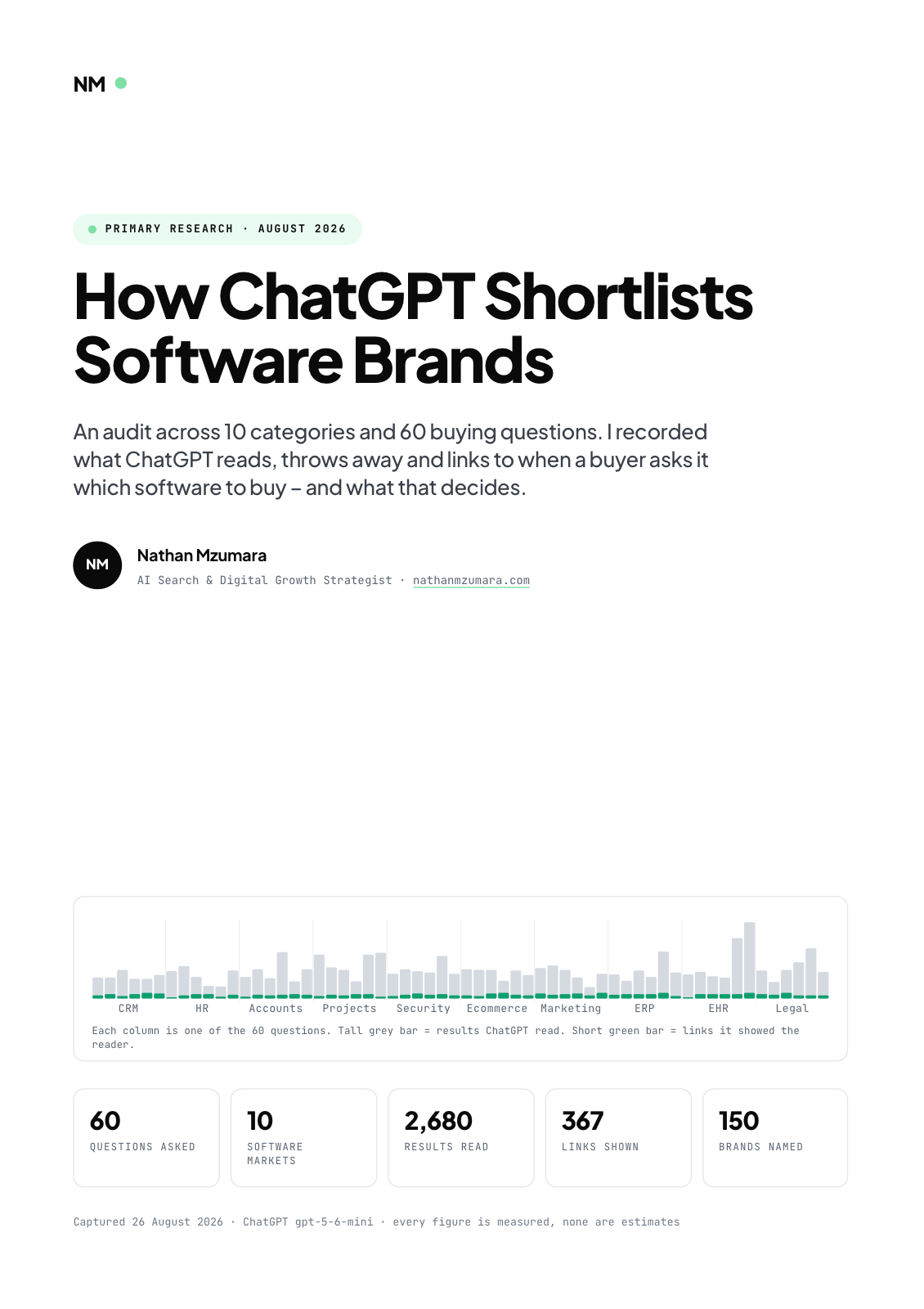
- How ChatGPT Shortlists Software Brands, the full report as a PDF
- Forty-Five Reads, Six Links: How ChatGPT Actually Cites Software Brands
- Same Buyer, Same Category, Different Shortlist: Prompt Shape Rewrites the Answer
- Your AI Visibility Tool Is Blind to 79% of the Web ChatGPT Reads
- ERP in ChatGPT: Twelve Vendors Named, Zero Sources, One Comparison Site Deciding the Shortlist
About the research. Nathan Mzumara is an organic growth and AI search practitioner. Brand detection used a fixed 350-term lexicon scoped to each category, with overlapping matches masked longest-first so that "Microsoft Dynamics 365" is never double-counted as "Dynamics 365". Method and limitations are stated in the pillar report.
The bottom line on the best ChatGPT SEO rank tracking software
The best ChatGPT SEO rank tracking software does one thing that single-number tools cannot: it separates citation from recommendation. With 69.3% of ChatGPT's picks unsourced, tracking only citations misses most of the decision. Track your citation share and your mean rank as two metrics, and you will know which lever to pull and how long it will take.