Algorithm
Entity salience
Also known as: salience score, entity prominence
Entity salience is a measure of how central an entity is to a piece of content, as opposed to merely being mentioned in it. Natural language processing systems assign a salience score based on signals such as position, frequency, grammatical role and surrounding context. It helps a system decide what a document is actually about.
What it is
Salience is usually expressed as a relative score across the entities found in a document, with the main subject scoring highest and passing references scoring low. Google's Cloud Natural Language API is the best known implementation practitioners test with, returning entities with salience values from its analysis. The score is about prominence within that document, not the entity's general importance in the world.
Why it matters
If a search or answer system reads a competitor, a partner or an unrelated topic as the most salient entity on your page, the page is less likely to be retrieved for the topic you care about. Clear salience helps machines connect a page to the right entity in a knowledge graph, which supports both classic ranking and inclusion in AI answers. It also exposes drift, where a page is stuffed with so many topics that none stands out.
How it works
Practitioners run key pages through an entity extraction tool, check whether the intended entity tops the salience list, then edit to strengthen it: name it in the title, opening paragraph and headings, use consistent naming rather than varied synonyms, and cut tangents that pull attention elsewhere. Internal links, structured data and clear on-page definitions reinforce the association. The test is repeated after editing to confirm the intended entity now dominates.
When it applies
It applies when auditing pages that underperform for their target topic, when building topic clusters and entity-led site structures, and when a brand keeps being confused with a similarly named one. It is most useful on pages with a single clear subject, such as product, service, location or glossary pages.
Examples
- A service page targeting 'roof insulation' returns a boiler brand as the most salient entity, because a case study quote dominates the copy.
- A glossary entry is edited to name the term in the title, first sentence and two headings, after which extraction tools rank it first.
- A local clinic page mentioning three nearby towns is split into separate location pages so each town becomes salient on its own page.
How it is measured
- Salience score of the intended entity from an entity extraction API, before and after editing
- Rank of the intended entity within the page's extracted entity list
- Count of off-topic entities scoring above a set salience threshold on key pages
- Change in impressions, clicks and assistant citations for the target topic after salience clean-up
Insights on Entity salience
Related terms in Algorithm
- Core updateA broad Google algorithm update affecting search rankings sitewide rather than a single feature. Recent core updates (e.g. May 2026) have increasingly favoured intent-aligned content over keyword-optimised content.
- EEATGoogle's quality framework: Experience, Expertise, Authoritativeness, Trustworthiness. EEAT signals are increasingly weighted in both classical ranking and AI Overview source selection.
- Google Search algorithmThe Google Search algorithm is the collection of ranking and retrieval systems Google uses to find, order and present results for a query. It is not a single formula but many interacting systems that assess content, links, query intent, context and user signals. Google updates these systems continuously, with larger changes announced as core updates.
- Google Spam UpdateA Google Spam Update is a rollout of changes to the systems Google uses to detect and demote content that breaks its spam policies. These updates target things like scaled content abuse, cloaking, hacked pages, link schemes and site reputation abuse rather than general content quality. Sites hit by a spam update usually need to remove the offending practices before they can recover.
- Helpful Content UpdateGoogle's quality-focused update class targeting low-value, AI-generated, or thin content. Successive HCUs have favoured first-hand experience and named expertise over comprehensive but shallow coverage.
- Ranking signalsRanking signals are the inputs a search system uses to decide which results to show and in what order. They include relevance signals from the page and query, quality and authority signals, and context such as location, device and language. Search engines do not publish the full list or the weightings, so practitioners work from documented signals, patents, testing and observed patterns.
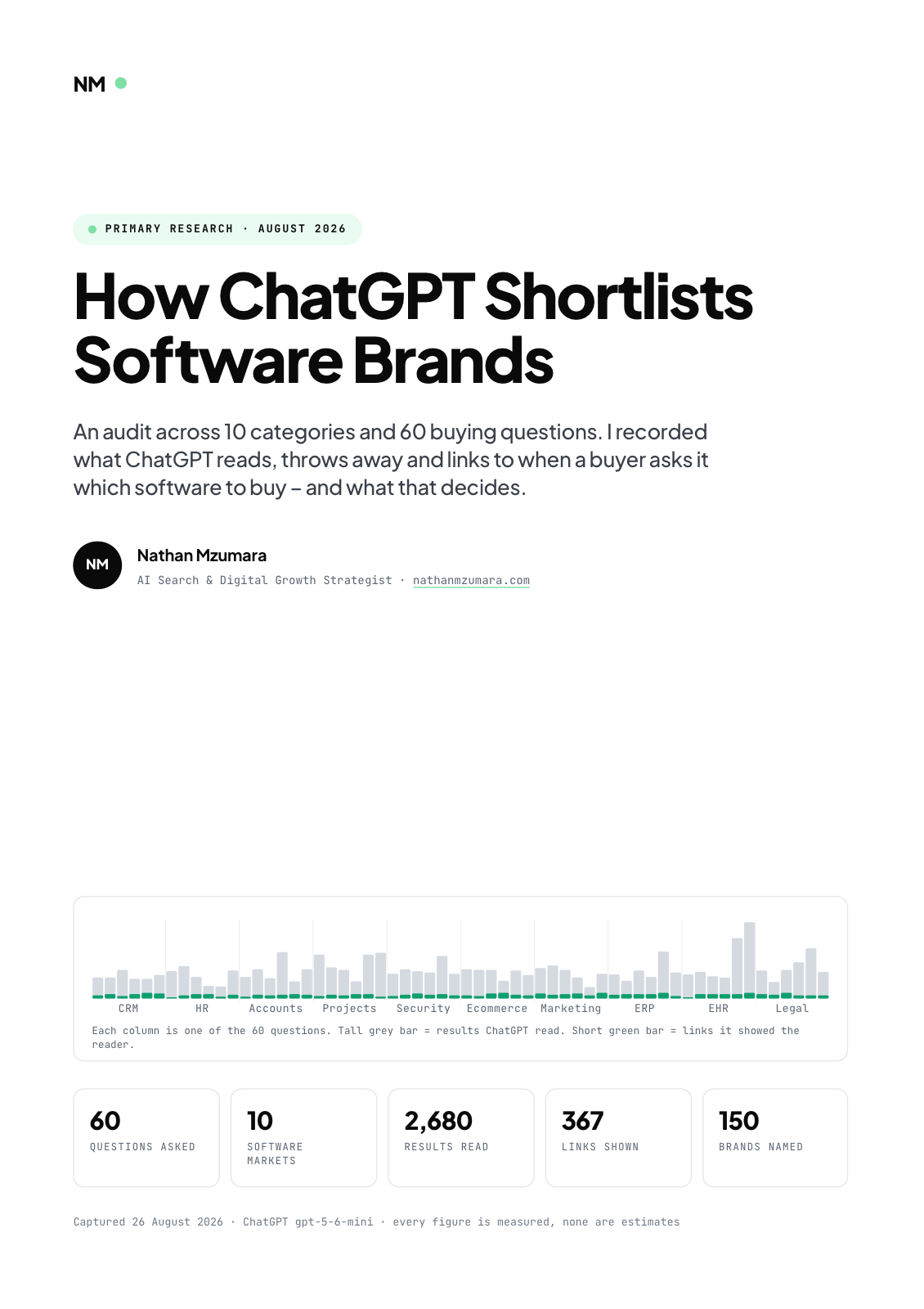
Primary research · August 2026
How ChatGPT Shortlists Software Brands
An audit across 10 categories and 60 buying questions. I recorded what ChatGPT reads, throws away and links to when a buyer asks it which software to buy, and what that decides.
- 60
- Questions asked
- 10
- Software markets
- 2,680
- Results read
- 367
- Links shown
Free download
Get the full report
35 pages · PDF · 536 KB. Enter your details and it downloads straight away.