Algorithm
Google Spam Update
Also known as: spam update, spam policy update
A Google Spam Update is a rollout of changes to the systems Google uses to detect and demote content that breaks its spam policies. These updates target things like scaled content abuse, cloaking, hacked pages, link schemes and site reputation abuse rather than general content quality. Sites hit by a spam update usually need to remove the offending practices before they can recover.
What it is
Google publishes spam policies covering practices such as cloaking, doorway pages, scaled content abuse, expired domain abuse and link spam, and it enforces them with automated systems including SpamBrain alongside manual actions. A spam update is a confirmed change to those automated detection systems, announced on Google's ranking updates page and Search Status Dashboard. It is separate from a core update, which adjusts how Google assesses helpfulness and relevance more broadly.
Why it matters
A spam update can remove a site or a set of pages from visible results almost entirely, which is a harsher outcome than the reshuffling typical of a core update. Because spam detection also feeds the pool of pages available to AI summaries and assistants that lean on search indexes, losing organic visibility often removes you from AI answers too. Understanding which type of update hit you determines whether the fix is editorial improvement or removal of a violating tactic.
How it works
Practitioners confirm the dates from Google's official announcements, then compare traffic and ranking losses against those windows to separate spam updates from core updates and seasonality. They audit against the specific spam policies, looking for mass-produced pages, unvetted third-party content on subdomains or subfolders, purchased links, thin AI output published at scale, and legacy tactics inherited from previous owners or agencies. Remediation means removing or noindexing the offending content, disavowing or removing paid links where relevant, and waiting for the next refresh of the systems, since recovery is rarely instant.
When it applies
It applies whenever you see a sharp, policy-shaped drop in Google organic visibility that coincides with a confirmed spam update, and as a preventative check before you scale content, syndicate third-party pages or buy an existing domain.
Examples
- A publisher rents out a subfolder to a coupon affiliate, and those pages disappear from Google after a spam update targeting site reputation abuse.
- A SaaS company publishes several thousand near-identical location pages generated from a template, then loses rankings across the whole set while its editorial blog is unaffected.
- An agency buys an expired charity domain to redirect its authority into a betting site, and the new site's rankings collapse in the next spam update.
How it is measured
- Google organic clicks and impressions in Search Console, segmented by page group, against the confirmed update dates
- Number of indexed URLs before and after the update, to spot whole sections being dropped
- Manual Actions and Security Issues reports in Search Console
- Share of ranking keywords retained in the top 20 for affected page templates compared with unaffected ones
Related terms in Algorithm
- Core updateA broad Google algorithm update affecting search rankings sitewide rather than a single feature. Recent core updates (e.g. May 2026) have increasingly favoured intent-aligned content over keyword-optimised content.
- EEATGoogle's quality framework: Experience, Expertise, Authoritativeness, Trustworthiness. EEAT signals are increasingly weighted in both classical ranking and AI Overview source selection.
- Entity salienceEntity salience is a measure of how central an entity is to a piece of content, as opposed to merely being mentioned in it. Natural language processing systems assign a salience score based on signals such as position, frequency, grammatical role and surrounding context. It helps a system decide what a document is actually about.
- Google Search algorithmThe Google Search algorithm is the collection of ranking and retrieval systems Google uses to find, order and present results for a query. It is not a single formula but many interacting systems that assess content, links, query intent, context and user signals. Google updates these systems continuously, with larger changes announced as core updates.
- Helpful Content UpdateGoogle's quality-focused update class targeting low-value, AI-generated, or thin content. Successive HCUs have favoured first-hand experience and named expertise over comprehensive but shallow coverage.
- Ranking signalsRanking signals are the inputs a search system uses to decide which results to show and in what order. They include relevance signals from the page and query, quality and authority signals, and context such as location, device and language. Search engines do not publish the full list or the weightings, so practitioners work from documented signals, patents, testing and observed patterns.
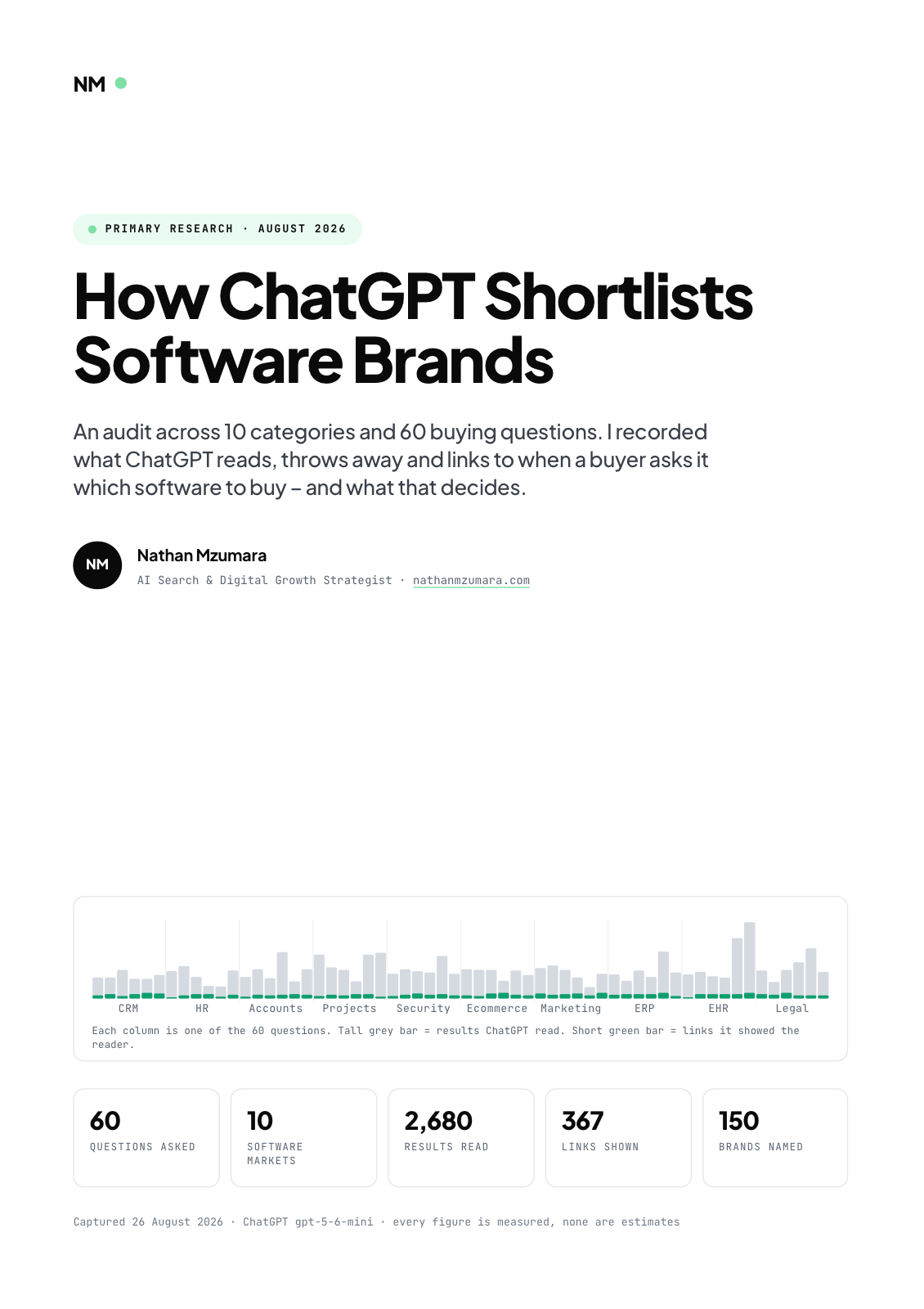
Primary research · August 2026
How ChatGPT Shortlists Software Brands
An audit across 10 categories and 60 buying questions. I recorded what ChatGPT reads, throws away and links to when a buyer asks it which software to buy, and what that decides.
- 60
- Questions asked
- 10
- Software markets
- 2,680
- Results read
- 367
- Links shown
Free download
Get the full report
35 pages · PDF · 536 KB. Enter your details and it downloads straight away.