Google Search Status Dashboard Logs September 2026 Spam Update
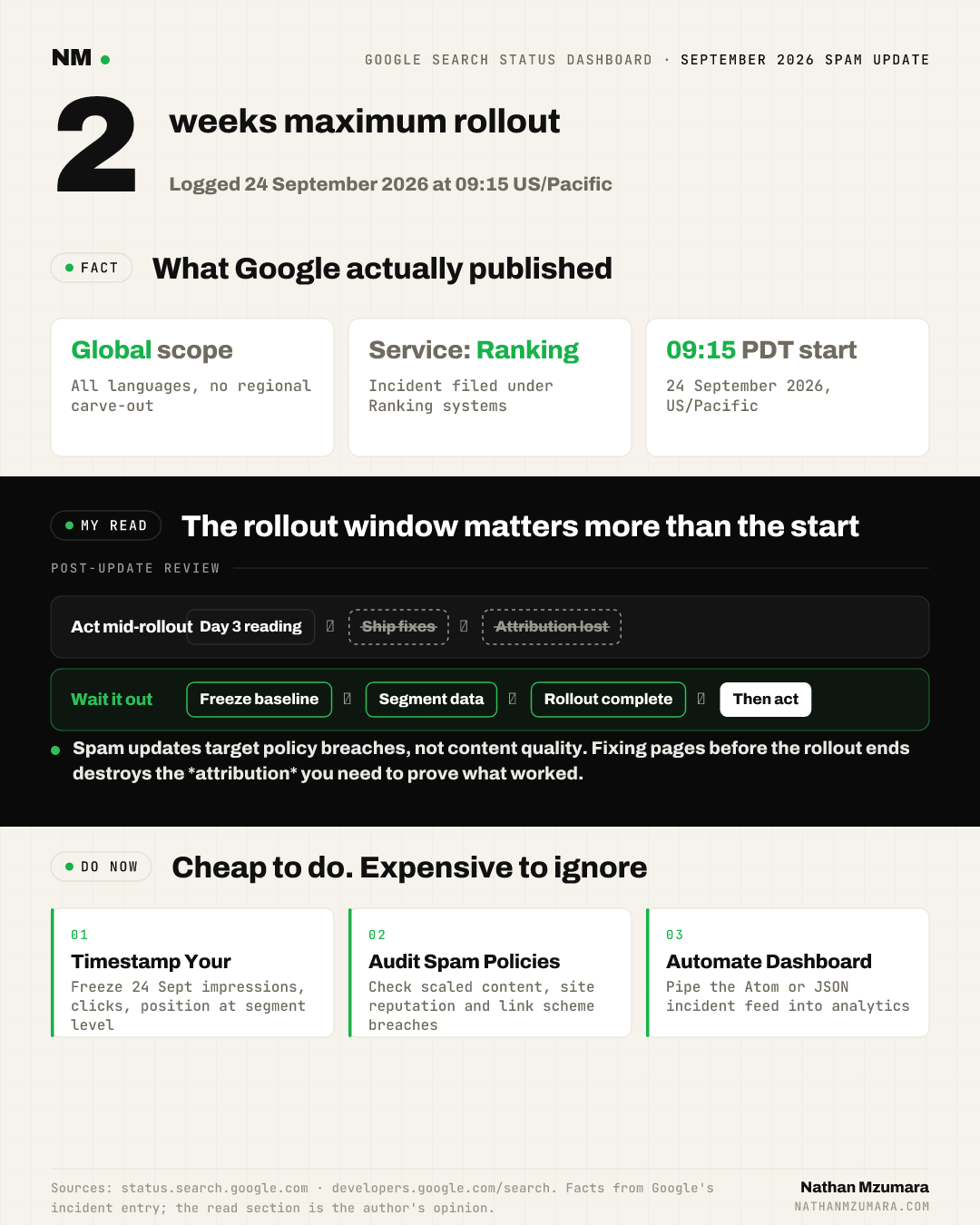
The Google Search Status Dashboard logged the September 2026 spam update at 09:15 US/Pacific on 24 September 2026. Google states that the update applies globally and to all languages, and that the rollout may take up to two weeks to complete. The incident is filed under Ranking. That is the whole of the public record so far.
What Google actually published, and when
Google posted a single line on the dashboard. The September 2026 spam update incident page records the start time, the scope and the expected rollout length, and links to Google's spam updates documentation. There is no list of affected sites, no named target and no regional carve-out.
| Detail | What the dashboard says |
|---|---|
| Name | September 2026 spam update |
| Incident began | 24 September 2026, 09:15 PDT (US/Pacific) |
| Service affected | Ranking |
| Scope | Global, all languages |
| Rollout | May take up to two weeks to complete |
The table above is the full set of confirmed facts. Anything beyond it is inference, including anything you read elsewhere this week.
Why the two week rollout window matters more than the start date
A rollout of up to two weeks from 24 September 2026 means completion at some point on or before roughly 8 October 2026. Until then, ranking movement can be partial, uneven and reversible in appearance.
That window is the reason most post-update analysis goes wrong. Teams take a reading on day three, brief the board on day four, and act on a picture that was never finished. Google's own wording, "may take up to two weeks to complete", is an instruction to wait.
From my own experience running post-update reviews, the most expensive decisions are the ones made mid-rollout. Pages get rewritten, redirects get fired, and the team then cannot tell whether the recovery came from the fix or from the update finishing.
What is a Google spam update, in plain terms?
A Google spam update is a change to the systems that detect and demote content and behaviour which break Google's spam policies. It is not a core update. Core updates reassess how useful content is across the board, while spam updates target policy breaches.
The distinction changes the diagnosis. If a site loses visibility during the September 2026 spam update, the first question is not "is this content good enough", it is "does anything here breach a published spam policy". Google's spam updates documentation is the reference point, and it is linked directly from the incident entry.
What should in-house teams do while the update rolls out?
Timestamp your baseline. Freeze a snapshot of impressions, clicks and average position for 24 September 2026 at segment level, not site level. Without a dated baseline, every later claim about impact is an argument rather than a measurement.
Segment before you conclude. Split by template, by market and by language. The update is global and applies to all languages, so a single global trend line will hide the markets that actually moved.
Audit against the spam policies, not against instinct. Scaled content abuse, site reputation abuse, expired domain abuse and link schemes are policy categories. Check your own estate against them honestly, including anything a third party publishes on your domain.
Hold changes until the rollout ends. Log what you would change, then wait for the dashboard to mark the incident complete. Shipping fixes into an unfinished rollout destroys the attribution you will need later.
Watch the wider discovery surfaces too. Ranking shifts can travel into what AI systems retrieve and cite, which is a separate measurement job. Our analysis of brand visibility in AI search sets out why retrieval, not rank alone, decides whether you get quoted.
The reporting trap: attribution during a live rollout
Search Console data lags by a couple of days, and the September 2026 spam update began mid week. That combination produces a first reading that is both incomplete and skewed by the weekend pattern.
Compare like for like: same weekdays, same markets, same page types. If your reporting has changed shape recently, for example through new dimensions in Search Console, factor that in before you blame the update. We covered one such change in our piece on web multimodal reporting in Search Console.
How to monitor the Google Search Status Dashboard properly
Most teams check the dashboard manually, late, after someone spots a traffic drop. Google publishes machine readable feeds that remove that delay. The dashboard offers an Atom RSS feed and a JSON incident history, each with a published schema.
Pipe the JSON feed into your alerting stack and annotate your analytics automatically with every incident start and end. Google also documents what does and does not get posted in its status dashboard documentation.
My read is that the September 2026 spam update will be judged on how calmly teams handle the two week window rather than on the update itself. Set the alerting up now, keep the Google Search Status Dashboard wired into your reporting, and make your first real call once Google marks the rollout complete.
Tags