Search Tactic
Technical SEO
Also known as: technical search engine optimisation
Technical SEO is the practice of making a website easy for search engines and other automated agents to crawl, render, index and understand. It covers site architecture, URL and status code handling, page speed, mobile rendering, structured data and controls such as robots.txt, canonicals and sitemaps. It sets the conditions that allow content and links to earn visibility.
What it is
Technical SEO deals with the infrastructure layer of organic search rather than the words on the page or external links. Typical scope includes crawl budget and crawl paths, indexation rules, JavaScript rendering, internal linking, redirect chains, hreflang for international sites, Core Web Vitals and machine readable markup. On large sites it extends to log analysis, CDN and edge behaviour, and template level fixes.
Why it matters
Content that cannot be crawled, rendered or indexed cannot rank, and technical faults scale fast because they usually sit in templates rather than single pages. As AI answer engines and retrieval systems fetch pages programmatically, clean HTML, stable URLs and fast responses also affect whether your content can be used as a source. Technical work often unlocks existing content rather than requiring new production, which makes it efficient.
How it works
Practitioners audit with crawlers such as Screaming Frog or Sitebulb, verify against Search Console coverage and crawl stats, and confirm behaviour with server logs and rendered HTML checks. Findings are prioritised by the volume of pages and revenue affected, then delivered as engineering tickets with clear acceptance criteria. Ongoing monitoring catches regressions from releases, migrations and CMS changes.
When it applies
It applies throughout a site's life, with concentrated effort before and after migrations, replatforming, internationalisation and major template changes. It is usually the first area to investigate when traffic drops without a content or link explanation.
Examples
- An ecommerce site blocks faceted filter URLs from crawling and cuts wasted crawl on near duplicate pages.
- A publisher discovers key article content only loads after a client side fetch, and moves it to server rendered HTML.
- A site migration plan maps every old URL to a 301 target and is tested in staging before launch.
How it is measured
- Indexed pages as a share of valid, canonical URLs submitted in sitemaps
- Crawl stats: requests per day, average response time and share of non 200 responses
- Core Web Vitals pass rate by template in the Search Console page experience data
- Count of errors by type in coverage and Enhancements reports over time
Related terms in Search Tactic
- Answer Engine OptimisationThe practice of structuring content so it can be lifted directly into AI answers. Close cousin of GEO; emphasises clean, parseable facts and unambiguous attribution.
- Citation-worthy contentContent with the qualities LLMs select for when synthesising an answer: a single, defensible claim per paragraph; named entities; first-hand evidence; and a clear authority signal.
- Content auditA content audit is a structured review of every page or asset in a content set, scored against performance, quality, accuracy and search intent. The output is a decision for each item: keep, improve, consolidate, redirect or remove. It turns a large and uneven content library into a prioritised action plan.
- Crawler policyA crawler policy is the set of rules a site publishes and enforces to decide which automated agents may access its content, how often, and for what purpose. It typically combines robots.txt directives, server side rules and terms of use, and increasingly distinguishes search crawlers from AI training and assistant crawlers. The policy defines both what is allowed and what happens when a bot ignores it.
- Digital discoveryThe full set of channels through which people find brands, products, and answers, search engines, AI assistants, social platforms, marketplaces, and agentic browsers. Replaces the narrower frame of just “SEO”.
- Ecommerce SEOEcommerce SEO is the practice of making an online store's category, product, brand and editorial pages discoverable in organic search. It combines technical work on crawling, indexing and site structure with commercial decisions about which queries each page should serve. The goal is qualified non-paid traffic that converts into orders.
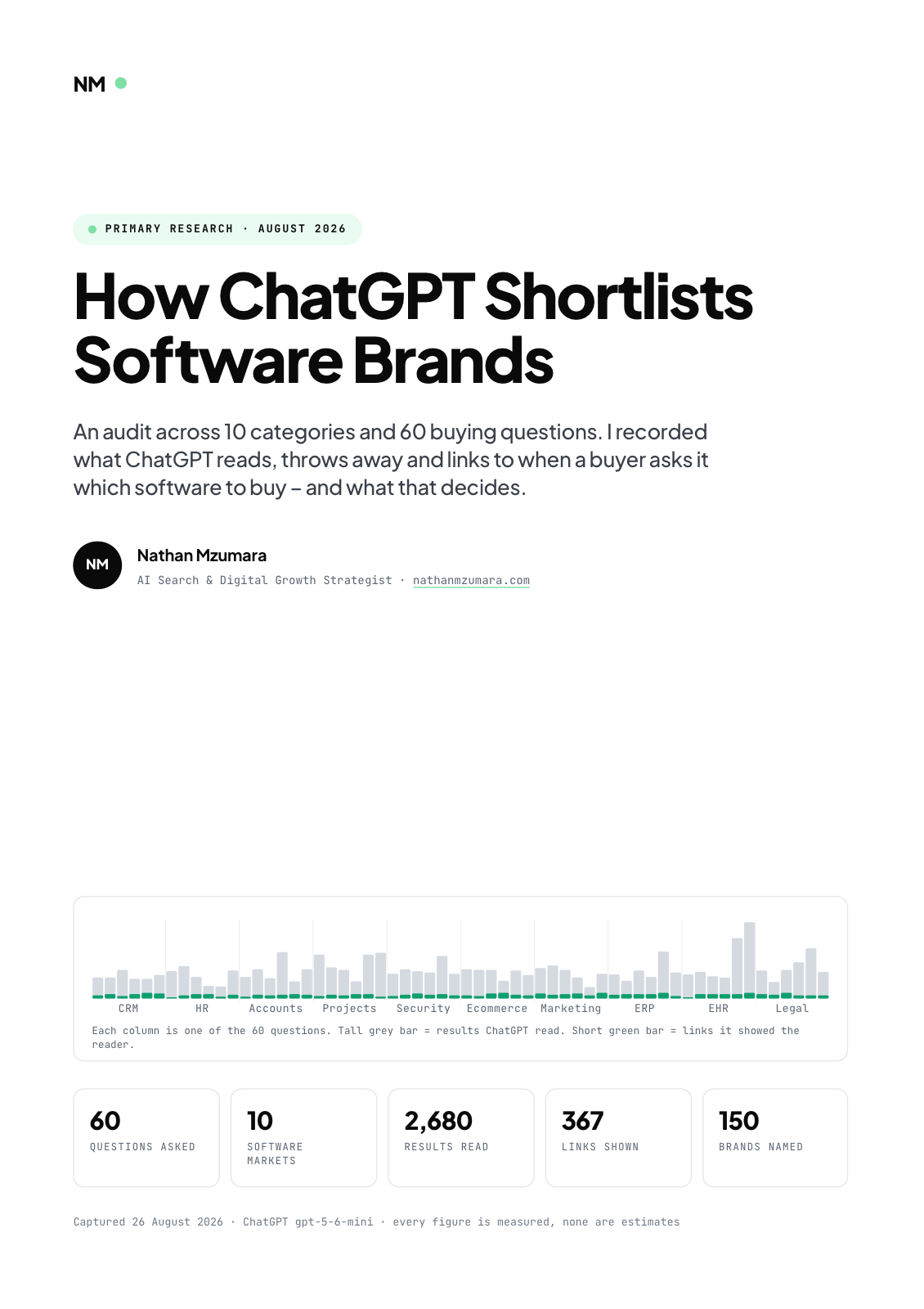
Primary research · August 2026
How ChatGPT Shortlists Software Brands
An audit across 10 categories and 60 buying questions. I recorded what ChatGPT reads, throws away and links to when a buyer asks it which software to buy, and what that decides.
- 60
- Questions asked
- 10
- Software markets
- 2,680
- Results read
- 367
- Links shown
Free download
Get the full report
35 pages · PDF · 536 KB. Enter your details and it downloads straight away.