Algorithm
Ranking signals
Also known as: ranking factors, search ranking signals
Ranking signals are the inputs a search system uses to decide which results to show and in what order. They include relevance signals from the page and query, quality and authority signals, and context such as location, device and language. Search engines do not publish the full list or the weightings, so practitioners work from documented signals, patents, testing and observed patterns.
What it is
Ranking signals, also called ranking factors, are the measurable features a search engine or AI retrieval system evaluates when scoring candidate documents against a query. They span content relevance, such as topical match and semantic similarity, page and site level quality signals, link and mention data, usability signals, and personalisation or contextual signals. In practice, signals interact rather than act as a simple checklist.
Why it matters
Understanding signals helps teams focus effort on things that plausibly move visibility rather than on folklore. It also makes prioritisation possible, because signals differ in strength, in how easily they can be improved and in how quickly they take effect. In AI search, similar signals influence whether a page is retrieved into a context window and cited as a source.
How it works
Practitioners treat confirmed signals such as crawlability, indexing, relevance, links and page experience as the working foundation, then test changes on a subset of pages and measure the outcome. They avoid chasing precise weightings, which are not public and vary by query type, and instead compare their pages against the ones currently succeeding for the query. Documentation from search engines and controlled experiments carry more weight than correlation studies.
When it applies
Signals matter whenever you plan on-page work, internal linking, technical fixes or link acquisition, and when diagnosing why a page underperforms competitors for a specific query set.
Examples
- A page is relevant but uncrawlable because of a robots.txt rule, so no other signal can help it until the block is removed.
- Two comparable guides target the same query, and the one with more editorial links and clearer topical coverage ranks higher.
- A local query returns different results in Manchester and Bristol because location is used as a contextual signal.
How it is measured
- Average position and impressions for a defined query set before and after signal-focused changes
- Internal links and referring domains pointing to priority pages
- Core Web Vitals and mobile usability status across key templates
- Index coverage and crawl frequency for the pages you want ranked
Related terms in Algorithm
- Core updateA broad Google algorithm update affecting search rankings sitewide rather than a single feature. Recent core updates (e.g. May 2026) have increasingly favoured intent-aligned content over keyword-optimised content.
- EEATGoogle's quality framework: Experience, Expertise, Authoritativeness, Trustworthiness. EEAT signals are increasingly weighted in both classical ranking and AI Overview source selection.
- Entity salienceEntity salience is a measure of how central an entity is to a piece of content, as opposed to merely being mentioned in it. Natural language processing systems assign a salience score based on signals such as position, frequency, grammatical role and surrounding context. It helps a system decide what a document is actually about.
- Google Search algorithmThe Google Search algorithm is the collection of ranking and retrieval systems Google uses to find, order and present results for a query. It is not a single formula but many interacting systems that assess content, links, query intent, context and user signals. Google updates these systems continuously, with larger changes announced as core updates.
- Google Spam UpdateA Google Spam Update is a rollout of changes to the systems Google uses to detect and demote content that breaks its spam policies. These updates target things like scaled content abuse, cloaking, hacked pages, link schemes and site reputation abuse rather than general content quality. Sites hit by a spam update usually need to remove the offending practices before they can recover.
- Helpful Content UpdateGoogle's quality-focused update class targeting low-value, AI-generated, or thin content. Successive HCUs have favoured first-hand experience and named expertise over comprehensive but shallow coverage.
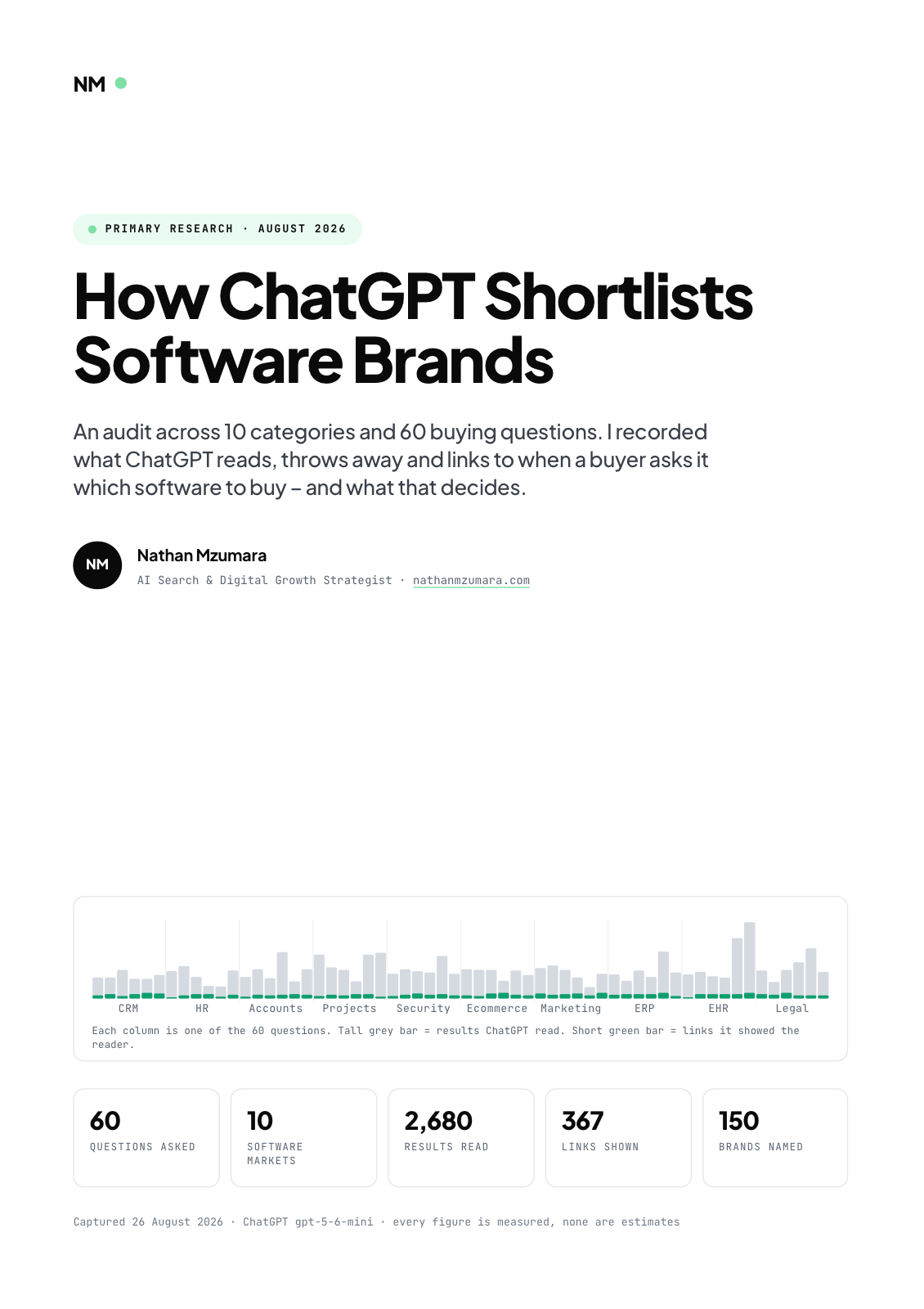
Primary research · August 2026
How ChatGPT Shortlists Software Brands
An audit across 10 categories and 60 buying questions. I recorded what ChatGPT reads, throws away and links to when a buyer asks it which software to buy, and what that decides.
- 60
- Questions asked
- 10
- Software markets
- 2,680
- Results read
- 367
- Links shown
Free download
Get the full report
35 pages · PDF · 536 KB. Enter your details and it downloads straight away.