Meta's Your Algorithm Hands Facebook Ranking to Users

Meta announced Your algorithm on 13 October 2026, a set of AI-powered tools that let people tell Facebook, in their own words, what they want to see in Feed and Reels. Recommendations update in real time. Meta says Your algorithm is rolling out, but the announcement gives no further rollout dates.
Your algorithm is a dedicated space inside the Facebook app where you can directly add and manage the topics you want to see in Feed and Reels. You find it in the three-dot menu. Meta has updated that three-dot menu on every post to make the new customisation tools easier to access.
What Meta changed in Facebook Feed and Reels
Meta described four changes in its 13 October 2026 Newsroom post. Each one moves a small amount of ranking control from the system to the person using it.
- A dedicated topics space: Your algorithm is where you add and manage the topics you want to see in Feed and Reels. Meta calls it a dedicated space to tell it exactly what you are into.
- An updated three-dot menu: the three-dot menu on every post has been updated so these customisation tools are easier to reach.
- Richer post-level feedback: after you click 'Interested' or 'Not interested' on a post in Feed or Reels, Facebook may ask follow-up questions for more detail on what you liked or disliked.
- Free-form input: you can tell Facebook, in your own words, what you want to see more or less of, and your recommendations update in real time.
Meta says recommendations adapt within the same session to reflect what matters to you right now. That is the detail most people will skim past, and it is the one with the biggest consequence for planning.
How does Your algorithm actually work?
Meta explains the mechanism in two parts: the signals it already had, and the new input layer sitting on top of them.
Existing engagement signals
Meta's ranking systems documentation describes inference from behaviour: the posts you like and comment on, what you watch, and, in Meta's words, thousands of other signals. None of that goes away.
Large language models
Meta says large language models can incorporate the interests, context and intent behind natural language, which unlocks "an algorithm you can actually talk to". A large language model is an AI system trained to interpret and produce ordinary written language.
The combination
Meta describes the change as bringing free-form text together with everything it already understands about what you enjoy. So stated preference is combined with inferred preference, not substituted for it. That distinction matters when you forecast reach.
From inferred signals to stated preference: why this is a real shift
Facebook distribution has worked on inference for most of its history. You watched three cycling videos, so the system decided you liked cycling. The user never had to name the interest, and often could not have.
Your algorithm adds a second route in. A person can now type the interest out, and the ranking response arrives in the same session rather than after days of behavioural drift.
| Input type | How it is captured | Speed of effect |
|---|---|---|
| Inferred engagement signals | Likes, comments, watch time, among thousands of other signals | Builds over repeated sessions |
| Stated preference via Your algorithm | Topics added and managed in a dedicated space, plus free-form text | Real time, within the same session |
| Post-level feedback | 'Interested' or 'Not interested', plus follow-up questions | Real time, within the same session |
Table: the three inputs Meta describes in its 13 October 2026 announcement of Your algorithm.
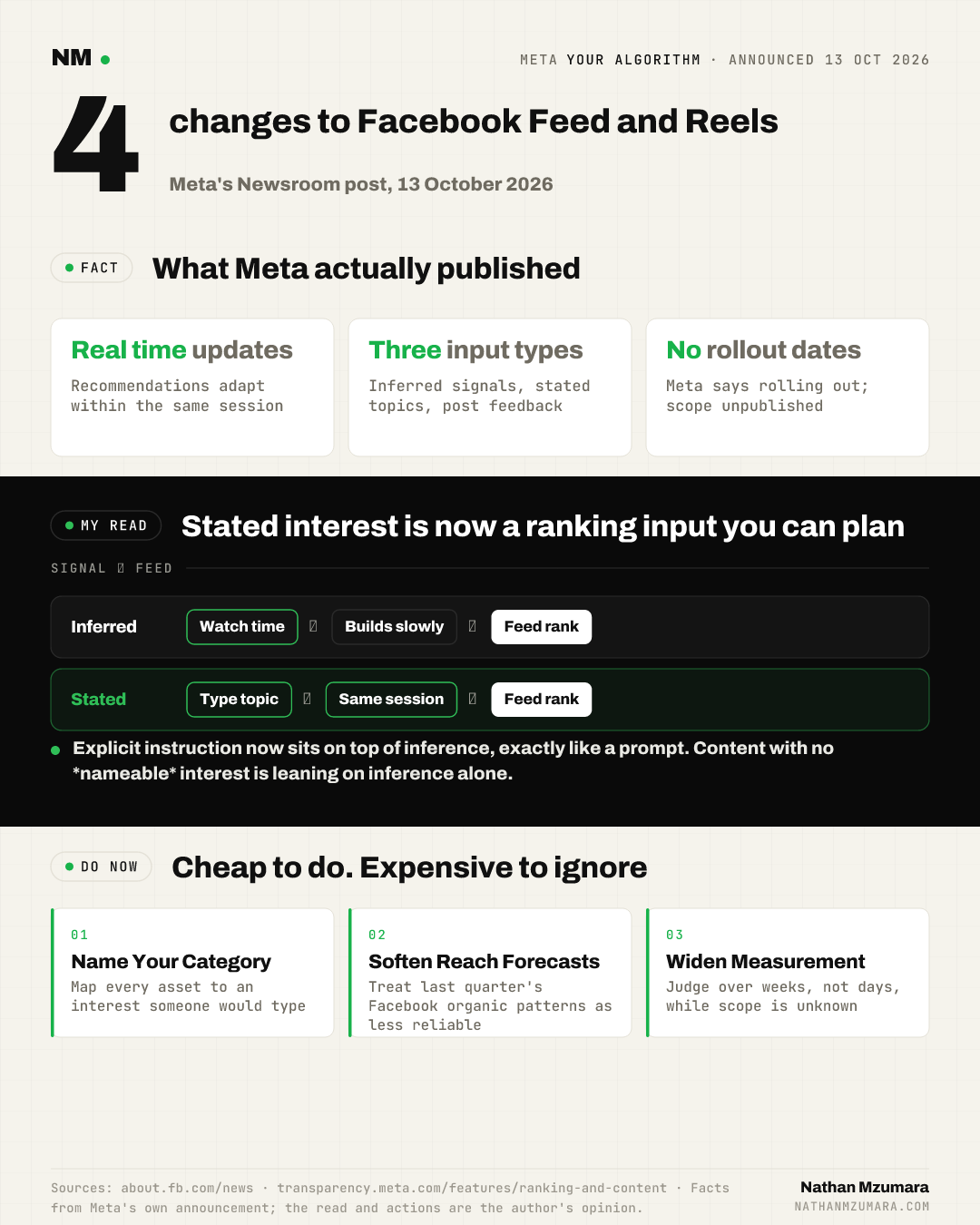
This is the same pattern spreading across AI surfaces generally. An explicit instruction from the user overrides what the system had inferred. That is exactly how a prompt works in an answer engine, and it is now how a Facebook feed works too. For a related read on instruction-driven interfaces, see our analysis of GPT-6 and intelligent UI in ChatGPT.
What Your algorithm means for marketers, in plain English
Facebook distribution has been an auction on behaviour. Your algorithm adds an auction on stated interest. The practical test for your content becomes simple: would a real person type this interest into a box?
- Nameable categories win: content that maps cleanly to an interest somebody would actually write out, such as home renovation, marathon training or small business finance, is easier for the system to match to a stated topic.
- Incidental reach is exposed: brands relying on engagement bait, borrowed trends and scroll-stopping tricks collect behavioural signal without ever occupying a namable interest. A 'Not interested' click plus a follow-up answer now removes that reach quickly.
- Brand-safety adjacency assumptions move: if users are actively curating topics in Feed and Reels, the content sitting next to your post is shaped partly by their stated instructions, not only by Meta's inference.
- Creative needs a category, not just a hook: every asset should answer which stated interest it belongs to. If the answer is none, it is relying on inference alone.
The decision this forces is a budget one. My read is that organic reach forecasts for Facebook built on last quarter's behavioural patterns should be treated as softer than usual while Your algorithm rolls out, because the rollout scope is not published and the in-session effect is immediate rather than gradual.
The risks, and what the announcement does not tell you
Meta's post does not state which markets, users or devices get the tools. Scope is unclear, so any modelling of the impact is modelling on an unknown denominator.
Volatility is the second risk. If recommendations adapt within the same session, a single week of measurement may not describe a stable state. Hold judgement across a longer window before you re-cut budget.
Does Your algorithm apply to Instagram?
People already search for phrases like your algorithm instagram and how to see your algorithm on instagram. Meta's 13 October 2026 announcement covers Facebook Feed and Reels only. It does not mention Instagram, so there is nothing in the source to support an Instagram version of these tools.
The counter-view: why this may matter less than it looks
Most people never touch feed settings. If adoption of the dedicated topics space is low, the thousands of inferred engagement signals keep doing almost all of the ranking work, and the practical effect on brand reach is small.
There is a second argument. Meta frames this as combining free-form text with existing understanding, not replacing it. Heavy users of the feedback options may simply be the users who were already easy to model. In that case Your algorithm sharpens personalisation rather than redistributing reach.
Both readings are consistent with the announcement. The honest position is that nobody outside Meta can size this yet, because the rollout scope was not published.
What to do this week about Your algorithm
- Audit your last 30 Facebook and Reels posts and tag each with the single interest a user would type to ask for it. Anything untaggable is reach built on inference alone.
- Re-cut your content calendar around three to five explicitly nameable interest categories rather than formats or campaign themes.
- Set a baseline now for organic reach, reach per follower and Reels completion, dated before the rollout reaches your markets, so you have a comparison point.
- Flag to finance and the board that Facebook organic reach forecasts for next quarter carry more uncertainty than usual, and state why: the rollout scope is unpublished.
- Check paid creative against the same nameable-interest test. The measurement question is the same one we covered in our piece on ChatGPT ads and third-party attribution.
Your algorithm is the clearest consumer-facing example yet of stated instruction sitting on top of inferred intent. Brands that can name the interest they serve will keep their place in Feed and Reels. Those that cannot will find out how much of their reach was borrowed.
Published 13 October 2026. Last updated 13 October 2026. Primary source: Meta Newsroom, Introducing Your algorithm on Facebook.
Tags