Your AI Visibility Tool Is Blind to 79% of the Web ChatGPT Reads

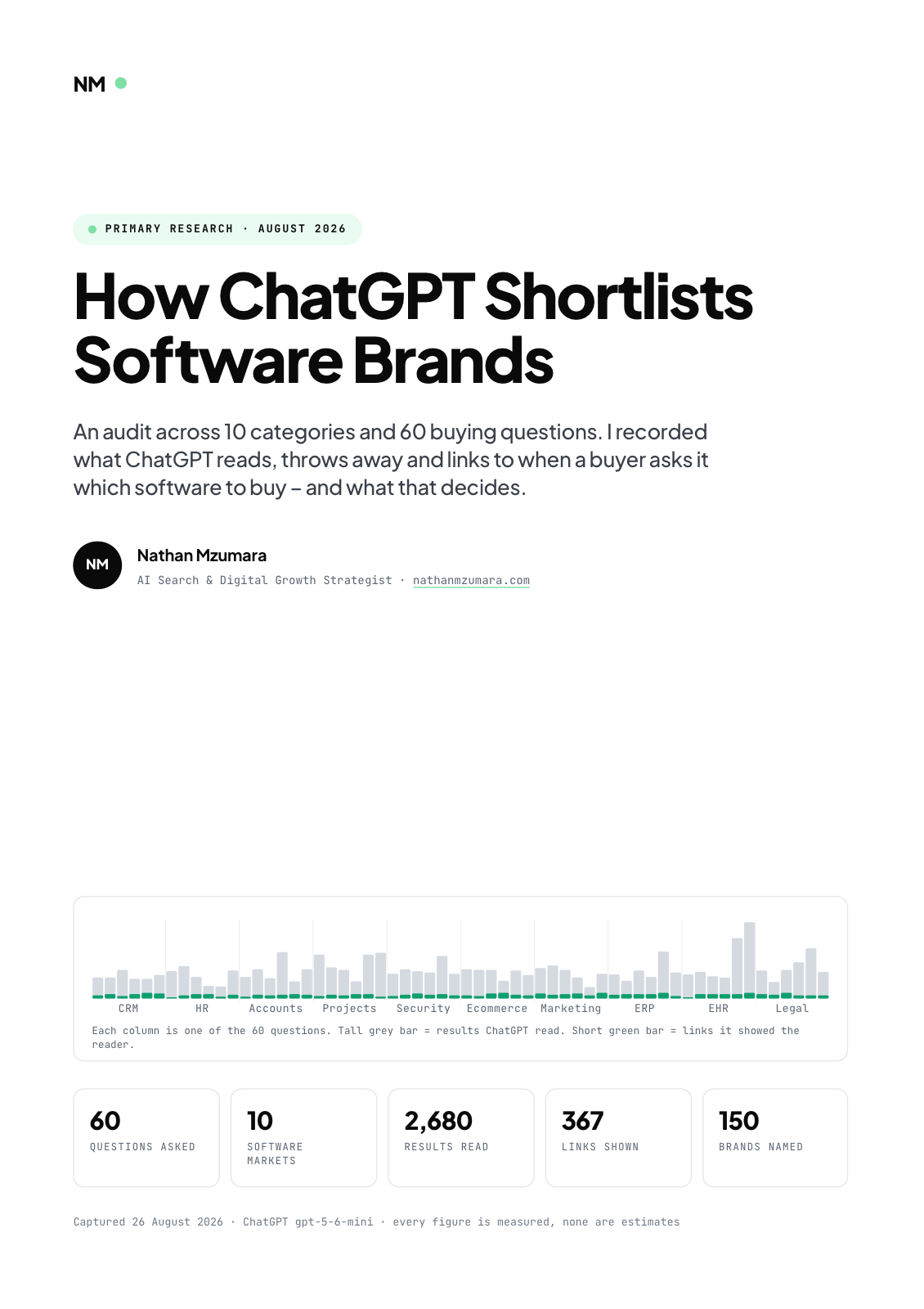
ChatGPT pulled 564 distinct domains into context across 60 software buying answers. It cited 118 of them. Every AI visibility tool on the market measures the 118 and cannot see the other 446. That is 79.1% of the corpus the model actually consulted, invisible – including, in many cases, the pages that shaped the answer's framing without earning a link. If your dashboard says "not cited", you do not know whether you were absent from the room or present and overruled.
This article sets out what the measurement gap is, why it exists, and a framework for closing it.
The gap, in numbers
| Stage | Count | Visible to citation-only tools |
|---|---|---|
| Search results returned | 2,680 | No |
| Unique URLs considered | 2,327 | No |
| Distinct domains retrieved | 564 | No |
| Citations rendered | 367 | Yes |
| Unique URLs cited | 258 | Yes |
| Distinct domains cited | 118 | Yes |
Two survival rates fall out, and they are not the same number.
URL survival is 11.09% – the odds that a specific page, having been retrieved, appears as a link. Domain survival is 20.9% – the odds that a publisher, having been read at all, is named anywhere.
Of 564 domains ChatGPT consulted, 446 were read and discarded. 2,069 of 2,327 unique URLs – 88.91% – never became a citation.
Why the gap exists
ChatGPT streams its answer over a server-sent-event connection. That stream carries far more than the visible text: the resolved model, the tool invocations, the full set of search results returned to the model, and the citation objects attached to the final message.
Almost every AI visibility product on the market works from the rendered page, or from an API response, and therefore sees only the last of those. The retrieval set – what the model read – is available in the stream and discarded before render.
The gap between the retrieval set and the citation set is the single most useful thing in this dataset, and no third-party AI-visibility tool currently exposes it.
What you lose by measuring citations only
You cannot distinguish absence from defeat. A brand that was never retrieved has a discoverability problem: the query fan-out is not surfacing its pages at all. A brand that was retrieved five times and cited zero times has a conversion problem: its pages surface but do not contain the extractable, checkable claims that citations bind to. Those are completely different diagnoses with completely different fixes, and citation-only monitoring reports both as zero.
You mis-rank source types. Review aggregators convert retrievals into citations at 28.8%, the best rate of any source type in the corpus, but were retrieved only 52 times across sixty answers – 1.9% of everything read. From a citation-only view, aggregators look weak. From a retrieval view, they look strong but starved. The fix in one case is content structure; in the other it is discoverability. Same data, opposite conclusions.
| Source type | Retrieval share | Citation share | Conversion |
|---|---|---|---|
| Review aggregator | 1.9% | 4.1% | 28.8% |
| Independent comparison site | 9.3% | 14.4% | 21.3% |
| Editorial media | 3.0% | 4.1% | 18.5% |
| Analyst / market research | 3.2% | 4.4% | 18.4% |
| Vendor-owned | 55.1% | 65.9% | 16.4% |
| Independent testing lab | 0.8% | 0.8% | 13.6% |
| Government / regulator | 0.6% | 0.5% | 11.8% |
| Agency / consultancy / partner | 7.7% | 5.7% | 10.2% |
| Community / UGC | 1.2% | 0.0% | 0.0% |
You miss the long tail entirely. 339 domains in this corpus were retrieved fewer than twice and never cited – 453 retrievals, 16.9% of everything read, contributing zero citations. That tail is where new comparison sites appear before they start winning citations. By the time one shows up in a citation-only dashboard, it has already been shaping your category's shortlist for months.
A measurement framework that survives this data
Four principles, each of which follows directly from a finding in the corpus.
1. Measure retrieval and citation as separate funnels
Report three numbers per brand per category: retrieval rate (share of answers in which any page on your domain was pulled into context), citation rate (share in which you were cited), and conversion (citation rate divided by retrieval rate). Conversion isolates the content-structure problem from the discoverability problem.
2. Measure the prompt space, not the prompt
Six phrasings of the same buying question returned brand sets overlapping by a mean Jaccard of 0.338, and the top-ranked vendor changed 3.8 times out of six across ten categories. A single tracked prompt is close to noise. Run all six archetypes – unconstrained best-of, segment-constrained, head-to-head, alternatives-to, budget-constrained, category landscape – and report the distribution with its variance.
3. Separate "cited" from "recommended"
69.3% of the 358 brand recommendations in this corpus had no citation to that vendor anywhere in the answer, and the top-ranked pick was unsupported 28.3% of the time. Citation share and recommendation share are different metrics with different levers on different timescales. Merging them into one "AI visibility score" destroys the signal.

Report recommendation separately as: presence rate, mean rank, and times ranked first.
4. Track the publisher tail, not a watchlist
118 cited domains, a Herfindahl–Hirschman index of 177, top domain share 4.9%, and 55 domains cited exactly once. There is no publisher watchlist that covers this. Monitoring has to be built around discovering unfamiliar domains that recur, not checking a fixed list of known ones.
The minimum viable instrumentation
You do not need a vendor to do this. The method used for this study is reproducible.
ChatGPT streams to /backend-api/f/conversation. A fetch interceptor installed in the page tees the response body – the browser renders one copy, your harness parses the other. Nothing about the request is altered. For each prompt, record:
- Resolved model slug – the model that actually served the turn, not the one selected in the UI. All sixty runs here resolved to
gpt-5-6-miniunder automatic routing. - The retrieval set – every search result group, keyed by domain, with URL, page title and publication date. This is what the model read.
- The citation set – every source pill rendered into the answer, with its resolved URL. This is what the user sees.
- The answer text, response latency, and the ordered position of every brand mention.
Then normalise domains to the registrable domain so help.asana.com and www.asana.com resolve to one publisher, and classify each domain by source type. In this study all 225 cited-or-repeatedly-retrieved domains were classified by hand, and where a domain's nature was not obvious the site itself was read before classifying it.
Controls that make the numbers mean something
Run every prompt in a fresh conversation so no answer conditions another. Use temporary chat where possible – it is excluded from history and from model personalisation. Record the resolved model on every run, because automatic routing can change what serves the turn.
For brand detection, use a fixed lexicon scoped to each category with overlapping matches masked longest-first, so that "Microsoft Dynamics 365" is never double-counted as "Dynamics 365". That single detail will otherwise inflate your mention counts materially.
And state your limits. Sixty prompts is a probe, not a census. Geography varied by prompt wording rather than by IP means geo-routing effects are not measured. Citation pills grouped behind a "+1" affordance counted by primary URL means the citation count is a floor. A Free-tier account routing to a small model may behave differently from a paid tier routing to a large one.
Measurement that states its own limits is worth more than a confident single number that cannot be interrogated. That is as true in AI visibility as it was in organic search.
FAQ
Why do AI visibility tools only show citations?
Because they work from the rendered answer or an API response, which contains only the citation objects. The full retrieval set - every search result returned to the model - is present in the response stream but discarded before render. Capturing it requires instrumenting the stream itself.
How much does a citation-only view miss?
79.1% of the domains the model consulted. Across 60 answers ChatGPT retrieved 564 distinct domains and cited 118. At URL level, 2,069 of 2,327 unique URLs - 88.91% - never appeared as a citation.
What is the difference between retrieval rate and citation rate?
Retrieval rate is the share of answers where your pages were pulled into the model's context. Citation rate is the share where you were linked. Conversion - citation divided by retrieval - separates a discoverability problem from a content-structure problem, and citation-only tools report both as zero.
How many prompts do I need to measure AI visibility reliably?
More than one per question. With shortlist overlap at a mean Jaccard of 0.338 and the category leader changing 3.8 times across six phrasings, single-prompt tracking is close to noise. Run all six buying archetypes per category and report the distribution with its variance.
Can I measure ChatGPT retrieval myself?
Yes. ChatGPT streams to /backend-api/f/conversation over server-sent events. A fetch interceptor tees the response body so you can parse the retrieval set, citation set, resolved model and answer text while the browser renders normally. Nothing about the request is altered.
Related in this series
- How ChatGPT Shortlists Software Brands, the full report as a PDF
- Forty-Five Reads, Six Links: How ChatGPT Actually Cites Software Brands
- 69.3% of ChatGPT's Software Recommendations Have No Source Behind Them
- Same Buyer, Same Category, Different Shortlist: Prompt Shape Rewrites the Answer
- Vendor Pages Take 65.9% of ChatGPT's Citations. G2 Takes 4.1%.
About the research. Nathan Mzumara is an organic growth and AI search practitioner working on measurement methodology for AI search. All figures here come from a live capture of the ChatGPT response stream on 26 August 2026: 60 prompts, 2,680 retrieved results, 367 citations, 225 hand-classified domains. Method and limitations are stated in the pillar report.
Tags