Forty-Five Reads, Six Links: How ChatGPT Actually Cites Software Brands

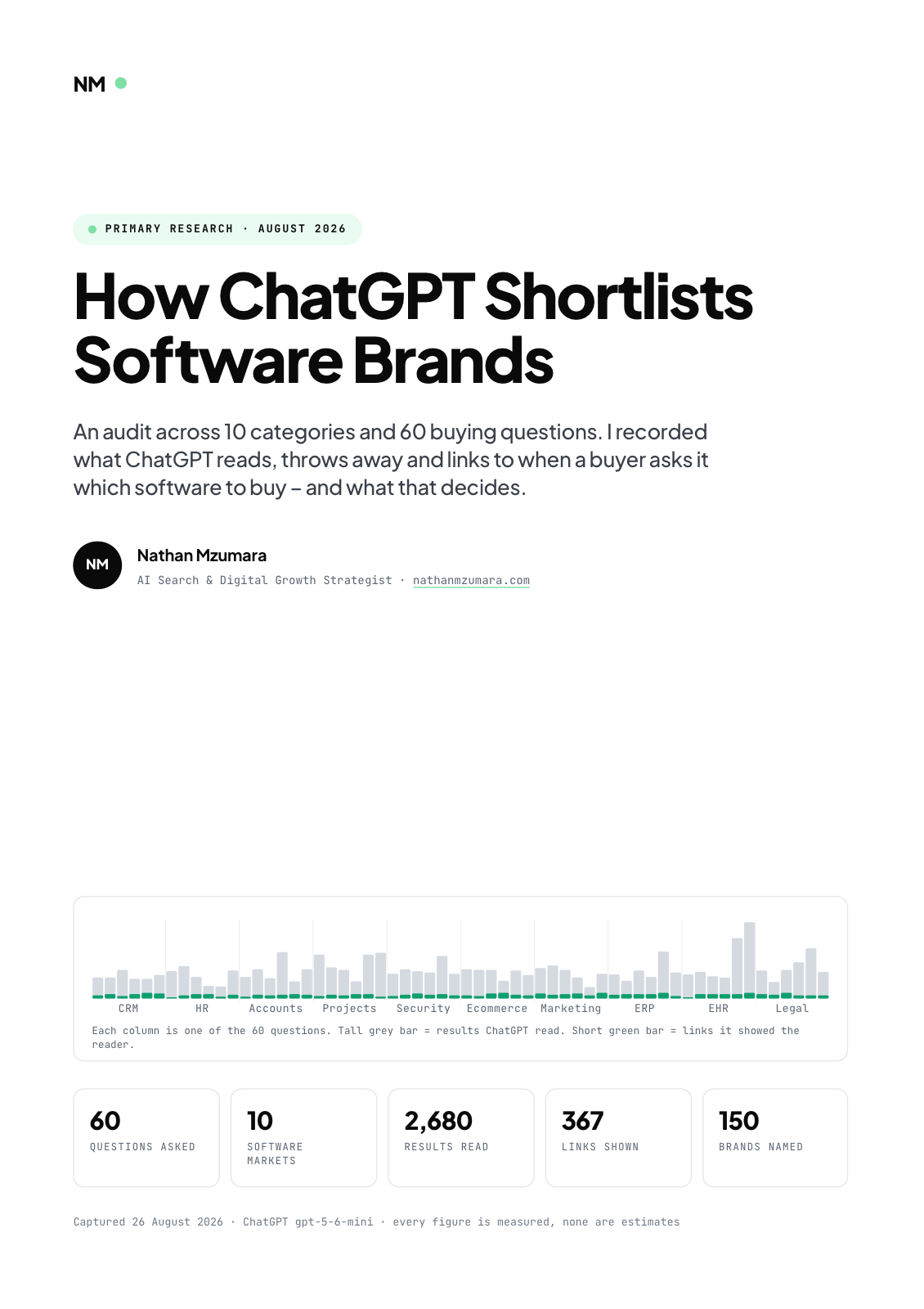
In 60 purchase-intent software prompts, ChatGPT read a mean of 44.7 search results per answer and rendered 6.1 citations. Of 2,327 unique URLs pulled into context, 88.91% were never shown to the user. Only 11.09% of read URLs and 20.9% of read domains survived into the visible answer. The compression between what the model reads and what it links is the single most important fact in AI search visibility, and almost nobody is measuring it.
I put sixty buying questions to ChatGPT and instrumented the response stream at the network layer rather than scraping the rendered page. That distinction matters. The rendered page shows you citations. The stream shows you the full retrieval set – every search result the model pulled into context, grouped by domain, with URL, page title and publication date. The gap between those two things is where the entire discipline of AI visibility currently has a blind spot.
The corpus in one table
| Measure | Value |
|---|---|
| Prompts executed | 60 |
| Software categories | 10 |
| Prompt archetypes per category | 6 |
| Search results returned | 2,680 |
| Unique URLs considered | 2,327 |
| Distinct domains retrieved | 564 |
| Citations rendered to the user | 367 |
| Unique URLs cited | 258 |
| Distinct domains cited | 118 |
| Unique software brands recommended | 150 |
| Brand recommendations made | 358 |
| Model resolved | gpt-5-6-mini (100% of runs) |
| Capture date | 26 August 2026 |
Every figure in this study is computed from that capture. None is estimated.
The five-stage pipeline, and why only one of them is visible
A software recommendation from ChatGPT is not retrieved. It is assembled, in five stages, of which the buyer sees the last one.
1. Route. The request hits a router that selects a model and decides whether the turn needs tools at all. All sixty turns resolved to gpt-5-6-mini, and 100% of purchase-intent software prompts triggered web retrieval. Not one was answered from model memory alone.
2. Fan out. The model calls its web.run tool, issuing multiple queries in parallel. The queries themselves are not streamed to the client, but their results are, arriving as groups keyed by domain. Mean fan-out: 44.7 results across 15.9 distinct domains per answer, ranging from 18 results to 120.
3. Read and discard. Result titles and snippets enter the context window. The overwhelming majority are then dropped. Observed: 2,069 of 2,327 unique URLs, or 88.91%, never became a citation. They still shaped the answer. They just left no trace.
4. Compose. The answer is generated from a blend of retrieved evidence and parametric memory. This is the stage that produces brand rankings, category framings and "best for" judgements – and 69.3% of the 358 brand recommendations in this corpus carried no citation to that vendor anywhere in the answer.
5. Attach citations. Source pills are bound to specific claims, usually pricing, feature and capability statements. Observed: 6.1 pills per answer across 3.6 distinct domains, 65.9% of them pointing at vendor-owned pages. Outbound links are tagged utm_source=chatgpt.com.
Stages one to four are invisible to the buyer. The entire user-facing evidence trail is stage five: roughly six links standing in for forty-five documents.
Two survival rates, and they are not the same number
The headline compression splits into two distinct measures, and conflating them is a common analytical error.
URL survival is 11.09% – the odds that a specific page, having been retrieved, appears as a link in the answer.
Domain survival is 20.9% – the odds that a publisher, having been read at all, is named anywhere in the answer.
The second number is the one that should reframe how AI visibility is measured. Of 564 domains ChatGPT pulled into context across this corpus, 446 were read and discarded. Any tool that measures only citations is blind to 79.1% of the corpus the model actually consulted – including, in many cases, the pages that shaped the answer's framing without earning a link.
If your brand-monitoring dashboard reports "not cited", that is not the same as "not read". It may mean you were in the room and lost the argument. Those are different problems with different fixes, and only one of them is visible today.

Retrieval scales with contested categories. Citation does not.
The distribution of retrieval is lumpy. The heaviest single retrieval in the corpus was 120 results for one question about healthcare practice management software. The lightest was 18. Citations barely move by comparison: every one of the sixty answers landed between 2 and 9 source pills.
| Category | Mean results read | Mean citations |
|---|---|---|
| Healthcare EHR | 60.5 | 6.5 |
| Project management | 55.2 | 5.3 |
| Legal practice management | 48.8 | 6.2 |
| Cybersecurity | 45.8 | 6.0 |
| ERP / manufacturing | 43.2 | 6.7 |
| Accounting | 43.0 | 5.5 |
| Ecommerce platforms | 40.8 | 6.2 |
| Marketing automation | 39.2 | 7.2 |
| HR & payroll | 35.2 | 5.0 |
| CRM | 35.0 | 6.7 |
Retrieval scales with how contested and fragmented a category is. Citation is close to fixed at around six. The practical consequence: in fragmented enterprise categories, the ratio of reads to links is brutal, and the odds that any individual page surfaces are correspondingly worse. Healthcare EHR answers read 60.5 results to show 6.5 links – a 10.7% URL survival rate before you even start competing.
Six results that carried most of the weight
- Retrieval is enormous and citation is tiny. 44.7 results read per answer, 6.1 cited. 88.91% of unique URLs never shown.
- Vendor-owned pages are the dominant source. 65.9% of all citations pointed at a software vendor's own website. In 26 of 60 answers – 43% – every single citation was a vendor page.
- The review aggregators are not the gatekeepers. G2, Capterra, Software Advice, TrustRadius and TechnologyAdvice combined supplied 4.1% of citations. A long tail of 43 small independent comparison sites supplied 14.4%.
- Most recommendations are unsourced. 69.3% of the 358 brand recommendations had no citation to that vendor anywhere in the answer. The brand was asserted from model memory, not evidence.
- Recency is close to absolute. Of the 1,249 retrieved results carrying a publication date, 86.3% were published in the current year and 90.4% within twelve months.
- The shortlist is unstable. Six different phrasings of the same buying question returned brand sets that overlapped by a mean Jaccard of only 0.338. Across ten categories the top-ranked vendor changed 3.8 times on average out of six prompts.
Each of those findings has its own article in this series, linked at the foot of this page.
What changes if you accept this model
The mental model most marketing teams carry is that AI answers are assembled from third-party authority – reviews, analyst notes, community discussion – and that the job is to be well regarded on those properties. This corpus does not support that model.
What it supports is closer to the opposite. The model reads very widely, trusts very narrowly, and the narrow set it trusts is dominated by primary sources for checkable facts: pricing pages, feature tables, integration lists, supported-platform matrices. Pricing pages alone accounted for 278 of the retrieved results.
Meanwhile, the brand ranking itself – the thing that actually decides which vendors the buyer hears about – is largely produced before retrieval starts, from what the model already associates with the category. Citations decorate the parts of that answer that happen to be checkable.
That splits the problem in two. Getting cited is a retrieval and content-structure problem, solvable on a quarterly timescale with pages the fan-out can find. Getting recommended is an entity-salience problem operating on a much longer horizon. They are not the same game, and winning the first does not automatically win the second.
Method and limitations
ChatGPT streams its answer over a server-sent-event connection to /backend-api/f/conversation. A fetch interceptor tees the response body: the browser renders one copy, the harness parses the other. Nothing about the request is altered. For every prompt the harness recorded the resolved model slug, the full retrieval set grouped by domain with URL and publication date, the citation set with resolved URLs, the answer text, response latency and the ordered position of every brand mention.
Every prompt ran in a fresh conversation. 54 of 60 ran in temporary chat, excluded from history and personalisation; the remaining six were written to account history, so memory could in principle have influenced later answers in the same account. Geography was varied by prompt wording, not by IP – all runs originated from one UK connection, so true geo-routing effects are not measured here. The account was Free tier and automatic routing selected gpt-5-6-mini every time; a paid tier with a larger reasoning model may retrieve and cite differently. Citation pills grouped behind a "+1" affordance were counted by their primary URL, so 367 is a floor, not a ceiling. Sixty prompts is a probe, not a census: category-level figures rest on six observations each and should be read as directional.
FAQ
How many sources does ChatGPT read before answering a software question?
In this 60-prompt corpus ChatGPT read a mean of 44.7 search results per answer, spanning 18 to 120 results, across a mean of 15.9 distinct domains. It rendered a mean of 6.1 citations from that reading, drawn from 3.6 distinct domains.
What percentage of pages ChatGPT reads actually get cited?
11.09%. Of 2,327 unique URLs pulled into context across 60 answers, 2,069 – 88.91% – never appeared as a citation. At domain level the survival rate is 20.9%: 446 of 564 retrieved domains were read and discarded.
Does ChatGPT always search the web for software recommendations?
In this corpus, yes. 100% of the sixty purchase-intent software prompts triggered web retrieval, and not one was answered from model memory alone. Retrieval volume varied enormously by category, from 18 results to 120 for a single question.
Are ChatGPT citations a reliable measure of AI visibility?
Only partially. Citations show 21% of the domains the model actually consulted. A citation-only monitoring view is blind to the 79.1% of domains that were read and discarded, which includes pages that influenced the answer's framing without earning a visible link.
Which model was used and does that matter?
All sixty runs resolved to gpt-5-6-mini under automatic routing on a Free-tier account. Model choice almost certainly matters: a paid tier routing to a larger reasoning model may fan out differently, read more, or cite more conservatively. Treat these figures as a measurement of the default free experience.
Related in this series
- How ChatGPT Shortlists Software Brands, the full report as a PDF
- Vendor Pages Take 65.9% of ChatGPT's Citations. G2 Takes 4.1%.
- 69.3% of ChatGPT's Software Recommendations Have No Source Behind Them
- Same Buyer, Same Category, Different Shortlist: Prompt Shape Rewrites the Answer
- Your AI Visibility Tool Is Blind to 79% of the Web ChatGPT Reads
About the research. Nathan Mzumara is an organic growth and AI search practitioner. This study is primary research: all 2,680 retrieved results, 367 citations and 358 brand recommendations were extracted from the ChatGPT response stream rather than from the rendered page, on 26 August 2026. The same capture is also published as a report: How ChatGPT Shortlists Software Brands, the full report as a PDF.
Tags