Citation Share Is Not Traffic: How AI Search Engines Actually Differ, and What That Means for B2B

Most GEO advice treats "AI search" as one channel with one playbook. It isn't. There are three distinct architectures underneath the label, they reward completely different work, and the platform that cites you most is not the platform that sends you anyone.
Here is the taxonomy, the numbers, and the myths that keep costing teams budget.
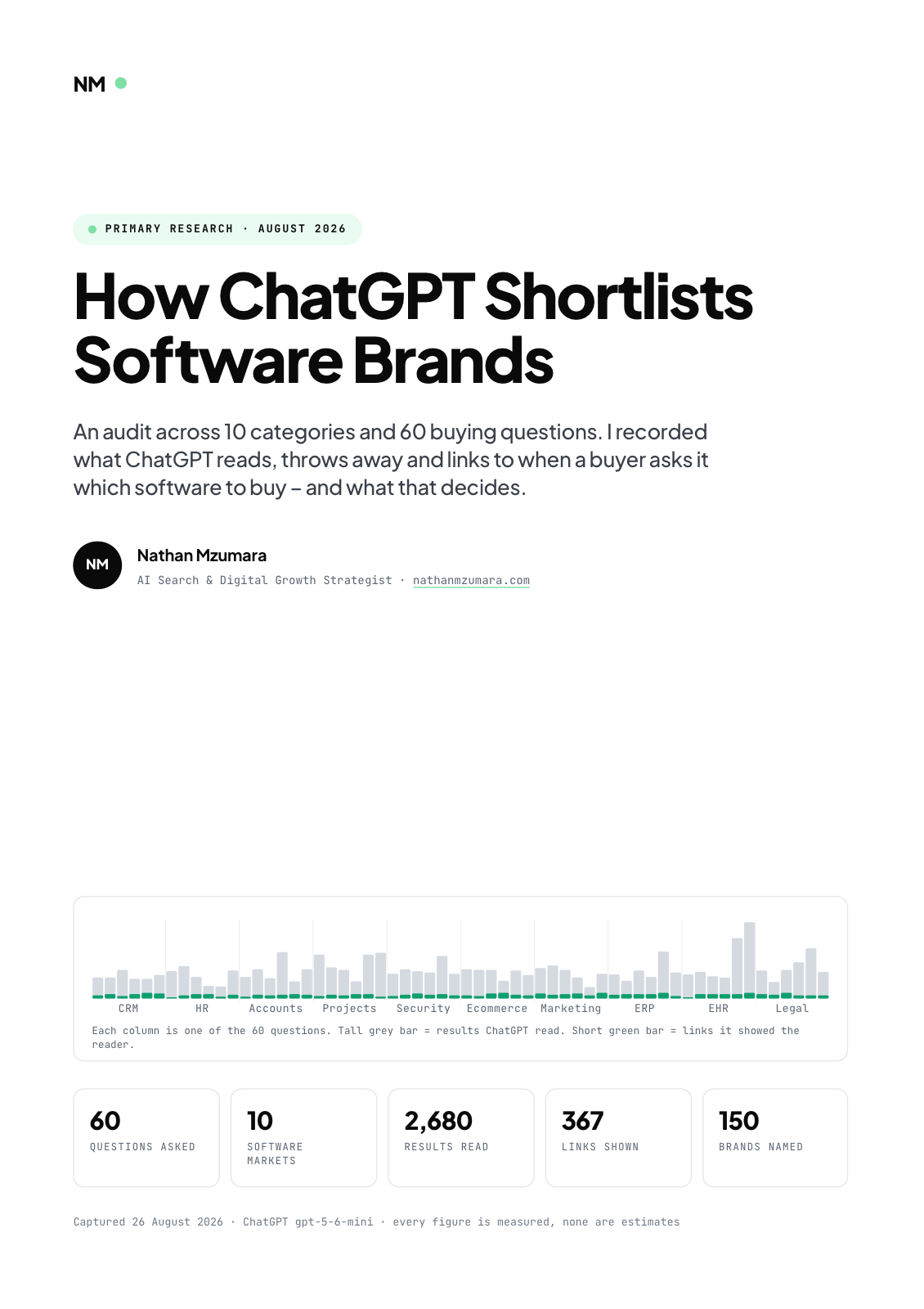
For a measured look inside the hardest of those tiers, my audit of how ChatGPT shortlists software brands recorded every result it read and every link it showed across 60 buying questions. Only 11.1% of the pages it pulled in became a visible citation.
Three tiers, not one channel
Retrieval-first engines search on nearly every query and assemble the answer from fetched passages. Perplexity, Google AI Overviews and AI Mode, and Bing Copilot sit here. Getting cited is fundamentally an SEO problem: crawlability, index presence, schema, answer capsules.
Hybrid model-led engines answer from training weights unless something forces a search. ChatGPT Search, Claude with web search, and the Gemini app sit here. Retrieval fires when the query looks time-sensitive or specific enough that the model doesn't trust itself. This is where most enterprise B2B queries land, and it is the hardest tier to influence.
Pure parametric systems don't retrieve at all. Base chat with browsing off, DeepSeek, and the overwhelming majority of API calls. There is no page to optimise. Presence here is an entity problem, decided by Wikidata, consistent brand mentions across the corpora these models trained on, and enough third-party coverage that the weights already know who you are.
Citation density tracks the tiering. Research from Trakkr puts Perplexity at a median 6.4 unique domains per answer, Claude at 3.6, ChatGPT at 3.1 and Gemini at 2.4. Perplexity is also the most reproducible engine across repeat runs, which matters more than the headline figure.
The Perplexity paradox
If Perplexity cites the most, why do businesses see far more referral traffic from ChatGPT?
Four reasons, and none of them are about content quality.
Audience arithmetic. ChatGPT crossed a billion monthly active users in June 2026. Google's AI Overviews reach roughly 1.5 billion monthly users, making it the largest AI surface by audience. Perplexity's per-answer advantage is spread across a fraction of that.
Density dilutes. Twenty-plus citations in one answer means each link gets a thinner slice of attention. ChatGPT's three-domain median concentrates it.
Perplexity is deliberately keeping users in. Previsible's analysis found its monthly referral sessions down 61% from a March 2025 peak, attributed in part to the product retaining users inside its own browser and agent tools. Retrieval-first is an architecture choice, not a distribution promise.
AI Overviews aren't referral traffic at all. Google bundles AI Mode and AI Overview clicks into google / organic with no clean way to separate them in GA4. What teams call "AIO traffic" is organic traffic with an AIO influence layered over it. The measurable mechanism is that cited brands earn roughly 35% more organic clicks than uncited ones.
Three layers people keep collapsing into one
Citation share asks whether you appear in the answer. Referral traffic asks whether anyone clicked. Attribution asks whether you saw the click. They move independently, and reporting them as a single number to a CMO will get the channel defunded a year too early.
The attribution layer is worse than most teams realise. ChatGPT's mobile apps open external links in the system browser and the referrer header does not survive the hand-off. Pasted URLs pass nothing. ChatGPT Atlas has been reported to strip referrers on many outbound opens. All of it lands in GA4 as Direct. Goodie's panel estimates that if just 5% of direct traffic is misattributed AI, that alone would more than double the total AI figure most brands currently report. Separate industry estimates put 25-35% of AI-influenced traffic as misattributed or untracked.
Then there is the ceiling: around 93% of AI search sessions end without a website visit at all. Most AI visibility produces awareness, not sessions.
The platforms sending nothing, and why they differ
Grok, Meta AI and DeepSeek all show near-zero referrals for three unrelated reasons, which matters because only one of them is fixable.
Grok passes no referrer at all, on the standalone product or inside X, and behaves as a content destination rather than a router. Average visit duration approaching twelve minutes and nearly seventeen pages per visit tells you users are staying. Meta AI has over a billion monthly actives but lives inside messaging products, so B2B referral output is effectively nil. DeepSeek combines no retrieval with no referrer, and its referral traffic has been flat at zero since September 2025.
Claude is the one people get wrong. An all-verticals study from SE Ranking puts it at 2.62% of AI referrals. Goodie's 41-brand B2B panel puts it at 18.5% and second only to ChatGPT, up from 1.35% a year earlier. Both can be true, because Claude skews hard toward B2B and technical audiences. If your buyer is an enterprise decision-maker and you see nothing from Claude, check your crawler access before concluding it isn't there. Its crawl-to-referral ratio runs around 500,000:1, so it is reading your content regardless, and blocking it only forfeits citation eligibility.
Conversion inverts the volume picture entirely. Claude converts at 16.8%, the highest of any platform, on roughly 2% traffic share. ChatGPT sits at 14.2-15.9%, Perplexity at 10.5%, Gemini at 3.0%, against a Google organic baseline of 1.76-2.8%.
B2B and B2C are being routed to opposite surfaces
The split is clean once you see it. B2B wins where the model is asked to evaluate and shortlist. B2C wins where the model is asked to find and buy. Evaluation is retrieval-and-citation shaped. Buying is feed-and-catalogue shaped.
B2B's structural advantages are real. Comparison pages cite at 1.87 per retrieval, the highest of any page type, and listicles took 61% of citations in B2B technology services. Reddit appeared among the top cited domains for seven of eight brands in one study. Technology, SaaS and finance lead AI traffic adoption at 18-25% while local services lag at 3-7%. Long consideration cycles mean more prompts per deal and more chances to be retrieved.
D2C's advantages are entirely different and mostly technical. Google AI Overviews cite retailers in only 4% of shopping responses against ChatGPT's 36%, a nine-fold asymmetry that breaks any evenly-allocated multi-platform budget. AI traffic to US retailers grew 393% year on year in Q1 2026, with AI shoppers converting 42% better. Shopify merchants get automatic catalogue syndication into ChatGPT through Agentic Storefronts. And Amazon blocking OpenAI's crawlers in robots.txt has handed non-Amazon brands a temporary structural opening.
None of that has a B2B equivalent. There is no feed, no GTIN, no Agentic Commerce Protocol for enterprise ERP.
Six myths worth killing
"Optimise for Perplexity first." It cites the most and refers the least. Treat it as a brand visibility channel, measured on citation share, not sessions.
"AI Overviews send traffic." They send nothing you can isolate. The mechanism is uplift on existing organic clicks.
"Nobody gets traffic from Claude." In B2B panels it is second. Absence usually means a robots.txt or WAF problem.
"Volume is the KPI." Volume is tiny and conversion is several times organic. Report both or lose the budget.
"One AI-optimised page works everywhere." Each surface has a distinct audience and product model. A single asset will not perform evenly across them.
"GEO replaces SEO." Tier one is straight SEO. Tier two is content and entity work. Tier three cannot be retrieved into at all. GEO is a routing decision about which problem you actually have.
The honest caveat
Published estimates of ChatGPT's share of AI referrals range from 63% to 92% depending on panel composition and methodology. Anyone quoting one of those as settled fact is selling something. Citation behaviour is non-deterministic, so a single-shot prompt check is a sample, not a measurement. Run every tracked prompt at least three times, publish the spread rather than the point estimate, and treat your own GA4 as the only number that belongs in a board deck.