OpenAI Just Hired a Sales Machine. ChatGPT Is Now a B2B Channel.
OpenAI has appointed Dali Rajic as its Chief Revenue Officer to lead the company's global revenue organisation. Read past the headline and here is what actually matters: the operator who scaled the go-to-market engines at Zscaler and Wiz is now building what OpenAI itself calls a "revenue operating system" on top of a product with more than two million paying businesses. ChatGPT is no longer a consumer novelty. It is becoming a structured B2B buying channel with a real sales org behind it.
What happened
On 13 August 2026, OpenAI announced Dali Rajic as Chief Revenue Officer, replacing Denise Dresser who built the commercial foundation over the prior period. Rajic most recently served as President and COO of Wiz (recently acquired by Google) and previously held the same role at Zscaler and Chief Customer and Revenue Officer at AppDynamics.
Read that CV again. It is not a consumer growth resume. It is a disciplined, metrics-led enterprise selling resume, three times over.
When, and why the timing is the signal
OpenAI paired the hire with a strategic partnership with Chad Peets and RPT Partners to build out a world-class go-to-market team. It landed the day after OpenAI published its note on how enterprises put AI to work, and two days after it confirmed it was testing ads in ChatGPT. Those three moves in one week are not a coincidence. They are the opening moves of a company building a monetised enterprise pipeline.
The scale behind it: over one billion weekly active users and more than two million businesses, twice as many as a year ago. In my opinion, that is the moment novelty ends and a repeatable sales motion begins.
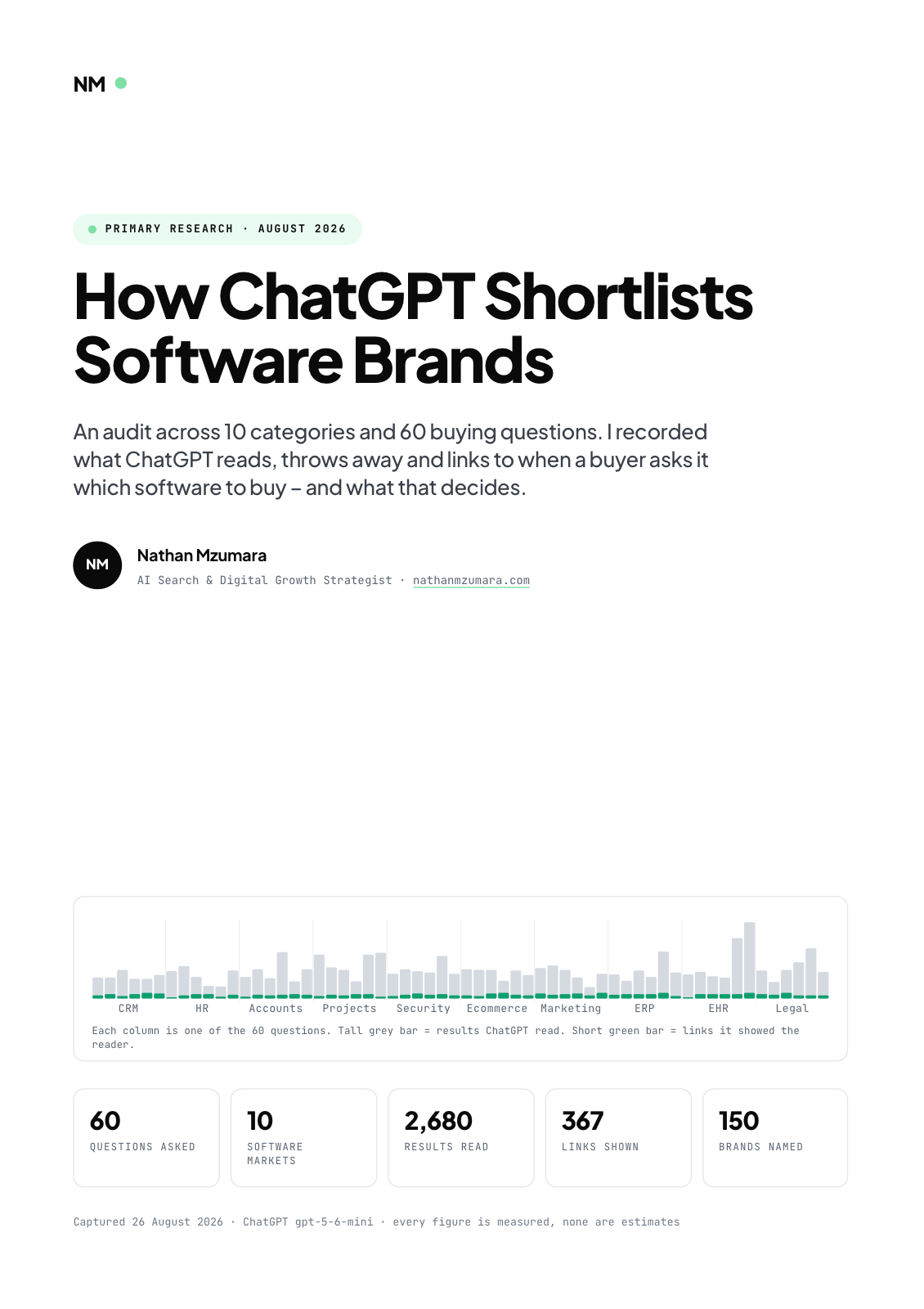
It is worth knowing what those buying answers already look like. In a 60-question audit of ten software categories, two in every three links ChatGPT showed pointed at a vendor's own website, and in 26 of the 60 answers every single source was a vendor page.

How this changes discovery for your brand
Here is the mechanism most marketing leaders are missing. When a technical enterprise vendor scales a metrics-led GTM, it builds structured product tiers, procurement paths, partner ecosystems and embedded integrations. Your brand no longer just needs to appear in a ChatGPT answer. It needs to appear inside the enterprise buying surface: the shortlists, the app directories, the integration marketplaces and the procurement-grade comparisons.
| Discovery surface | Consumer ChatGPT (before) | Enterprise ChatGPT (now forming) |
|---|---|---|
| Who asks | Individual user, casual query | Buying committee, procurement-grade research |
| What wins | Citation in the answer box | Trusted vendor in a structured shortlist |
| Optimisation target | Answer visibility | Procurement pipeline and integrations |
| Buying trigger | None | Sales-assisted, tiered, contract-led |
The discovery surface is shifting from the answer box to the enterprise buying pipeline.
What growth leaders should do now
- Audit how ChatGPT describes you to a business buyer. Ask it, in a procurement framing, and note whether you make the shortlist. As I have argued before, ChatGPT often picks winners before it searches.
- Structure your proof for procurement, not just SEO. Security posture, integration lists, pricing tiers and comparison-ready facts are what a sales-led surface rewards.
- Track presence, not just clicks. Remember that citation share is not traffic, and enterprise influence rarely shows up in your referral report.
From my observation, the teams that treat ChatGPT as a search box will be optimising for the surface that mattered last year. The action to take this quarter: map how you are discovered, shortlisted and procured inside the enterprise tier, and build the structured signals a sales-led OpenAI will surface.