OpenAI Reaffirms Zero Data Retention. Who Watches Your Agents Now?
OpenAI has reaffirmed Zero Data Retention (ZDR) for eligible API customers and previewed a system called Private Safety Processing. The headline for growth teams: you can now run long, autonomous, multi-step agent tasks while keeping the underlying content invisible to OpenAI personnel, yet still screened for abuse. That combination is what makes this worth your attention today.
The compliance question has quietly shifted. For two years the boardroom concern was 'does OpenAI retain my data'. From my observation, that is now the wrong question. The one that matters is: 'how does safety monitoring work when no human can see the content'.
What actually changed
ZDR means eligible API requests are not stored after the response is returned. No prompt logging, no output retention, no training on your data. Private Safety Processing sits alongside it, running abuse detection in a way that does not expose the raw content to OpenAI staff.
In plain terms, the screening happens, but the humans do not read your data. I think this is the piece most compliance teams have been waiting for, because 'trust us, we do not look' was never going to survive a serious DPIA.
Why ZDR matters for regulated marketing data
If your agents touch first-party customer records, CRM exports, purchase history or anything special-category, retention is a liability. ZDR removes the retained copy that a regulator, a breach, or a subject access request could othewise reach.
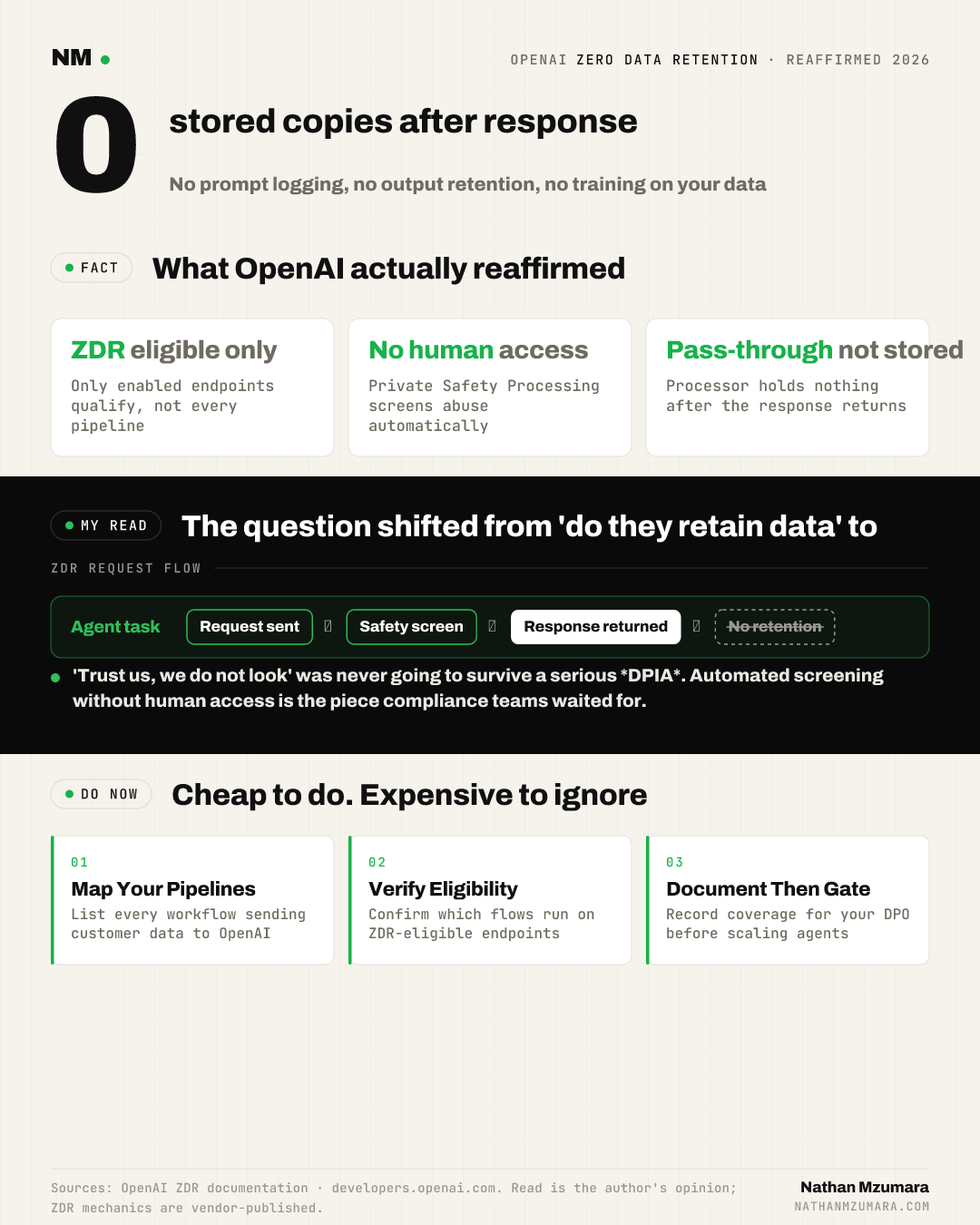
This is the difference between a processor that holds your data and one that merely passes through it. For anyone running personalisation or discovery pipelines on customer records, that distinction is the whole compliance case.
How the mechanism works, step by step
| Stage | What happens | Who can see the content |
|---|---|---|
| 1. Request sent | Agent submits a multi-step task via a ZDR-eligible endpoint | Nobody at OpenAI |
| 2. Safety screen | Private Safety Processing checks for abuse signals | No human, automated only |
| 3. Response returned | Output delivered to your system | Your team only |
| 4. After response | No prompt or output retained | No stored copy exists |
Caption: How a ZDR request flows through Private Safety Processing without human access. Source: OpenAI.

The concrete action for your team
Do not assume every pipeline qualifies. ZDR is only available on eligible endpoints and requires enablement, so audit before you scale agents into production.
- Map your pipelines. List every discovery, personalisation and analytics workflow that sends customer data to OpenAI.
- Check eligibility. Confirm which of those run on ZDR-eligible endpoints, using the official ZDR documentation.
- Document for your DPO. Record which flows are ZDR-covered and which are not, and note that safety screening is automated.
- Gate production. Only autonomous agents on ZDR-eligible paths should touch regulated data.
I have written before about why you need to be able to prove OpenAI cannot see your agent data, not just believe it. And as ChatGPT keeps expanding into a paid discovery surface across European markets, the data-governance stakes only rise.
In my opinion, the teams that win here are the ones treating ZDR as a documented control, not a marketing claim. Map, verify, record, then scale.
Tags