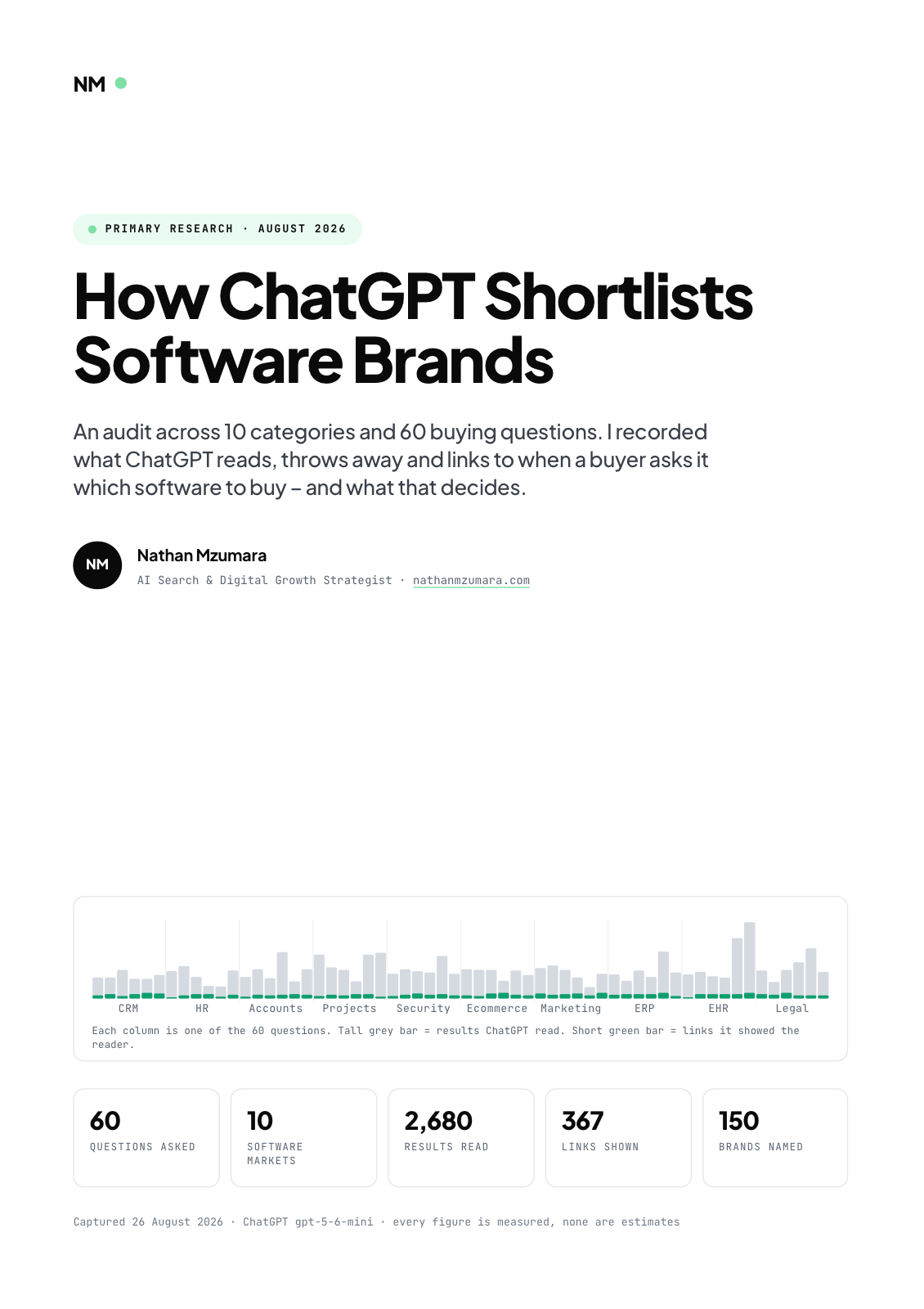
Legal Practice Software in ChatGPT: Clio Wins 67% of Prompts, and a Funeral Home Made the Shortlist

Clio holds the strongest position of any brand in this entire study. It appeared in five of six legal prompts, took the top slot in four of them, and carries a mean rank of 1.20 – better than HubSpot at 1.91, Shopify at 1.50 or Asana at 1.60. But legal practice management vendors take only 54.1% of citations, meaning nearly half the evidence base belongs to third parties. One of those third parties, a comparison site read directly for this study, published a legal software list that included a funeral-home product.
The category at a glance
| Measure | Legal practice management | Corpus average |
|---|---|---|
| Mean results read per answer | 48.8 | 44.7 |
| Mean citations per answer | 6.2 | 6.1 |
| Distinct cited domains (6 prompts) | 16 | – |
| Distinct brands surfaced | 17 | – |
| Vendor-owned citation share | 54.1% | 65.9% |
| Citation concentration (HHI) | 1,161 | – |
| Most-named brand | Clio | – |
| Shortlist stability (Jaccard) | 0.287 | 0.338 |
| Distinct leaders across 6 prompts | 3 | 3.8 |
The category has a split personality. Its leading brand has the strongest model conviction in the study, and its citation surface is one of the weakest for vendors.
Which legal brands the model already believes in
| Brand | Answers naming it | Times ranked #1 | Mean rank | Total mentions |
|---|---|---|---|---|
| Clio | 5 | 4 | 1.20 | 65 |
| MyCase | 5 | 1 | 1.80 | 42 |
Clio's mean rank of 1.20 across five answers, with four top finishes, is the single strongest entity position in the corpus. When ChatGPT talks about legal practice management, it leads with Clio and it does so with unusual consistency for a category whose shortlist overlap is only 0.287.
MyCase is a strong second at mean rank 1.80 with one top finish, and its domain mycase.com earned 8 citations across two answers – heavy concentration, suggesting a small number of very well-structured pages doing a lot of work. clio.com earned 7 citations.
Seventeen distinct brands surfaced across the six prompts, so beneath the top two the field is wide and unstable.
The accuracy problem in the third-party 45.9%
Legal sits at 54.1% vendor citation share, meaning nearly half the evidence in these answers comes from elsewhere. Some of that is legitimate: bar association resources, legal trade press, genuine practice-management analysis.
Some of it is not. Four independent comparison sites were read directly as part of this study to establish what they actually are. One of them, toolradar.com, was the strongest of the four on transparency – it has a named author, a dated review cycle, a published methodology and a stated policy of not selling placement. It also published a legal software list that included a funeral-home product.
That is a useful reminder that transparency and accuracy are separate variables, and that the retrieval layer is not selecting for either. The comparison-site long tail across the whole study – 43 sites taking 53 citations, 14.4% of the corpus total, 3.5 times what the established review aggregators managed – is winning on format and freshness, not on editorial rigour.
For a legal software vendor, that has a direct consequence. Roughly half of what ChatGPT tells a law firm about your product comes from pages whose accuracy you have not checked and whose authors, in several cases, are not identified.
Why legal behaves like an enterprise category
Legal practice management has the structural signature of a gated-pricing category, and it sits alongside ERP at 52.5% and healthcare EHR at 48.7% rather than alongside accounting at 90.9%.
Retrieval is heavy at 48.8 results per answer, third highest in the study. Cited domains are numerous at 16. Shortlist stability is below average at 0.287. The brand field is wide at 17. Every one of those indicators says the same thing: the model is working hard because the vendors are not supplying enough evidence.
The exception is Clio, which is precisely why its position is instructive. Clio publishes tiered per-user pricing publicly, maintains extensive product documentation, and has a very large partner and integrations ecosystem. It is the vendor in this category behaving most like an accounting-software vendor, and it holds the strongest rank in the study.

What this means if you sell legal software
Audit what the third parties say about you, this quarter. With 45.9% of citations going to non-vendor sources in a fragmented category, and with at least one cited comparison site demonstrably capable of putting a funeral-home product on a legal list, factual accuracy about your product on those pages is a commercial issue. Most of these sites have a contact route and an incentive to be correct.
Publish per-user pricing with named tiers. Clio does. It is the category leader by a wide margin on the metric that matters most. That correlation is not proof of causation, but the mechanism is well evidenced across this whole study: categories with public pricing gave vendors 80–91% of citations, gated categories 48–55%.
Publish the practice-area and jurisdiction facts. Which practice areas the product is configured for, which jurisdictions and court systems it supports, trust accounting compliance, e-filing coverage, conflict checking, document automation, and integration with the accounting packages firms actually use. Every one of those is a checkable claim and a defence against being listed in the wrong category.
Build the comparison pages. Clio versus MyCase, and every other pairing your prospects run. Head-to-head prompts corpus-wide take 91.0% of citations from the two named vendors' own sites, so those answers are built almost entirely from your page and your rival's.
Expect instability below the top two. At 0.287 shortlist overlap with 17 brands surfacing, everything outside the leading pair is highly phrasing-dependent. Measure across all six buying archetypes rather than tracking a single prompt.
FAQ
What legal practice management software does ChatGPT recommend?
Clio, most consistently. It appeared in five of six legal prompts, took the top slot in four of them and holds a mean rank of 1.20 - the strongest of any brand in the sixty-prompt study. MyCase was second at mean rank 1.80 with one top finish.
Why does Clio rank so highly in ChatGPT?
Its structural signals match the pattern that wins across this dataset: public tiered per-user pricing, extensive product documentation and a large integrations ecosystem. It is the vendor in a gated-pricing category behaving like a transparent-pricing one, and it holds the study's strongest mean rank.
How much of a legal software answer comes from third-party sites?
Just under half. Legal practice management vendors took 54.1% of citations, below the 65.9% corpus average, leaving 45.9% to comparison sites, trade press and other third parties across 16 distinct cited domains.
Are the sites ChatGPT cites for legal software accurate?
Not reliably. One comparison site read directly for this study - the most transparent of the four examined, with a named author, dated review cycle and published methodology - had a legal software list that included a funeral-home product. The retrieval layer selects on format and freshness, not editorial rigour.
How should legal software vendors improve AI visibility?
Publish per-user pricing with named tiers, then the practice-area and jurisdiction facts: supported practice areas, court systems, trust accounting compliance, e-filing coverage and accounting integrations. Build dated comparison pages against every rival prospects name, and audit third-party listings for accuracy.
Related in this series
- How ChatGPT Shortlists Software Brands, the full report as a PDF
- Forty-Five Reads, Six Links: How ChatGPT Actually Cites Software Brands
- The Sites Beating G2 in ChatGPT: 43 Comparison Sites, 53 Citations, 3.5x the Aggregators
- Publish Your Prices: Why Gated Pricing Costs You 30 Points of AI Citation Share
- 69.3% of ChatGPT's Software Recommendations Have No Source Behind Them
About the research. Nathan Mzumara is an organic growth and AI search practitioner. Category figures rest on six observations and should be read as directional. Method and limitations are stated in the pillar report.