OpenAI Status: What OpenAI Is, Who Owns It, and Where It Stands in 2026
The current OpenAI status, as of 13 August 2026, is a privately held AI company that is not publicly traded, with Microsoft as a major partner and Sam Altman as chief executive. Its newest release, previewed on 13 August 2026, is Ultrafast, a service tier that runs GPT-5.6 Sol up to 14x faster than standard processing.
This article explains what OpenAI is, who owns it, whether you can buy its stock, and the latest product news that matters for search and marketing teams. It reads as an update, not a stock tip.
What is OpenAI?
OpenAI is an artificial intelligence company. It builds AI models that read, reason and write text, and it makes the popular ChatGPT assistant. You reach its models through ChatGPT and through the OpenAI API, the paid service that lets developers plug OpenAI into their own apps.
Developers often test prompts in the OpenAI Playground, a browser tool for trying models before writing code. The OpenAI ChatGPT index page and the ChatGPT product pages are where most people first meet the company, and the familiar OpenAI logo now sits across all of them.
Who owns OpenAI, and does Microsoft own it?
OpenAI is privately owned. It runs a capped-profit arm under a non-profit board, and Microsoft is its largest partner and investor. Microsoft does not fully own OpenAI. The two firms have issued an OpenAI Microsoft joint statement in the past to clarify their partnership, but OpenAI remains an independent company.
The current CEO of OpenAI is Sam Altman. If you are checking OpenAI careers or OpenAI jobs, roles are posted on the company's own site, not through a stock listing.
Is OpenAI publicly traded, and what about the OpenAI IPO?
OpenAI is not publicly traded as of 13 August 2026. There is no OpenAI stock, OpenAI share price or OpenAI stock price you can buy on a public exchange. Searches for openai stocks or an openai stock price return no listed ticker, because the company has not held an initial public offering.
There is no confirmed OpenAI IPO date. Until one happens, any quoted openai share price is not from a public market. Treat unofficial figures with care.
Is OpenAI down, and where is the OpenAI status page?
To check if OpenAI is down, use the official OpenAI status page, which reports live uptime for ChatGPT, the API and related services. If ChatGPT or the API stops responding, the status page shows the incident and progress on a fix.
The OpenAI status page is the fastest way to tell a real outage from a local problem. Bookmark it if you rely on the API in production.
Has OpenAI released GPT-5, and what is Ultrafast?
OpenAI's newest previewed model tier is GPT-5.6 Sol, run through the Ultrafast service. If you are searching openai gpt5, this is the current frontier line. Ultrafast is a service tier that runs GPT-5.6 Sol up to 14x faster than standard processing, reaching up to 750 output tokens per second.
Ultrafast launched first in the OpenAI API on 13 August 2026, powered by Cerebras. Read the announcement on the OpenAI Ultrafast preview page.
Until now, real-time speed usually meant trading down to a smaller model. Ultrafast breaks that trade-off. You get frontier intelligence at the highest speed, in the same request. OpenAI frames the win as "more useful work per second". From my observation, that phrase matters more than the headline number.
When it rolls out
Ultrafast is in limited preview today with a select group of customers, starting in the API. OpenAI says access will expand as capacity grows, and is collecting sign-ups for access updates. Early testers span coding, commerce, financial research and voice. Podium's voice lead noted the speed "completely changes the call experience for the more complex work".
Other recent OpenAI news
OpenAI's wider 2026 activity includes the OpenAI Agent Builder for building agents, the OpenAI Sora 2 video model, and the OpenAI ChatGPT Go release for lower-cost access. Some searches also mention an openai Mixpanel data breach, a reported security incident tied to a third-party analytics tool. Check the OpenAI status page and official posts for the latest confirmed detail.
What does the OpenAI API cost, and how does pricing work?
OpenAI pricing runs on usage, not a flat fee. The OpenAI API pricing model charges per token, so you pay for the text a model reads and writes rather than a fixed monthly seat. Faster tiers like Ultrafast change the maths, because more tokens per second means more useful work in the same window. Check the official pricing page before you budget, as rates move as new models ship.
How token throughput works, and why speed matters for search
Large models generate text one token at a time. Tokens per second measures how fast that stream is produced, so 750 tokens per second is roughly the pace at which the model can read, reason and write.
Here is why that reshapes search behaviour:
Faster generation lets an assistant run more retrieval passes inside a single answer without the user noticing lag.
More passes mean it can cite more sources and cross-check claims live, not settle for the first plausible page.
Cheaper time per pass makes re-checking content in real time the default, not a luxury.
In my opinion, this is the shift growth teams keep underestimating. The bottleneck was never just intelligence, it was the time cost of thinking out loud.
Why latency is now a discovery variable
When an assistant runs near-real-time answer loops, it favours sources that respond fast enough to be included. Slow endpoints, heavy pages and stale feeds get skipped, not because they are wrong, but because they cannot keep pace.
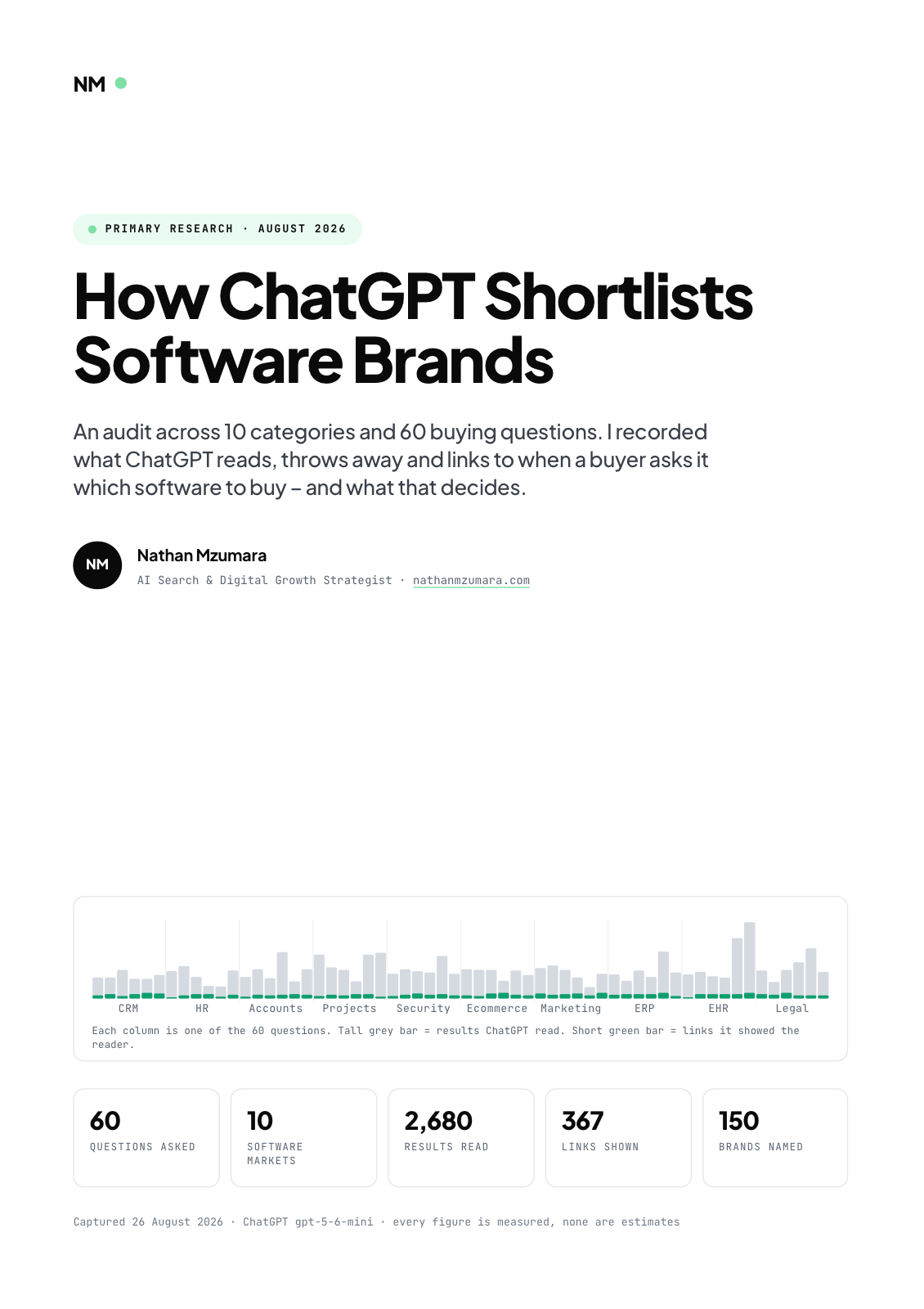
The recency bias is already measurable. In an audit of 60 software buying questions, 86.3% of the dated pages ChatGPT read carried a 2026 date, and only 5.0% were more than two years old.
This is the same lesson as page speed a decade ago, only the visitor is now a machine with a strict time budget. Citation share, as I argue in why citation share is not traffic, is increasingly decided in these hidden retrieval passes.
Key actions for in-house SEO and GEO teams
Three concrete moves, in order of leverage.
Make answers machine-readable: structure key facts, prices and specs as clean, extractable data so an assistant can lift them in one pass rather than parsing prose.
Prioritise feed and endpoint freshness: inventory, pricing and availability feeds should update fast and return fast. A slow or cached feed is invisible in a real-time loop, especially for commerce.
Cut server response time for bots: fast, stable responses to crawlers and agents are now a citation input, not a nicety.
This connects directly to how ChatGPT is shifting from asking to doing. As intent moves into action, the assets that respond in real time win the moment.
The current OpenAI status, in one line
The OpenAI status in 2026 is a private, fast-moving company: not listed on any exchange, backed by Microsoft, led by Sam Altman, and shipping faster models like GPT-5.6 Sol on Ultrafast. Content that is structured, fresh and fast enough to enter near-real-time answer loops will earn citations. Audit your feeds and response times this quarter.