AI Company
Cerebras
Also known as: Cerebras Systems
Cerebras Systems is a US computing company that builds very large wafer-scale processors and systems for training and running AI models. It sells hardware and also offers a hosted inference service that runs open models at high token generation speeds. It matters to search and marketing teams mainly as one of the infrastructure options behind fast AI assistants and agents.
What it is
Cerebras designs the Wafer Scale Engine, a processor built on a single large wafer rather than as many separate chips, along with the CS systems that house it. It targets both model training and inference, and provides cloud access so developers can call hosted open models through an API. The company competes with GPU based infrastructure providers in the AI compute market.
Why it matters
Inference speed and cost decide how much reasoning, retrieval and checking an assistant can afford per answer. Faster and cheaper generation makes it viable to browse more pages, run more tool calls and produce longer grounded answers, which changes how much source material gets cited. Infrastructure choices therefore feed through, indirectly, into what discovery surfaces can do.
How it works
Teams use Cerebras hosted inference in the same way as other model APIs, pointing an application at an endpoint and choosing an available open model. Typical uses are chat interfaces, retrieval augmented generation over a content set, summarisation at volume and agent loops where many quick calls are needed. Selection usually comes down to a trade off between speed, cost, model choice and data handling terms.
When it applies
It applies when you are choosing where to run models for an in-house assistant or content pipeline, or when you are explaining why some AI products answer far faster than others.
Examples
- An in-house site search assistant is served from a hosted open model so answers stream back with minimal waiting.
- A content team runs bulk summarisation of thousands of product pages through a fast inference endpoint overnight.
- An agent that checks brand mentions across many prompts uses a fast, low cost model for the routine passes and a larger model only for final review.
How it is measured
- Tokens generated per second for your chosen model and prompt length
- Time to first token on production traffic, measured at median and 95th percentile
- Cost per thousand tokens, and cost per completed task in an agent loop
- Error and rate limit frequency during peak usage
Insights on Cerebras
Related terms in AI Company
- Amazon Web ServicesAmazon Web Services is Amazon's cloud computing division, providing compute, storage, databases, networking and machine learning services on a pay as you go basis. It is one of the main cloud platforms used to host websites, data pipelines and AI applications. For AI work it offers services such as Amazon Bedrock, SageMaker, OpenSearch and various vector and database options.
- AnthropicAnthropic is an AI company that builds the Claude family of large language models and positions safety research at the centre of its work. Its products include the Claude apps, a developer API and Claude integrations used inside other tools. For marketers, Anthropic matters because Claude is one of the assistants where buyers now ask questions that used to start in a search engine.
- BroadcomBroadcom is a US semiconductor and infrastructure software company, listed as AVGO, that supplies networking, storage, wireless and custom silicon alongside a large enterprise software portfolio. In AI it is known for data centre networking components and for co-designing custom accelerators with large cloud operators. Its software side expanded significantly with the acquisition of VMware.
- GoogleGoogle is the search engine and technology company owned by Alphabet, and the operator of Search, YouTube, Chrome, Android, Google Ads and Google Cloud. It develops the Gemini family of AI models and surfaces generated answers in products such as AI Overviews. For most businesses it remains the largest single source of organic and paid search demand.
- Google DeepMindGoogle DeepMind is Google's artificial intelligence research and development unit, formed by combining DeepMind with the Google Brain team in 2023. DeepMind was founded in London in 2010 and acquired by Google in 2014. The unit develops Google's Gemini models alongside longer-running research projects such as AlphaFold.
- MetaMeta is the US technology company behind Facebook, Instagram, WhatsApp, Messenger and the Quest headsets, formerly known as Facebook, Inc. It runs one of the largest digital advertising businesses in the world. It also develops the Llama family of open weight large language models and the Meta AI assistant built into its apps.
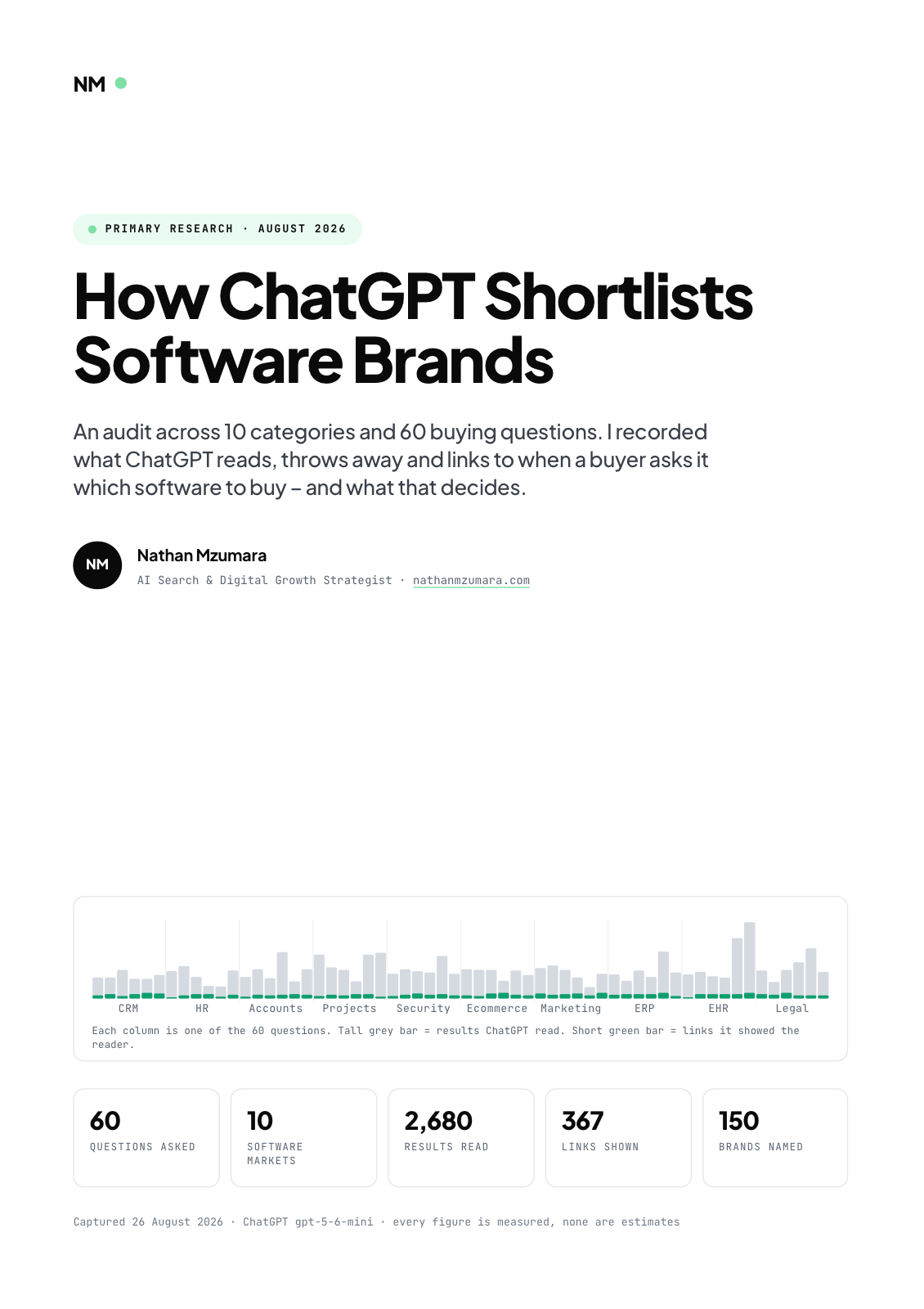
Primary research · August 2026
How ChatGPT Shortlists Software Brands
An audit across 10 categories and 60 buying questions. I recorded what ChatGPT reads, throws away and links to when a buyer asks it which software to buy, and what that decides.
- 60
- Questions asked
- 10
- Software markets
- 2,680
- Results read
- 367
- Links shown
Free download
Get the full report
35 pages · PDF · 536 KB. Enter your details and it downloads straight away.