ChatGPT Now Watches Everything You Do. Search Just Ended.
OpenAI has just given ChatGPT a memory that spans your entire computer. On 13 August 2026, the company announced Computer History in the ChatGPT desktop app, a feature that remembers your activity across the apps and websites on your machine and feeds that context into every future interaction. This is the moment personalisation stops being about what you type into a search box and starts being about what you actually do all day.
From my observation, this is the single biggest shift in how AI assistants build context since custom instructions. If you lead growth or search, read this twice.
What actually happened
ChatGPT can now remember your activity across the apps and websites open on your computer. According to OpenAI, this makes "future interactions feel more personalized and require less explanation". In plain terms: the assistant no longer needs you to explain your context, because it has already watched you build it.
It builds on OpenAI's earlier Chronicle research preview, with reduced token usage and, importantly, more privacy controls. A new timeline view lets users look back on their work and build repeatable skills from frequent tasks.
When it lands, and where
The feature began rolling out globally on 13 August 2026 to Pro, Business and Enterprise users on Mac. Access in the EEA, UK and Switzerland follows "in the coming weeks", almost certainly because of the consent and data-processing questions those regions ask harder than most.
It is opt-in, found under Settings then Integrations. Users can clear all or part of their history, include or exclude specific apps and websites, and pause or resume tracking at any point.
How the mechanism changes discovery
Here is the part that matters for anyone competing for visibility. When ChatGPT knows what tools you use, what sites you visit, and what tasks you repeat, it can surface, recommend and pre-select brands before you ever ask a question. The query is no longer the starting point. Your behaviour is.
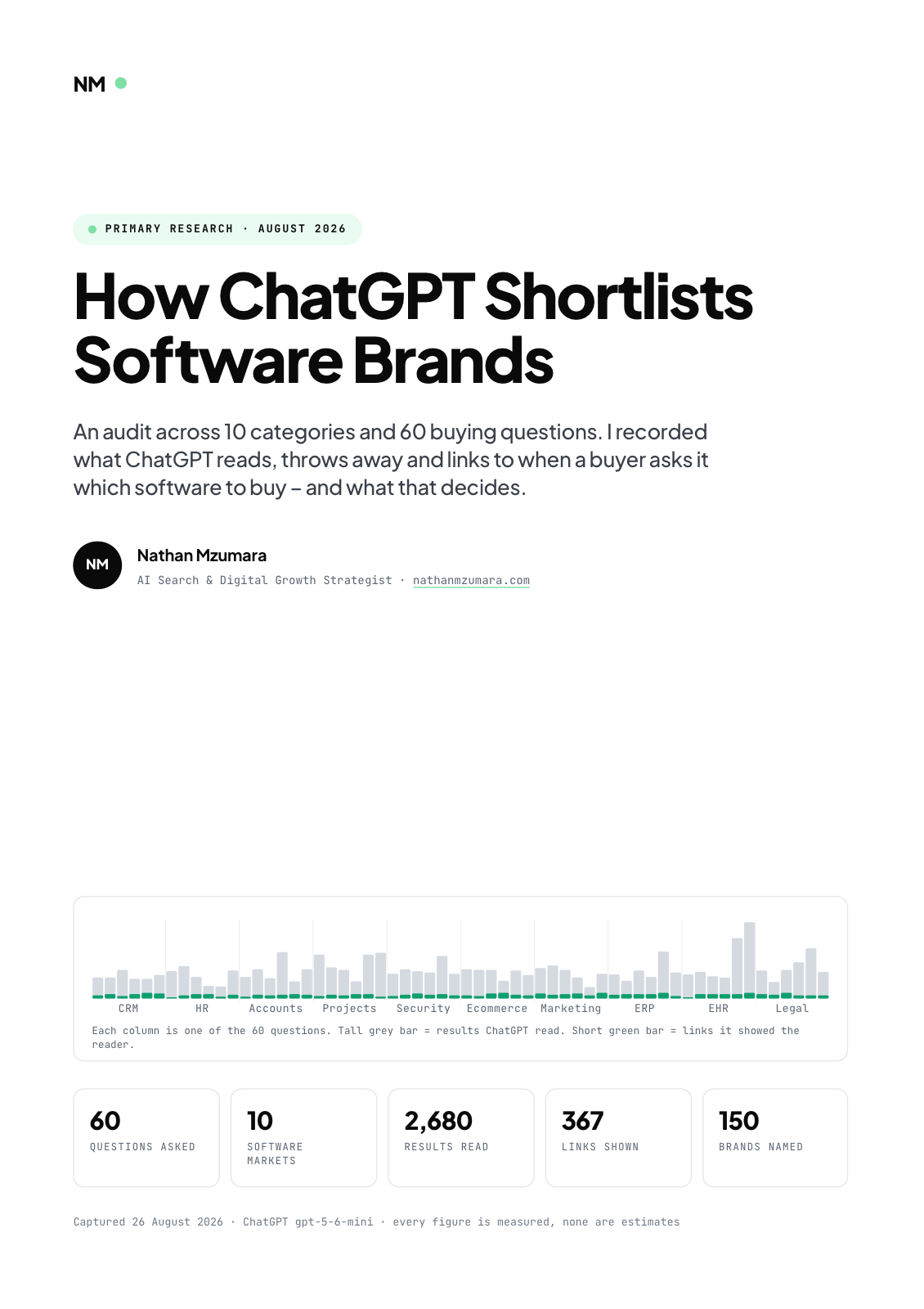
That lands on top of an already narrow funnel. Measuring what ChatGPT reads before it recommends software across 60 buying questions, only 11.1% of the pages it pulled in became a visible link, and 69.3% of its recommendations arrived with no source at all.
I think this quietly finishes a shift I have been tracking for a while: ChatGPT already builds a brand shortlist before it searches. Computer History supercharges that shortlist with live, personal, behavioural signals no traditional search box ever had.
Search box versus computer context
| Signal source | Old model (search box) | New model (Computer History) |
|---|---|---|
| What the assistant knows | Only what you type | Apps, sites and tasks across your day |
| When brands get considered | After the query | Before the query is asked |
| Personalisation depth | Session or chat memory | Ongoing behavioural context |
| Brand influence lever | Ranking and citations | Being part of the user's actual workflow |
Caption: How the source of AI context shifts from typed queries to observed behaviour.
The consent trade-off
This is a genuine trade-off, not a free upgrade. Users gain fluency and less repetition; they give up a detailed map of their working life to a model. The regional delay for the UK and EU tells you regulators will scrutinise this hard, and it sits alongside tightening rules like the EU AI Act transparency obligations.
What to do now
Stop optimising only for the query. In my opinion the real question is: when a user's assistant already knows their context better than any search box, is your brand part of the tools and sites they use every day? That presence is the new visibility. Audit where you show up in your buyers' actual workflows, not just in their searches, because that is the context the model now remembers.