AI Model & Product
OpenAI Dots
Also known as: dots, Dots by OpenAI
OpenAI Dots is a product name associated with OpenAI that has circulated in industry coverage and community discussion rather than in long-established documentation. Because public detail is limited and subject to change, it is best treated as an emerging surface to verify rather than a settled part of the stack. Practitioners track it the same way they track any new OpenAI release: confirm scope against official sources before planning around it.
What it is
Dots is a name linked to OpenAI in recent reporting and discussion, sitting in the wider family of OpenAI apps, features and developer surfaces. Publicly available detail is thin compared with established products such as ChatGPT, the API or Atlas, so its exact scope and availability should be checked against OpenAI's own announcements. Until that confirmation exists, the responsible position is to describe it as an emerging item on the roadmap radar rather than a fixed capability.
Why it matters
Every new OpenAI surface is a potential discovery channel, because anything that lets people ask questions or browse content can send attention and referrals to brands. Growth and search teams that spot new surfaces early get more time to test whether their content is retrievable there. Equally, naming a product in a strategy deck before its scope is confirmed is a reputational risk, so early-stage terms need careful handling.
How it works
Practitioners add the term to a watchlist, subscribe to OpenAI's release notes and changelog, and check whether any new user agent, referrer string or citation pattern appears in server logs and analytics. If and when the product is confirmed, the usual playbook applies: test branded and unbranded prompts, record whether your pages are cited, and check that your crawl and indexing permissions allow the relevant agents. Nothing should be built on assumed features until behaviour can be observed directly.
When it applies
It applies when you are maintaining a watchlist of emerging AI surfaces, or when a stakeholder asks about a product name they have seen in the press and you need a defensible answer.
Examples
- A search lead adds OpenAI Dots to a monthly emerging surfaces review alongside other unconfirmed product names, with a link to OpenAI's official changelog as the source of truth.
- An analytics manager creates a saved segment for any new openai.com referrer paths so that traffic from a newly launched surface is caught automatically rather than lumped into direct.
- A content strategist is asked in a board meeting whether the brand should optimise for Dots, and answers that scope is unconfirmed and the team is monitoring official releases before committing budget.
How it is measured
- Time from official OpenAI announcement to your team's documented assessment
- Referral sessions and assisted conversions from openai.com properties, split by path
- Number of new AI user agents or referrer strings detected in server logs each quarter
- Share of watchlist terms that are verified against a primary source before being used in client or board materials
Insights on OpenAI Dots
Related terms in AI Model & Product
- Agents APIAn Agents API is a programming interface for building applications where a model plans, calls tools and completes multi-step tasks rather than returning a single reply. The term is most often used for OpenAI's agent building interfaces, though other vendors offer equivalents. Teams use it to connect models to search, internal data and actions such as booking, updating records or generating reports.
- AI assistantAn AI assistant is a software product that uses a language model to hold a conversation, answer questions and carry out tasks on a user's behalf. It sits on top of one or more underlying models and adds an interface, memory, tools and safety controls. Examples include ChatGPT, Google Gemini, Microsoft Copilot, Claude and voice assistants such as Siri and Alexa.
- AI transcriptionAI transcription is the automatic conversion of spoken audio into written text using speech recognition models. Modern systems often add speaker labels, punctuation, timestamps and language detection, and can feed the output into summarisation or search. It is also called automatic speech recognition or ASR.
- BingBing is Microsooft's web search engine, available at bing.com and integrated into Microsoft Copilot and other Microsoft products. It maintains its own crawler, Bingbot, and its own index, and provides Bing Webmaster Tools for site owners. Its index and APIs have also supplied results to third-party search products and AI assistants.
- ChatGPT VoiceChatGPT Voice is the spoken conversation mode in OpenAI's ChatGPT apps, which lets you talk to the assistant and hear its replies read aloud. Advanced Voice Mode processes speech directly, so exchanges feel closer to a phone call and you can interrupt mid-answer. People use it hands free on mobile, and it is also available on desktop.
- Claude CodeClaude Code is Anthropic's agentic coding tool that works directly with a codebase, reading files, proposing and making edits, and running commands with permission. It runs in the terminal and in supported development environments, driven by natural language instructions rather than manual file by file editing. Marketing and growth teams use it for technical SEO, structured data and data tasks that would otherwise wait for engineering.
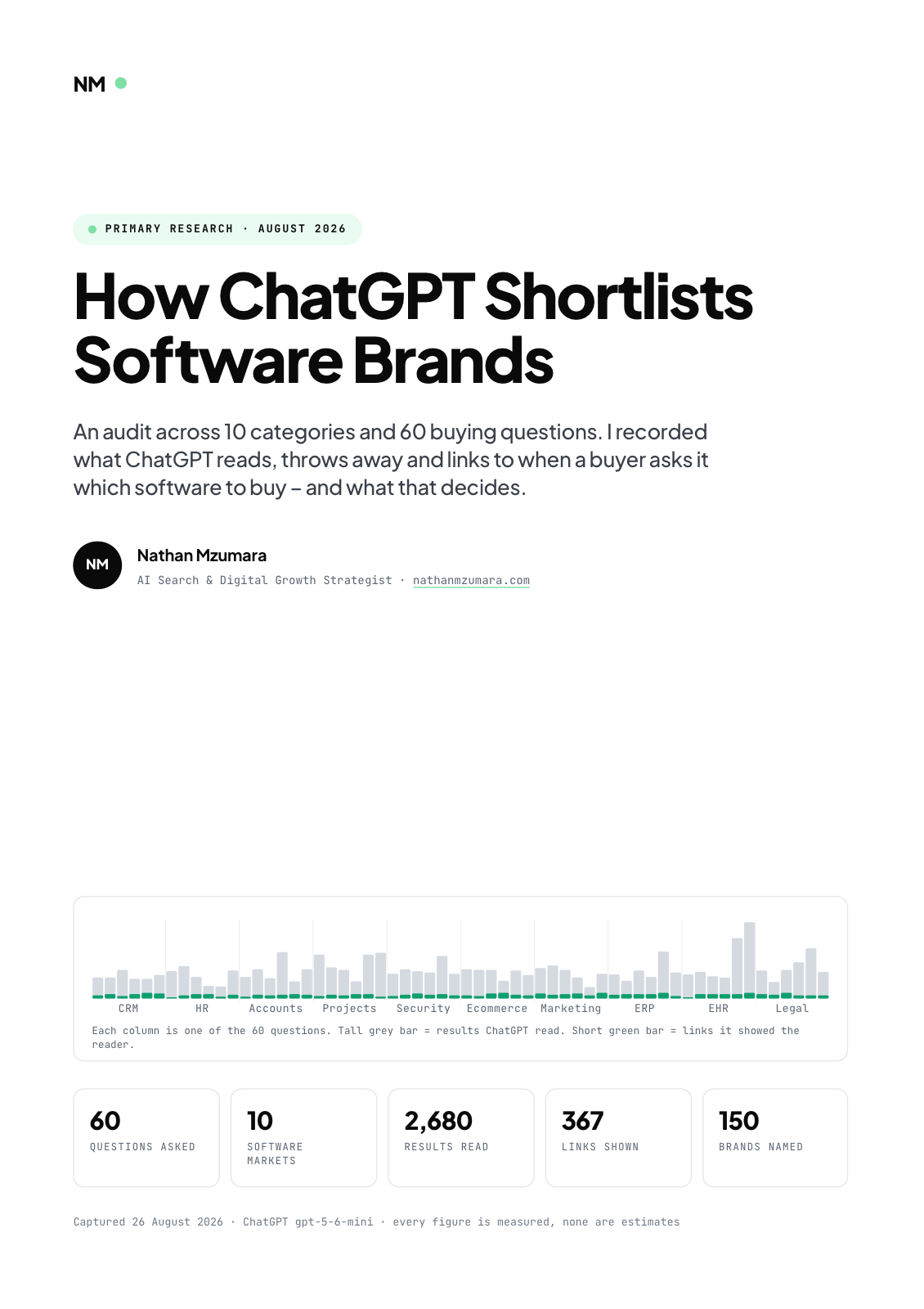
Primary research · August 2026
How ChatGPT Shortlists Software Brands
An audit across 10 categories and 60 buying questions. I recorded what ChatGPT reads, throws away and links to when a buyer asks it which software to buy, and what that decides.
- 60
- Questions asked
- 10
- Software markets
- 2,680
- Results read
- 367
- Links shown
Free download
Get the full report
35 pages · PDF · 536 KB. Enter your details and it downloads straight away.