AI Model & Product
GPT-Live
Also known as: GPT-Live-1
GPT-Live, sometimes written GPT-Live-1, is a name used for a live or real-time mode of a GPT style model, built for streaming interaction such as continuous voice, screen or camera input with low latency replies. Naming in this area changes quickly and varies between vendors, so treat the label as a category of behaviour rather than a fixed product. Verify current capabilities and availability against the provider's own documentation before planning work around it.
What it is
The term points at real-time or live model interfaces, where input arrives as a continuous stream and the model responds while the session is still running rather than after a completed prompt. Practically that means speech in and speech out, shared screens or video, interruption handling and persistent session context. It is a delivery mode layered on an underlying language or multimodal model rather than a separate kind of intelligence.
Why it matters
Live interaction changes the shape of discovery, because a spoken answer usually names one or two sources at most and offers no list of links to scan. If assistants answer while a user is walking round a shop, on a call or looking at a screen, the winning content is whatever can be stated in a sentence and trusted. That raises the value of clear factual pages, accurate business data and consistent naming across the web.
How it works
Developers connect through streaming APIs that keep a session open, send audio or video chunks, and receive incremental tokens or synthesised speech back. Practitioners test how such modes describe their brand, whether opening hours, pricing and availability are correct, and how the assistant behaves when interrupted or asked to check a source. Because latency is the constraint, these modes typically read fewer sources than a slower research mode, so being the obvious canonical answer matters more.
When it applies
It applies when planning for voice and multimodal assistants, in-store or in-car queries, and any customer support or sales use case where people expect to talk rather than type.
Examples
- A local services business checks whether a voice assistant reads its opening hours and callout charge correctly.
- A support team pilots a live voice agent that shares the customer's screen during a setup call.
- A retailer tests spoken product comparisons to see which attributes an assistant chooses to mention first.
How it is measured
- Accuracy of spoken answers about your brand across a fixed prompt set
- Inclusion rate as the single named source in voice responses
- Median response latency and interruption recovery in live sessions
- Volume and resolution rate of live voice support sessions
Related terms in AI Model & Product
- Agents APIAn Agents API is a programming interface for building applications where a model plans, calls tools and completes multi-step tasks rather than returning a single reply. The term is most often used for OpenAI's agent building interfaces, though other vendors offer equivalents. Teams use it to connect models to search, internal data and actions such as booking, updating records or generating reports.
- AI assistantAn AI assistant is a software product that uses a language model to hold a conversation, answer questions and carry out tasks on a user's behalf. It sits on top of one or more underlying models and adds an interface, memory, tools and safety controls. Examples include ChatGPT, Google Gemini, Microsoft Copilot, Claude and voice assistants such as Siri and Alexa.
- AI transcriptionAI transcription is the automatic conversion of spoken audio into written text using speech recognition models. Modern systems often add speaker labels, punctuation, timestamps and language detection, and can feed the output into summarisation or search. It is also called automatic speech recognition or ASR.
- BingBing is Microsooft's web search engine, available at bing.com and integrated into Microsoft Copilot and other Microsoft products. It maintains its own crawler, Bingbot, and its own index, and provides Bing Webmaster Tools for site owners. Its index and APIs have also supplied results to third-party search products and AI assistants.
- ChatGPT VoiceChatGPT Voice is the spoken conversation mode in OpenAI's ChatGPT apps, which lets you talk to the assistant and hear its replies read aloud. Advanced Voice Mode processes speech directly, so exchanges feel closer to a phone call and you can interrupt mid-answer. People use it hands free on mobile, and it is also available on desktop.
- Claude CodeClaude Code is Anthropic's agentic coding tool that works directly with a codebase, reading files, proposing and making edits, and running commands with permission. It runs in the terminal and in supported development environments, driven by natural language instructions rather than manual file by file editing. Marketing and growth teams use it for technical SEO, structured data and data tasks that would otherwise wait for engineering.
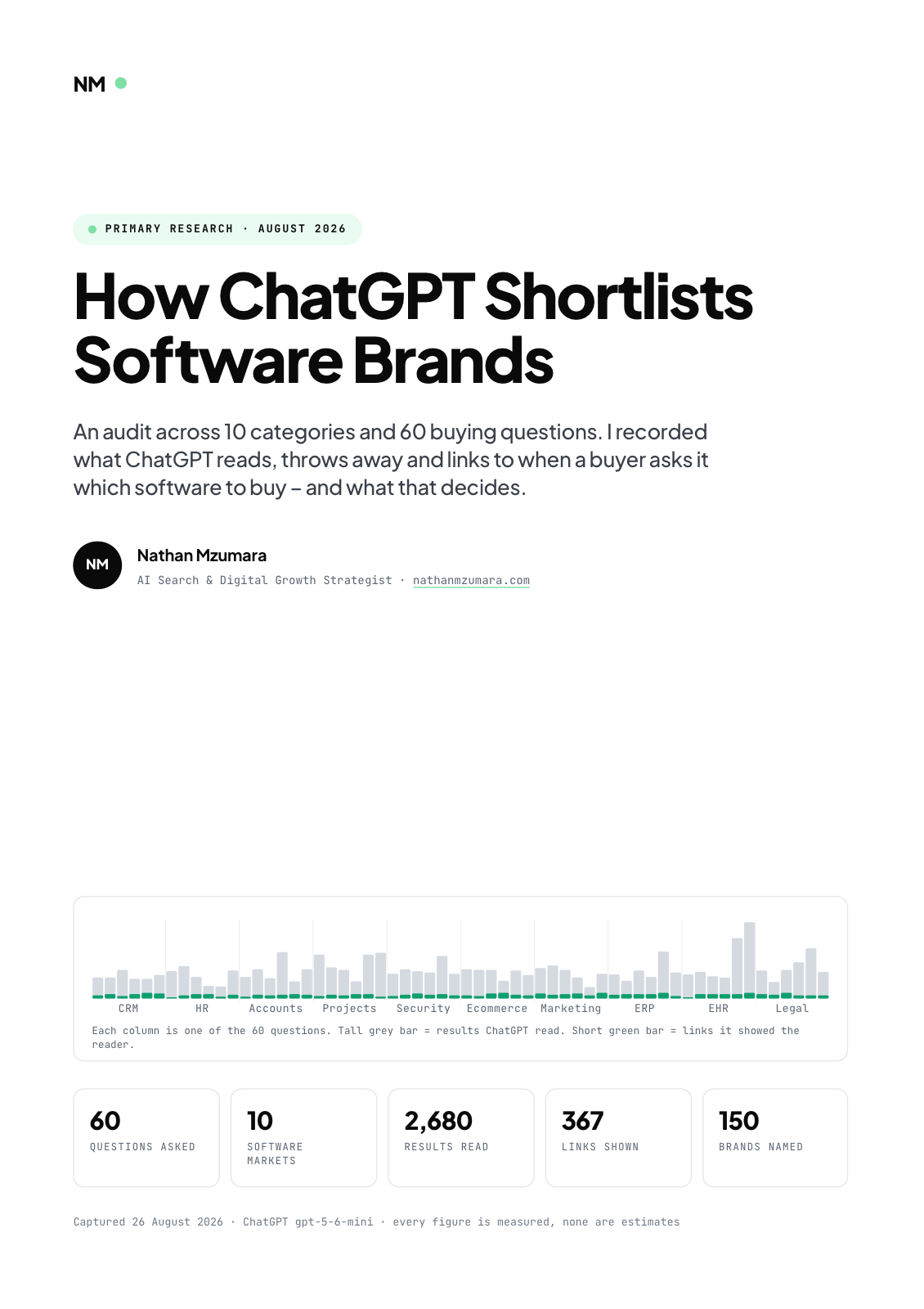
Primary research · August 2026
How ChatGPT Shortlists Software Brands
An audit across 10 categories and 60 buying questions. I recorded what ChatGPT reads, throws away and links to when a buyer asks it which software to buy, and what that decides.
- 60
- Questions asked
- 10
- Software markets
- 2,680
- Results read
- 367
- Links shown
Free download
Get the full report
35 pages · PDF · 536 KB. Enter your details and it downloads straight away.