Tooling
Google Search Console
Also known as: GSC, Search Console
Google Search Console is Google's free tool for site owners, showing how a verified site performs in Google Search and how Google crawls and indexes it. It reports clicks, impressions, average click-through rate and average position by query, page, country and device. It is the only first-party source of Google query data for your own site.
What it is
Search Console combines performance reporting with technical diagnostics. The performance report covers search traffic, while indexing reports, the URL Inspection tool, sitemap submission and Core Web Vitals data show how Google handles individual pages. Query and page data is available for the trailing sixteen months.
Why it matters
It is the closest thing to ground truth for what people search before they reach your site, which makes it the starting point for content and technical priorities. Google has said data from AI Overviews and AI Mode is included in the performance report rather than broken out as a separate search type, so visibility shifts in AI-led results show up as changes in impressions, position and click-through rate. That makes trend analysis in Search Console essential when diagnosing traffic drops.
How it works
Practitioners verify the property, then compare date ranges to spot query and page level movements, filter by page group to test hypotheses, and use URL Inspection to confirm indexing and rendering. Larger teams export data through the API or Looker Studio to keep more than the interface limits and to join it with analytics and revenue data.
When it applies
It applies to any site you own or manage, from first launch through migrations, redesigns and ongoing reporting, and whenever you need evidence about impressions, rankings or indexing.
Examples
- A retailer compares this quarter with last year at page level and finds informational guides losing clicks while impressions hold steady
- An SEO uses URL Inspection to confirm a new category page is indexed after a sitemap update
- A team exports sixteen months of query data to Looker Studio to build a branded versus non-branded traffic dashboard
How it is measured
- Clicks, impressions, click-through rate and average position by query and page
- Indexed pages against submitted pages in sitemaps
- Count and trend of pages flagged as not indexed, by reason
- Core Web Vitals URL groups passing, needing improvement or failing
Insights on Google Search Console
- Google Just Introduced Web Multimodal for Search Performance Reporting in Search Console
- GSC Now Tracks Your Instagram, TikTok, X and YouTube Posts in Search
- GSC's AI Overview Report: Read It Wrong and You'll Strategy Wrong
- May 2026 Core Update Is Done: Intent Alignment Is Now Your Most Urgent Priority
- Google Search Console Now Reports AI Feature Performance: What Growth Teams Must Do First
- May 2026 Core Update Is Done: Intent Alignment Is Now Your Most Urgent Priority
Related terms in Tooling
- Ahrefs Brand RadarAhrefs' AI-visibility module tracking brand mentions and impressions inside AI answers. Surfaces shifts in how brands appear across ChatGPT, Gemini, and other LLM surfaces.
- AI content detectionAI content detection is the use of software to estimate whether a piece of text, image, audio or video was generated by an AI model. Detectors return a probability or classification rather than proof, and accuracy varies with length, language, editing and model used. Because of that uncertainty, results are treated as a signal for review, not a verdict.
- AI watermarkingAI watermarking is the practice of embedding a signal into AI generated text, images, audio or video so the output can later be identified as machine produced. The signal is usually designed to be imperceptible to people but detectable by software that holds the matching key or detector. It is one of several provenance approaches used alongside metadata standards and content credentials.
- Bot detectionBot detection is the practice of identifying automated traffic to a website or API and separating it from human visitors. It distinguishes wanted automation, such as search engine and AI crawlers, from unwanted activity like scraping, credential stuffing and click fraud. Detection results feed decisions about what to allow, challenge, rate limit or block.
- Brave BrowserBrave is a Chromium based web browser from Brave Software that blocks third party trackers and most ads by default. It bundles privacy controls, Brave Search as the default engine, and an AI assistant called Leo. Because it strips tracking scripts, visits from Brave users are often harder to attribute in analytics.
- Brave SearchBrave Search is a search engine from Brave Software that serves results from its own web index rather than reselling another engine's results. It is the default engine in the Brave browser, offers AI generated answer summaries, and is sold to developers as the Brave Search API. That API makes it a grounding source for other search and AI products.
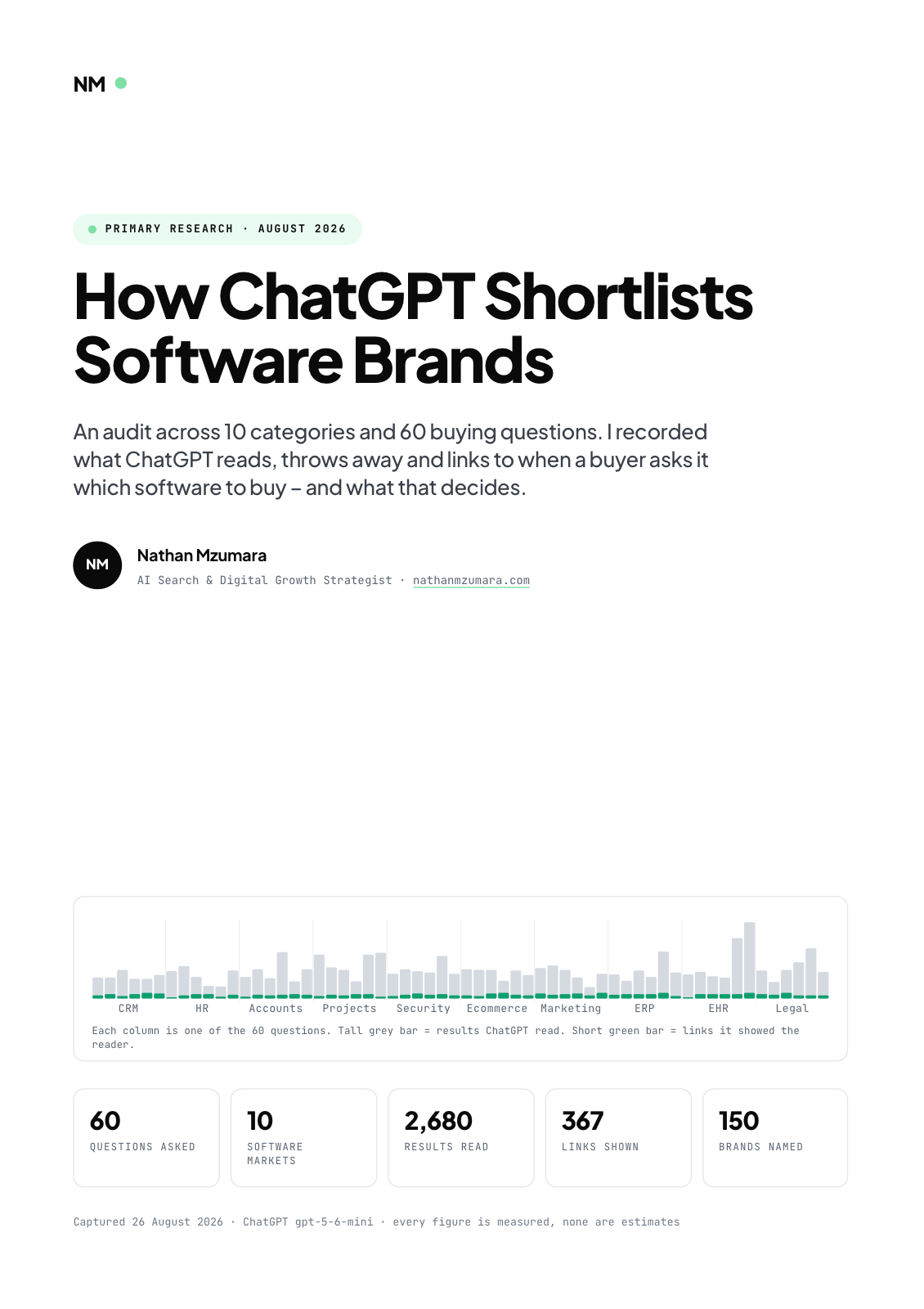
Primary research · August 2026
How ChatGPT Shortlists Software Brands
An audit across 10 categories and 60 buying questions. I recorded what ChatGPT reads, throws away and links to when a buyer asks it which software to buy, and what that decides.
- 60
- Questions asked
- 10
- Software markets
- 2,680
- Results read
- 367
- Links shown
Free download
Get the full report
35 pages · PDF · 536 KB. Enter your details and it downloads straight away.