Marketing Strategy
Content strategy
Content strategy is the plan that governs what content an organisation creates, for whom, why, and how it is maintained over time. It covers audience and topic decisions, formats and channels, editorial standards, ownership and the review cycle that keeps published work accurate. It sits above individual campaigns and briefs, and is what stops content production turning into an unmanaged backlog.
What it is
A content strategy documents the audiences you serve, the questions and jobs you will help with, the topics you intend to own, and the standards every piece must meet. It also defines governance: who approves, who updates, how often things are reviewed and when content is retired. The output is usually a short strategy document plus working artefacts such as a topic map, a style guide and an editorial calendar.
Why it matters
Discovery increasingly rewards depth and consistency across a topic rather than isolated pages, and AI assistants summarise whoever explains a subject most clearly and credibly. A strategy makes sure your best thinking is published in a form that both people and machines can parse, and that outdated pages do not quietly undermine trust. It also prevents duplicated effort across teams that all produce content for the same audience.
How it works
Practitioners start with customer research and sales conversations, audit what already exists, then map topics to funnel stages and assign each one a primary page and supporting pieces. They set formats, internal linking rules and structured data conventions, then run a repeating cycle of brief, produce, review, measure and refresh. Regular content audits decide what to keep, improve, merge or delete.
When it applies
A written strategy is worth the effort as soon as more than one person is publishing, or when output has grown faster than anyone's ability to maintain it. It is also the right starting point before any large site migration, rebrand or push into a new market.
Examples
- A SaaS company maps 12 core topics, assigns one pillar page and five supporting articles to each, and sets a six-month refresh cycle.
- A professional services firm audits 400 blog posts, keeps 90, merges 60 and redirects the rest.
- An ecommerce brand defines category page standards covering sizing, materials and returns so product questions are answered on site rather than in support tickets.
How it is measured
- Topic coverage: share of priority questions with a published, owned answer
- Content freshness: percentage of pages reviewed or updated within the agreed window
- Assisted pipeline or revenue influenced by content, by topic cluster
- Citation and mention rate in AI answers for the topics you have chosen to own
Insights on Content strategy
- AI Search Optimization Starts With the Questions Nobody Typed
- The Page Shapes AI Retrieval Actually Finds: 525 Versus Pages, 17 Reviews
- Recency Is Close to a Filter: 86.3% of What ChatGPT Read Carried a 2026 Date
- Grok Build Just Went Free. Your Micro-Tool Moat Is Gone.
- GPT-Live Is Here. Voice AI Just Became a Discovery Channel.
- Google Trends Now Shows You Trend Velocity. Your Spreadsheet Step Just Died.
- ChatGPT Just Shipped Its Most Ambitious Product Sprint. This Is What It Signals.
- GPT-5.5 Instant Now Matches Frontier AI on Health. Your Content Is the Last Gate.
Related terms in Marketing Strategy
- Agentic marketingAgentic marketing is the use of AI agents that can plan multi-step work and take actions across marketing tools, rather than only generating text on request. It also covers designing marketing for a world where buyers delegate research and purchasing to their own agents. In practice it is a mix of workflow automation, tool permissions and human review.
- AI searchAI search is the use of large language models to answer a query directly, usually with a written summary rather than a list of links. It covers AI overviews inside traditional search engines and assistants such as ChatGPT, Perplexity, Copilot and Gemini. The visible outcome for a brand is being described and cited inside an answer rather than ranked on a results page.
- AI-generated contentAI-generated content is text, images, audio, video or code produced wholly or mainly by a generative model rather than written or made by a person. It ranges from fully automated output to drafts that a human edits and approves. Its value in marketing depends on editorial control, accuracy and whether it adds anything a reader cannot get elsewhere.
- Audience intelligenceAudience intelligence is the practice of gathering and analysing data about who your audience is, what they care about, and how they search and buy, then turning that into decisions. It combines first party behavioural data with research, search data, social listening, and customer conversations. The output is usually segments, messaging guidance, and content priorities rather than a single report.
- B2B marketingB2B marketing is the practice of promoting products and services to other organisations rather than to individual consumers. It typically involves longer sales cycles, multiple decision makers, higher contract values and a heavier reliance on content, sales enablement and relationships. Success is usually measured through pipeline and revenue contribution rather than immediate transactions.
- Brand voiceBrand voice is the consistent personality and language a brand uses across every channel, covering vocabulary, tone, sentence rhythm and the things it will and will not say. It is documented in guidelines so different writers, agencies and AI tools produce work that sounds like the same organisation. Voice stays stable while tone flexes with context.
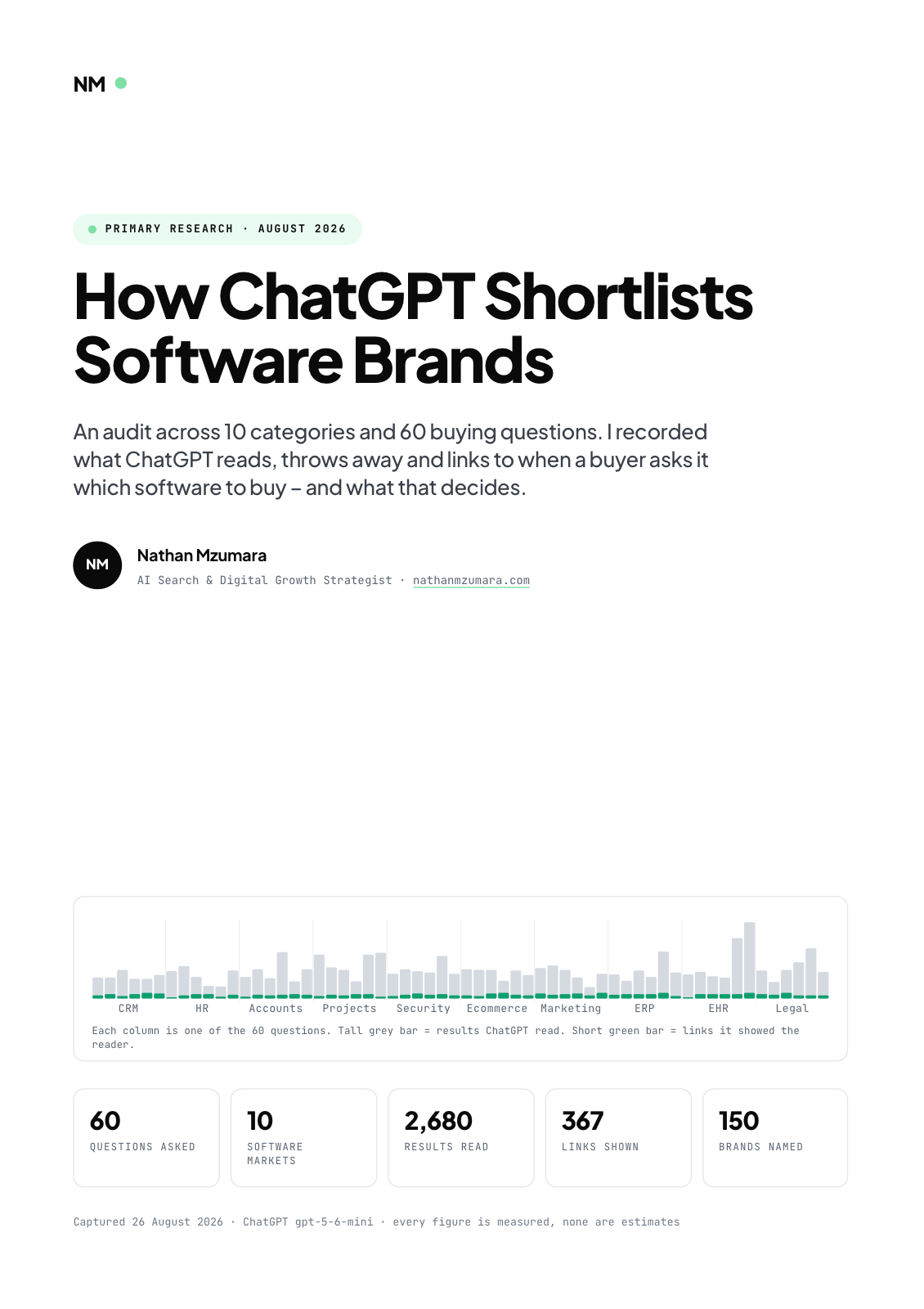
Primary research · August 2026
How ChatGPT Shortlists Software Brands
An audit across 10 categories and 60 buying questions. I recorded what ChatGPT reads, throws away and links to when a buyer asks it which software to buy, and what that decides.
- 60
- Questions asked
- 10
- Software markets
- 2,680
- Results read
- 367
- Links shown
Free download
Get the full report
35 pages · PDF · 536 KB. Enter your details and it downloads straight away.