Grok Build Just Went Free. Your Micro-Tool Moat Is Gone.
On 19 August 2026, xAI made Grok Build available on every plan, on web and mobile. Describe an app, a calculator, a dashboard or an interactive page, and Grok builds a working version live in the chat, then publishes it to its own link. The cost of building the kind of micro-tools that historically won links and citations just fell to zero.
For growth leaders, that is the whole story in one sentence. The build layer is now commoditised. What used to take a developer sprint and a budget line now takes a prompt.
What actually shipped, and when
Grok Build launched in July as an Early Beta locked to SuperGrok Heavy. As of 19 August 2026, it ships to everyone, on the web, iOS and Android, and it now does far more than generate a toy.
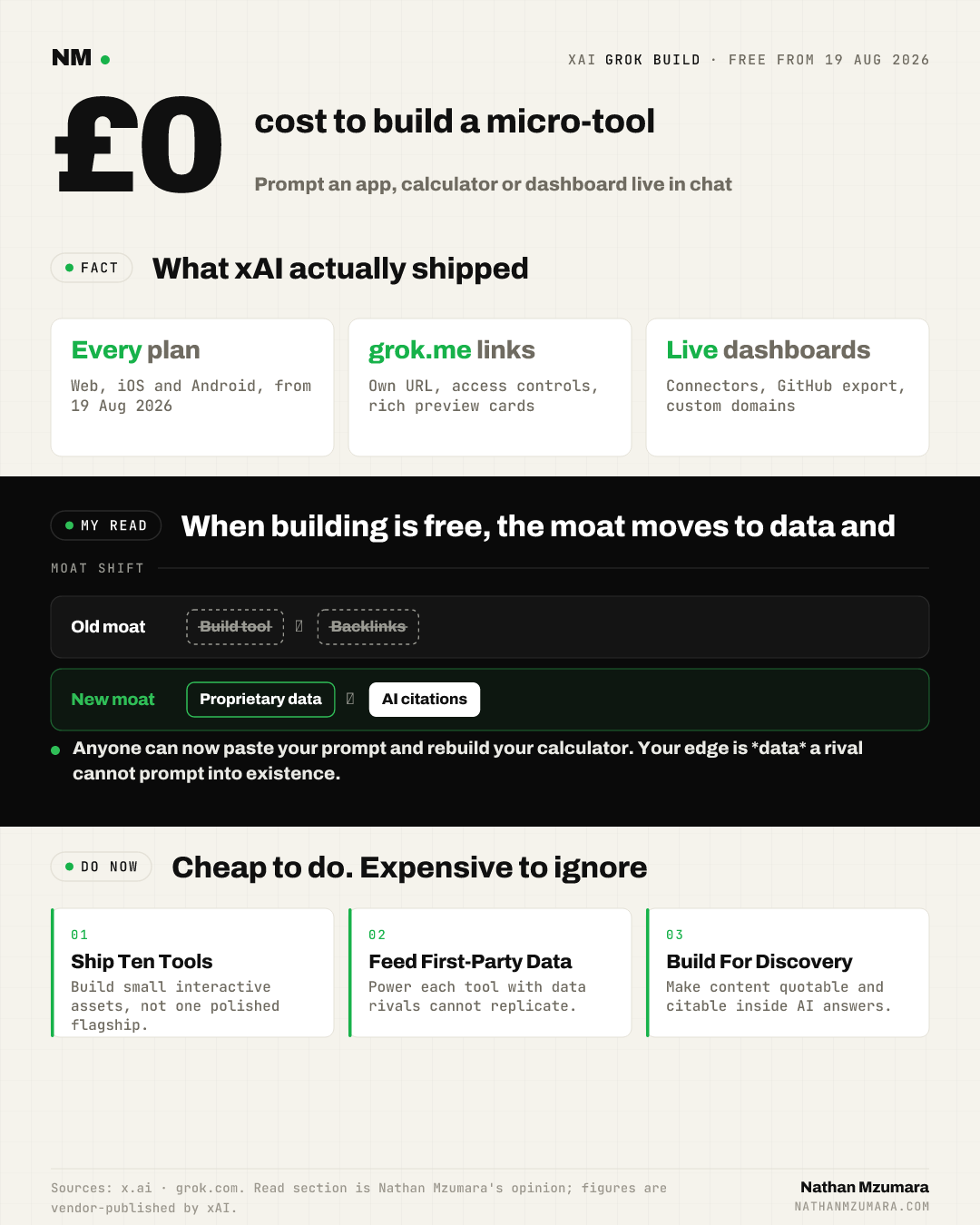
Each published app gets its own grok.me address with access controls (private, link-only, or public), auto-generated rich preview cards, custom domain support, GitHub export and connectors that pull business data into live, filterable dashboards. You can read the full feature set in the official Grok Build announcement from xAI.
Why this breaks the old playbook
For years, the interactive asset was a reliable moat. A well-built mortgage calculator, an ROI tool, a quiz or a data visualiser earned backlinks, dwell time and, increasingly, citations inside AI answers. The barrier was execution: most teams could not build one quickly or cheaply.
That barrier is gone. When anyone can prompt a functional tool into existence in minutes, the tool itself stops being the differentiator. In my opinion, this is the same shift we saw when website builders killed the bespoke brochure site as a signal of seriousness.
Where differentiation moves next
From my observation, the value is migrating from "who can build" to "who can distribute and be discovered". If a competitor can replicate your calculator by pasting your prompt, your edge is no longer the asset. It is proprietary data, brand trust, and a discovery strategy that gets the asset in front of both humans and models.
This matters more now that AI assistants build and cite interactive content directly. I covered a parallel move when Claude put a designer in the terminal, collapsing UI iteration in the same way.
What a defensible moat looks like now
| Old moat | New moat |
|---|---|
| Ability to build the tool | Proprietary data the tool runs on |
| Backlinks to a static asset | Citations across AI answer surfaces |
| Design polish | Brand trust and distribution reach |
| One-off launch | Discoverability across web and LLMs |
Caption: differentiation shifts from build capability to data, trust and discovery.
What to do this quarter
First, stop treating tool-building as a project cost and start treating it as free. Ship ten small interactive assets, not one polished flagship.
Second, feed each tool proprietary or first-party data that a rival cannot prompt into existence. That is your moat.
Third, build for discovery, not just links. Structure the surrounding content so it is quotable and citable inside AI answers, the same discipline I set out in the GEO playbook for Grok on Google Cloud.
I think the teams who win from here are not the ones who build fastest. They are the ones who own the data and the distribution when everyone else can build too. Try it yourself and pressure-test your own moat via the Grok Build entry point on grok.com.
Tags