Grok 4.6 Just Landed on Google's Cloud. Your GEO Playbook Changes.
On 21 August 2026, xAI made Grok 4.6 available through Google's Gemini Enterprise Agent Platform, listed in Model Garden. The same flagship model already runs inside rival cloud stacks, which means the model, not the platform, is now the thing that shapes discovery.
For growth leaders, that is the whole story in one sentence. If your buyers can reach the same reasoning engine inside Google or AWS, then how a model cites and reasons matters more than which vendor hosts it.
What actually shipped
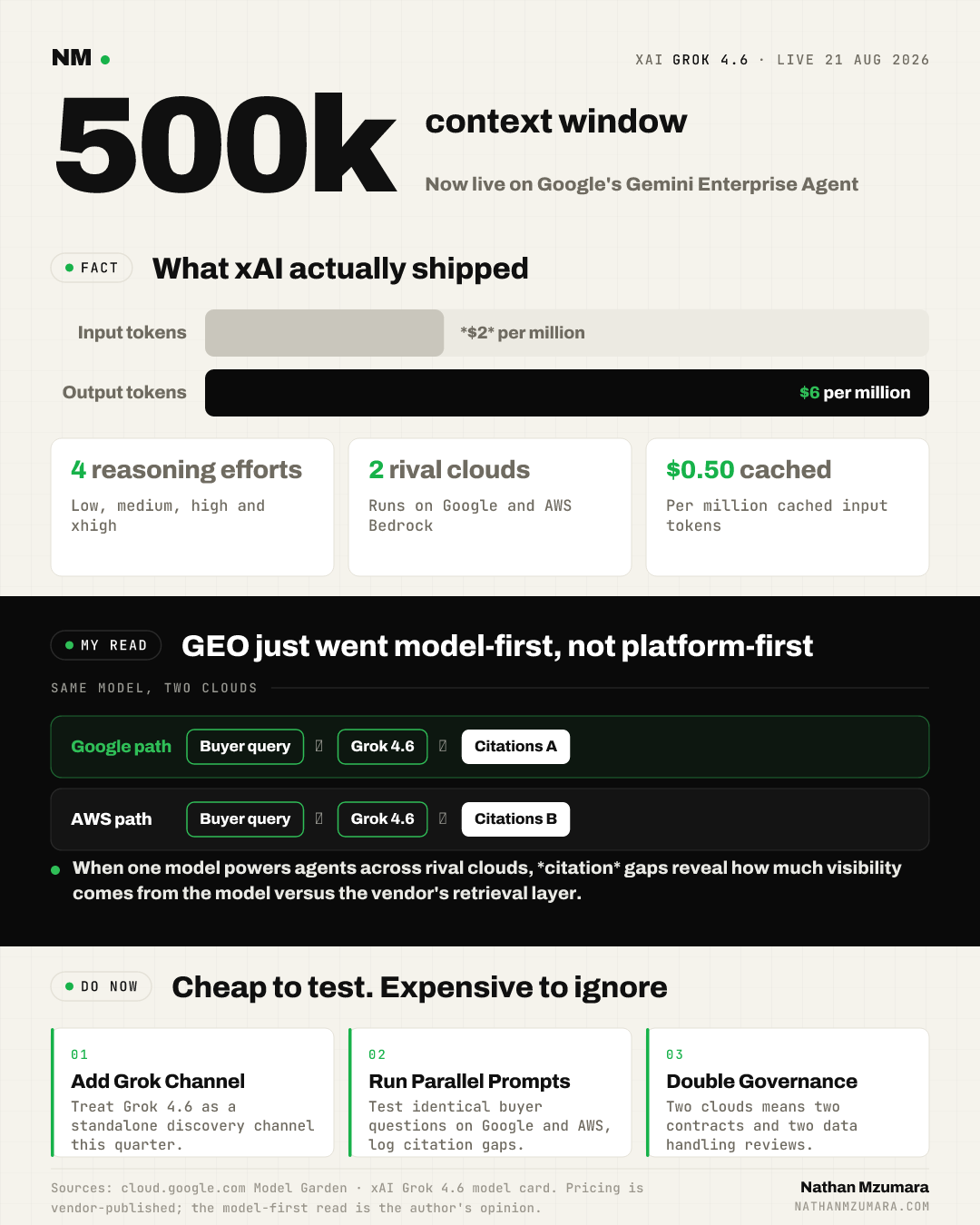
Grok 4.6 is xAI's latest flagship, built for long-running agents and heavy interactive work. It carries a 500k context window and four configurable reasoning efforts: low, medium, high and xhigh. You can read the specifics in the official Grok 4.6 on Gemini Enterprise announcement.
Pricing sits at $2 per million input tokens, $0.50 for cached input and $6 per million output tokens. The full technical detail lives in the Grok 4.6 model card.
Why the same model on two clouds changes things
Until recently, we treated each AI surface as its own walled garden. Google answers were a Google problem, AWS agents were an AWS problem, and teams built separate visibility plans for each.
That assumption is breaking. When Grok 4.6 runs inside both Google's agent platform and Amazon Bedrock, a buyer asking the same question can get answers driven by the same reasoning core, wrapped in different vendor context. From my observation, this is the point where GEO stops being platform-first and becomes model-first.
Treat Grok as its own discovery channel
I think the practical mistake here is to fold Grok into your existing Google or AWS testing. It has its own citation behaviour, its own retrieval quirks and its own sense of what counts as a trustworthy source.
As I argued in Citation Share Is Not Traffic, different engines cite differently, and citation share is not the same as traffic share. Grok deserves the same distinct measurement lens.
Test the same content across both clouds
Here is the concrete work for an in-house GEO or growth team:
- Run your priority buyer questions through Grok 4.6 inside Google's Gemini Enterprise Agent Platform and note which sources it cites.
- Run the identical questions through Grok 4.6 on AWS and compare the citation set.
- Log where the same model surfaces your brand differently depending on the cloud context around it.
- Adjust content and schema for the reasoning pattern, not just the platform.
The differences you find are the real signal. They tell you how much of your visibility comes from the model versus the vendor's own retrieval layer.
What about governance?
One model spanning two clouds also spreads your data footprint across two contracts. If you run agents on both, your data handling questions double. I covered why this matters in how agent data retention affects compliance, and the same discipline applies here.
The action to take
Add Grok 4.6 to your discovery testing as a standalone channel this quarter. Run parallel prompts on Google and AWS, document the citation gaps, and brief your content team on where the same model treats your brand differently. In my opinion, the teams that map cross-cloud citation behaviour now will own answer visibility long before their competitors realise the walls came down.