Issue 13. AI stops waiting for your query and starts watching your work
TL;DR
This week the ground shifted under discovery: ChatGPT now remembers your activity across every app and website on your machine, and new analysis proves it picks brand winners from memory before it searches the web. AI search is not one channel but three architectures, and the one that cites you most refers almost no one. Add Google's Ask Advisor landing in both Ads and Analytics, plus a hard EU labelling deadline, and the message is clear: context and trust are now the currency, not keywords.

1. ChatGPT now watches everything you do across your computer
- What
- OpenAI has launched Computer History in the ChatGPT desktop app, a feature that remembers your activity across the apps and websites open on your machine and feeds that context into future interactions. OpenAI says this makes interactions 'feel more personalized and require less explanation'. It builds on the earlier Chronicle research preview with reduced token usage and more privacy controls, and adds a timeline view that lets users review past work and build repeatable skills from frequent tasks. It is opt-in, found under Settings then Integrations, and users can clear history, include or exclude specific apps and sites, and pause or resume tracking.
- When
- Announced and rolling out globally from 13 August 2026 to Pro, Business and Enterprise users on Mac, with EEA, UK and Switzerland access following in the coming weeks.
- How it shifts discovery
- This is the biggest change in how AI assistants build context since custom instructions. When ChatGPT knows the tools you use, the sites you visit and the tasks you repeat, it can surface and pre-select brands before you ask a single question. The query is no longer the starting point, your behaviour is. For growth teams, the lever moves from ranking and citations to being part of the user's actual workflow. Audit whether your product is genuinely used in the daily work of your target buyers, because presence in that workflow is now a discovery signal.
- Questions to ask
- Is our product part of the daily workflows our target buyers actually run, not just a page they might visit?
- How do we appear in behavioural context when the assistant has already watched a user work all day?
- What is our stance on the consent trade-off, and how do we message it to privacy-conscious buyers in the UK and EU?
- Sources
2. Citation share is not traffic: AI search is three architectures, not one channel
- What
- Most GEO advice treats AI search as one channel, but there are three distinct architectures underneath. Retrieval-first engines (Perplexity, Google AI Overviews and AI Mode, Bing Copilot) search on nearly every query and reward classic SEO: crawlability, index presence, schema. Hybrid model-led engines (ChatGPT Search, Claude with web search, Gemini app) answer from training weights unless the query forces a search, and this is where most enterprise B2B queries land. Pure parametric systems (base chat with browsing off, DeepSeek, most API calls) do not retrieve at all, so presence is an entity problem decided by Wikidata, consistent brand mentions and third-party coverage. Research from Trakkr puts Perplexity at a median 6.4 unique domains per answer, Claude at 3.6, ChatGPT at 3.1 and Gemini at 2.4.
- When
- Analysis published 13 August 2026, citing engine-level citation research and referral data through mid-2026.
- How it shifts discovery
- The Perplexity paradox is the lesson: it cites the most yet refers the fewest. ChatGPT crossed a billion monthly users in June 2026 and Google AI Overviews reach roughly 1.5 billion, so their audience arithmetic dwarfs Perplexity's per-answer edge. Density dilutes too, as twenty citations in one answer each get a thinner slice, while ChatGPT's three-domain median concentrates attention. Previsible found Perplexity referral sessions down 61% from a March 2025 peak, partly because it retains users inside its own browser and agents. Stop treating citation share as a proxy for traffic. Measure each tier separately, and remember cited brands earn roughly 35% more organic clicks than uncited ones.
- Questions to ask
- Which of the three tiers do our priority queries actually land in, and are we resourcing the right work for each?
- Are we conflating citation share, referral traffic and influence in one dashboard when they should be three?
- What is our entity strategy (Wikidata, consistent mentions) for the parametric tier where there is no page to optimise?
- Sources
3. ChatGPT names its shortlist from memory before it searches the web
- What
- New analysis of a few hundred ChatGPT search queries shows the model writes its own search query first, and that query already contains brand names the user never typed. When asked for the best AI note-taking app in seven words, ChatGPT wrote a query ending Granola, Notion AI, Otter, Fireflies, Fathom, Mem, Limitless, then ran a site: probe against each company's own site. The fan-out is not a hunt for candidates, it is the model working down a list it already held from training memory. The data sits in the JSON your browser downloads under a key called search_queries, renamed from search_model_queries in early August 2026, and you can read it in DevTools in about two minutes.
- When
- Analysis by Suganthan Mohanadasan published 13 August 2026, based on two months of reading ChatGPT's generated queries.
- How it shifts discovery
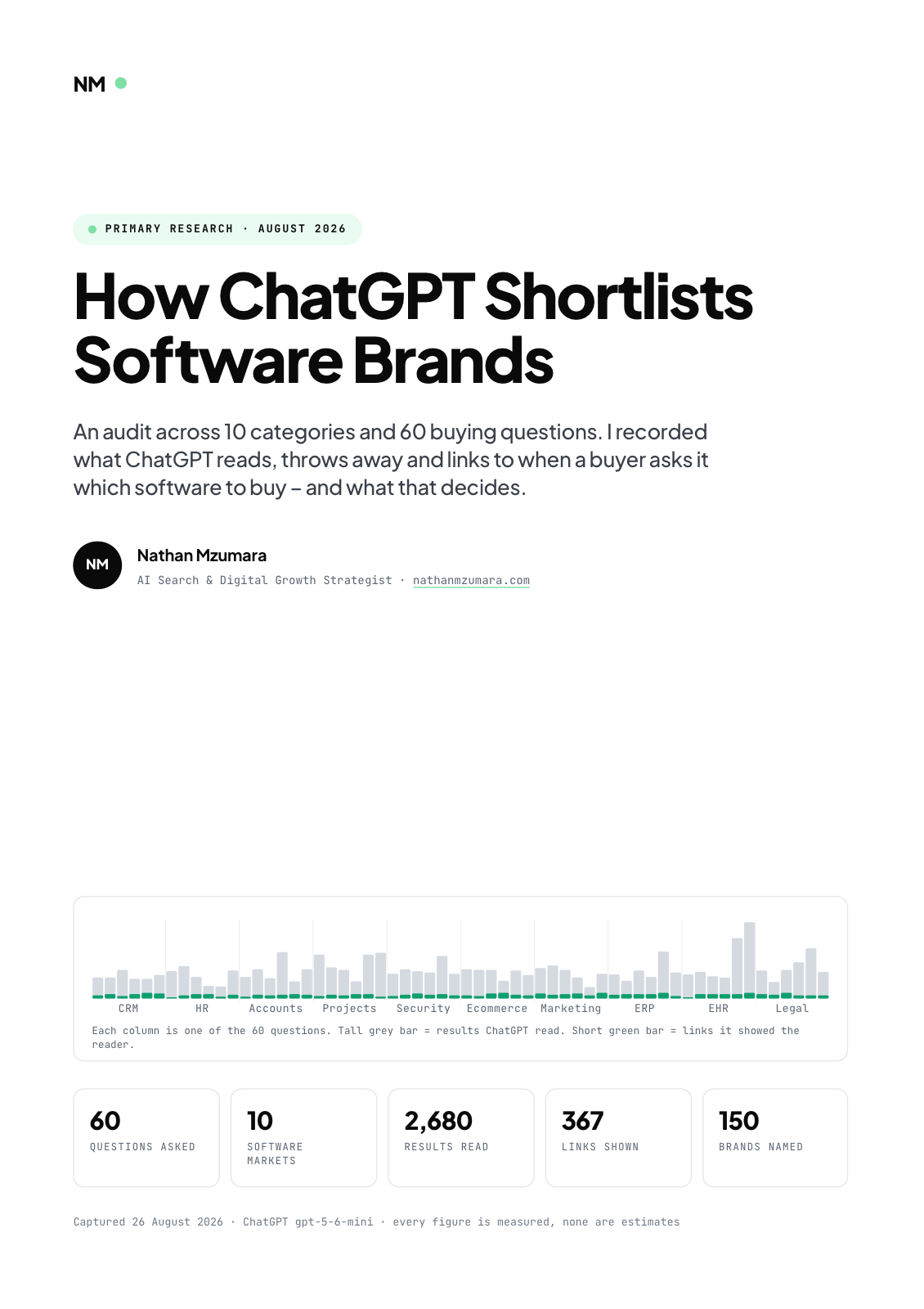
- Isolating the first user message and first search query (before anything is fetched), 21 of 27 conversations contained brands the user never typed, and 11 of 13 categories did the same. The figure that should reorder your budget: brands named in ChatGPT's own query appeared in the final answer 68.9% of the time, versus 2.1% for brands merely fetched but never named. Being on the shortlist is worth roughly 33 times more than being findable. Shift budget from on-page tweaks alone toward the training-memory signals that get you named: consistent third-party mentions, entity clarity and category authority the model absorbed before it ever searched.
- Questions to ask
- Does the model already know our brand in our category, or are we invisible until it fetches our site?
- What third-party coverage and entity signals get a brand into the training-memory shortlist?
- Have we tested our own priority queries in DevTools to see whether we appear in the search_queries key?
- Sources
4. Google previews Ask Advisor for Ads, and the strategist role shifts
- What
- Google Ads has previewed Ask Advisor, an AI assistant that pulls context from across platforms to shape ad creative and campaign strategy. It is billed as coming soon, with no confirmed rollout window. This is not a reporting tool, it is an advisory agent that sees the cross-channel picture media buyers used to assemble by hand. The framing from Google is blunt: making campaign decisions without the full picture is the problem, and Ask Advisor is the answer.
- When
- Previewed by Google Ads on 10 August 2026, positioned as coming soon.
- How it shifts discovery
- This moves synthesis, the core value of a good media buyer, inside the platform. Your role shifts from doing the join to governing the inputs and checking the output. An advisor is only as good as what it can see, so your first-party data becomes the fuel: thin signals mean it advises blindly, rich clean data means it advises well. Do not wait for launch. Fix conversion measurement, consolidate consented first-party data and offline conversions, tidy account structure so intent reads clearly, instrument reporting to track AI-influenced decisions, and set human review gates for which suggestions auto-apply.
- Questions to ask
- Are our conversion actions clean and de-duplicated, or will the advisor optimise toward noise?
- Do we have consented first-party lists and value signals flowing in to give the advisor real context?
- Which advisor suggestions do we allow to auto-apply, and where do we insist on human review?
- Sources
5. EU sets 2 August 2026 as the AI labelling deadline
- What
- The European Commission has published its Guidelines on transparency obligations under Article 50 of the AI Act, with a hard start date. From that day, AI-generated content needs machine-readable marks, and people must be told plainly whenever they are interacting with an AI system rather than a human. The guidelines split duties between providers (who build and supply AI systems) and deployers (who use them). Most marketing teams sit firmly in the deployer camp, which decides your obligations.
- When
- Article 50 transparency obligations apply from 2 August 2026. The guidelines were last updated on 6 August 2026, and the accompanying Code of Practice is already live.
- How it shifts discovery
- The deployer duty that matters most for content teams is the third one: text on matters of public interest published without human review or editorial control must be disclosed. If you auto-generate commentary on news, health or politics and publish it without a human editor, you now owe your reader a label. Most exposure is not in your chatbots, it is in your content pipeline. Treat 2 August as a start line, not a finish line, and bake labelling and human-review sign-off into workflows now rather than filing a compliance memo.
- Questions to ask
- Where in our pipeline are we publishing AI-touched content on public-interest topics without a human editor?
- Are we a deployer or provider under Article 50, and have we mapped our obligations accordingly?
- Do our chatbots and interactive tools clearly disclose that a user is dealing with a machine?
- Sources
6. Meta is crawling the whole web to build its own search index
- What
- Meta is reportedly crawling the web at scale to build its own search engine, one that would let its AI run web searches without ending up on Google. Developer Pieter Levels surfaced the claim, reporting 'heavy heavy heavy scraping' across all his sites in a single week, aggressive enough to trigger load average alerts on a VPS. One telling detail: the crawler hit url2og, his screenshot service that generates open graph images, behaviour that suggests a rich rendered index rather than a plain text scrape. If it holds, a fifth serious index is forming across the open web.
- When
- The scraping spike ran through the first week of August 2026, surfaced by Levels on 6 August and reported by Barry Schwartz on Search Engine Roundtable on 10 August 2026.
- How it shifts discovery
- The motive is independence. If Meta's AI answers queries with fresh web data through Google, Google sees those queries and could use them for its own training. Meta wants its own window onto the web instead, breaking a decade of leaning on partners like Bing. This makes your crawler access rules a strategic decision, not an IT afterthought. Review your robots.txt and server logs now, decide deliberately whether to allow Meta's crawler, and weigh the trade-off between discovery reach in a new index and the cost of serving aggressive crawls.
- Questions to ask
- Do we allow or block Meta's crawler, and have we made that a deliberate strategic call rather than a default?
- Can our infrastructure handle aggressive rendered crawling without degrading site performance?
- If a fifth major index forms, what is our presence strategy across all of them, not just Google and Bing?
- Sources
7. OpenAI flags Astra 'critical', and trust becomes ranking currency
- What
- OpenAI announced it could no longer rule out that its upcoming model, Astra, has reached the Critical cybersecurity threshold under its Preparedness Framework, the first time a frontier lab has gated a model this hard on the way in. Critical means a model could find and build working zero-day exploits in hardened systems without a human. The gating controls read like a spec: isolated testing, restricted tool access, encrypted weights, sandboxed execution, universal monitoring of the model's chain of thought, and verification with government agencies before wider deployment. Nothing is trusted by default.
- When
- Announced on 7 August 2026, following the framework OpenAI first published in December 2023 and the same playbook used in June 2025 for biology capabilities.
- How it shifts discovery
- The security headline hides a discovery lesson. Safety and discovery are converging on one question: can this be trusted? The same labs building these gated models build the answer engines mediating discovery, on the same trust-first architecture. Unverifiable, thin or anonymous content is the discovery-layer equivalent of an unmonitored agent action, and it gets held back. The action is to build provenance into your content: clear authorship, verifiable expertise and authoritative sourcing. Trust is replacing links and keywords as the ranking currency.
- Questions to ask
- Does our content carry verifiable authorship and provenance, or is it anonymous and thin?
- How do we demonstrate authority in a way an answer engine can verify before it cites us?
- Are we still optimising for links and keywords when the currency is shifting to trust?
- Sources
8. Ask Advisor lands in Google Analytics with proactive AI on the Home screen
- What
- Ask Advisor is now live in Google Analytics, bringing Gemini-powered proactive intelligence to the Home screen. It spots critical trends and provides instant takeaways so teams can adjust strategy in real time, surfacing seasonal peaks and traffic drops without you having to go looking. This is distinct from the Ask Advisor Ads preview: this one is the GA4 measurement rollout, with a live get-started link, that changes how in-house teams monitor data day to day.
- When
- Announced by Google Analytics on 12 August 2026.
- How it shifts discovery
- This moves GA4 from a place you query into a system that flags things at you, which is useful but demands discipline. Proactive alerts are only as good as your data quality, so noisy or duplicated events will produce noisy takeaways (one commenter already flagged an evening data anomaly). Treat the AI takeaways as a first look, not a verdict. Audit your event and conversion setup so the Home-screen intelligence surfaces real signal, and define which flagged trends warrant a human investigation before you act on them.
- Questions to ask
- Is our GA4 event and conversion tracking clean enough for proactive alerts to be trustworthy?
- Which flagged trends do we act on automatically, and which need human verification first?
- How do we stop proactive takeaways from becoming noise that the team learns to ignore?
- Sources
Key takeaways
What to walk away with this week
- 01
Personalisation has moved from what people type to what they do all day. ChatGPT Computer History means brands get considered inside a user's workflow, before any query is asked.
- 02
AI search is three architectures, not one channel. The engine that cites you most (Perplexity) refers the fewest, so measure citation share, referral traffic and influence separately.
- 03
Being named in ChatGPT's own query is worth roughly 33 times more than being findable. Entity signals and third-party mentions that shape training memory now beat on-page tweaks alone.
- 04
Google's Ask Advisor is arriving in both Ads and Analytics. Your first-party data quality decides whether the agent advises well or optimises toward noise.
- 05
Trust is the new ranking currency. From EU labelling rules to OpenAI's gating instinct, verifiable provenance is becoming the price of a citation.