Research Acceleration: OpenAI's Agent Metrics Marketers Should Copy

What OpenAI disclosed about research acceleration
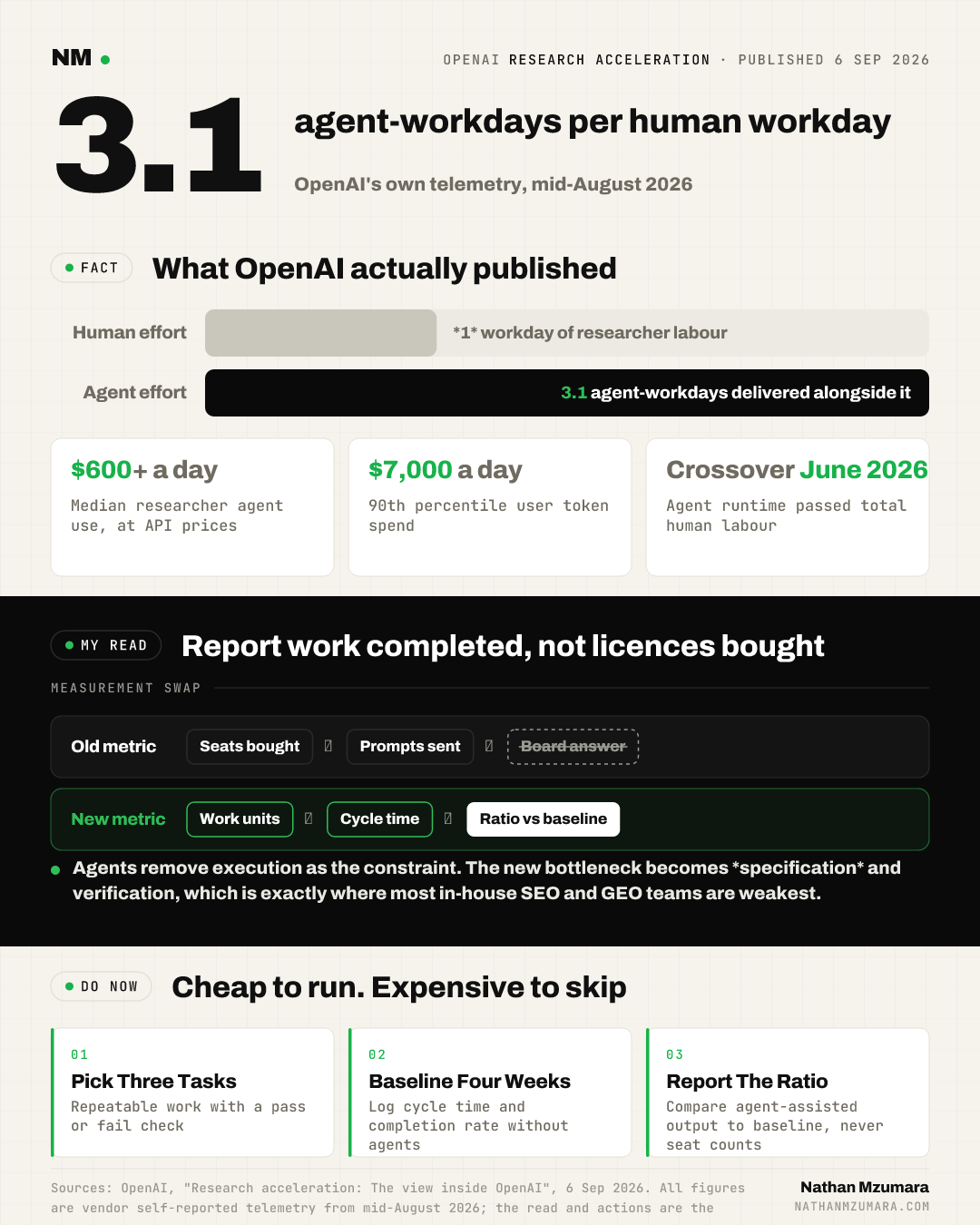
Research acceleration is the measurable speed-up a team gets when AI agents do part of its work. On 6 September 2026, OpenAI published Research acceleration: The view inside OpenAI, a snapshot of its own agent telemetry. It is the first time a frontier lab has shown the numbers behind the claim that AI makes teams faster.
The figures OpenAI reported
| Measure | Value | Period |
|---|---|---|
| Median researcher agent use | More than $600 per day of inference at API prices | Mid-August 2026 |
| 90th percentile user | More than $7,000 of tokens per day | Mid-August 2026 |
| Agent effort vs human effort | 3.1 agent-workdays per human workday | Mid-August 2026 |
| Crossover point | Agent runtime passed total human labour | After June 2026 |
OpenAI states that researchers are contributing code faster and running more experiments, and that agents are handling more complex tasks and succeeding more often. All figures above come from OpenAI's own post.
Why seat counts are the wrong marketing metric
Most CMOs still report AI adoption as licences bought and prompts sent. OpenAI reported something else: effort delivered and work completed, measured against human workdays. That is the model to copy. Track completed work units and cycle time per unit, then compare the two against last quarter.
OpenAI also warns that overall progress will not keep pace with these specific metrics, because research has many bottlenecks. Apply the same caution to marketing. A faster build stage does not shorten a campaign if approvals are the constraint.
Where agent gains actually concentrate
OpenAI's account points to well-defined tasks under human direction. In marketing, the equivalent work is well scoped and verifiable:
- Technical SEO fixes: crawl errors, redirects and internal linking, where success is checkable against a log or a crawl.
- Schema deployment: repeatable markup with a validator that gives a pass or fail.
- Feed hygiene: product data cleaning, where the error count before and after is the result.
- Variant production: ad and landing page variants judged by a live test, not an opinion.
Ambiguous strategic work does not behave this way. Positioning, brand and budget calls still need people to set priorities, exactly as OpenAI says its researchers do.
The bottleneck moves to specification and verification
If agents remove execution capacity as the constraint, the new constraint is the quality of your brief and your check. Most in-house SEO and GEO teams are weakest here. Build the verification loop first, as we argued in our piece on provider risk in agentic coding tools.
Safety is part of the same discipline. OpenAI paused reinforcement learning training after the Hugging Face incident, described in its post on pacing model development. Slowing down when a control fails is a legitimate operating choice.
How to measure research acceleration in your team this quarter
Pick three repeatable tasks. Record cycle time and completion rate for four weeks without agents, then four weeks with them. Report the ratio, not the seat count. For causal rigour on spend, pair it with the approach in Google Meridian GeoX and incrementality testing. Research and development acceleration is now something you can evidence, and research acceleration measured this way answers the board question with a number instead of an anecdote.
Tags