Google Meridian GeoX: MMM Moves From Correlation to Causation

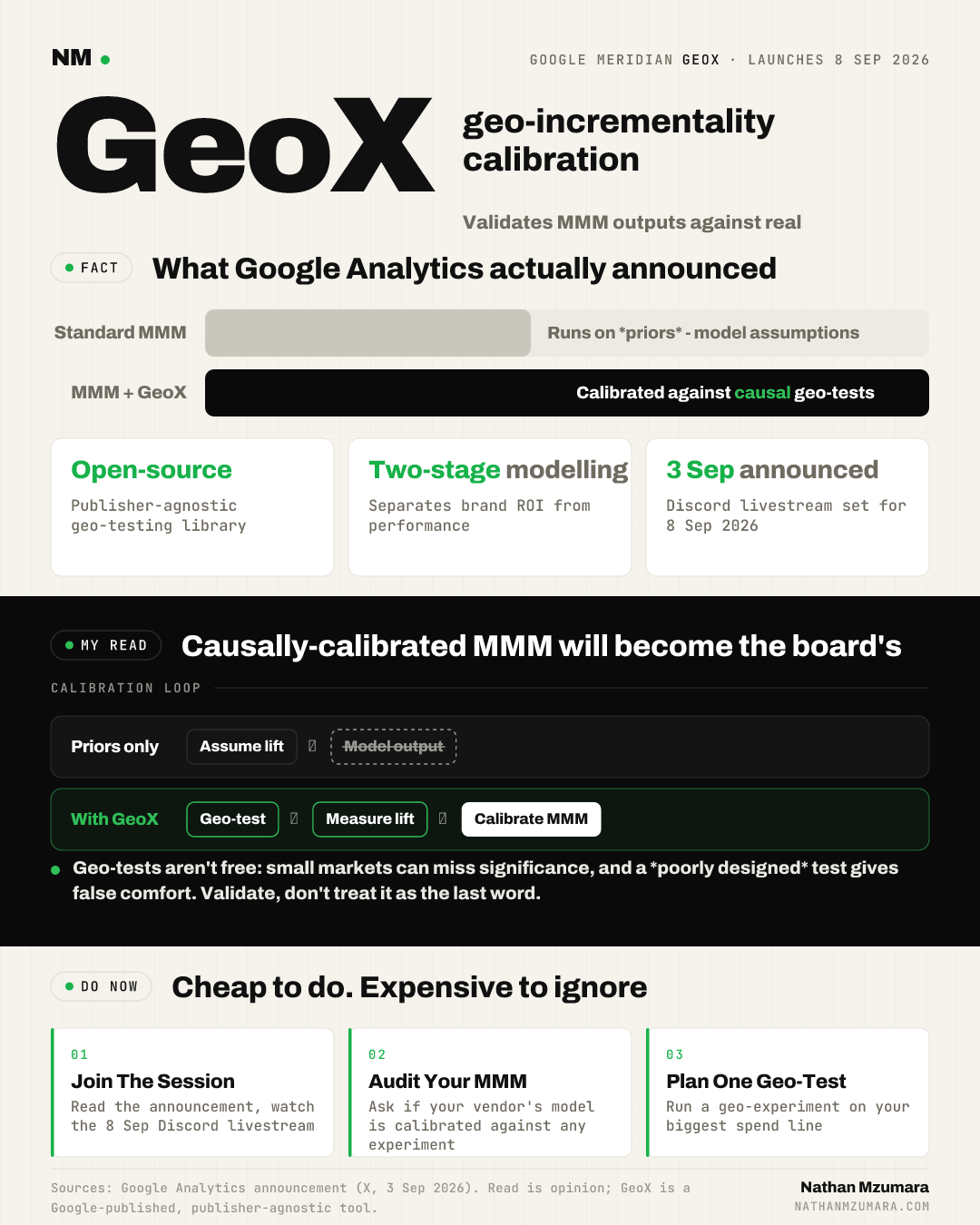
Google Meridian is Google's open-source marketing mix modelling library, and on 8 September 2026 it is adding Meridian GeoX, a geo-incrementality tool that calibrates your model against real experiments rather than the model's own assumptions. Google Analytics announced the launch on 3 September 2026, with a Discord livestream set for 8 September 2026. This moves marketing mix modelling from correlation towards causation.
What is Google Meridian?
Google Meridian is an open-source marketing mix model (MMM) from Google. A marketing mix model uses statistics to estimate how each channel contributes to sales, so you can decide where to spend. Meridian is Bayesian, which means it starts with prior assumptions and updates them as it sees your data.
The weakness of any MMM is those priors. If the model assumes a channel is effective, its output can flatter that channel without ever proving cause. That is the gap Meridian GeoX is built to close.
What is Meridian GeoX and what does it do?
Meridian GeoX is a publisher-agnostic geo-incrementality feature inside Google Meridian, announced by Google Analytics on 3 September 2026. It runs geo-experiments, where you change spend in some regions and hold others steady, then uses the measured lift to calibrate the marketing mix model.
In plain terms, GeoX gives you a causal truth to check the model against. Instead of trusting the model's priors, you validate its outputs with a real experiment. Because it is publisher-agnostic, it is not tied to Google media alone.
How to use Google Meridian with GeoX
The launch adds three things worth knowing, per Google Analytics on 3 September 2026:
- Open-source geo-testing: Run geo-experiments and feed the measured lift back into the Google Meridian MMM to calibrate it against real causal results.
- Two-stage modelling for Brand ROI: A method to separate brand-building effects from short-term performance, so brand investment is measured rather than assumed.
- Agentic Skills library: A new set of skills that signals where analytics workflows are heading, with modelling steps run through the terminal.
Why the Google Meridian marketing mix model matters now
Signal loss has left many teams unsure which numbers to trust. A marketing mix model that runs on priors alone can be argued away in any budget meeting. Calibrating the Meridian Google MMM against geo-experiments gives you a defensible answer to the question every CMO asks: did this spend cause the sales, or just correlate with them?
That changes three things. Budget allocation shifts towards channels with proven incremental lift. Vendor negotiations get harder for publishers whose claimed effect does not survive a geo-test. And the credibility of measurement itself improves, because the meridian MMM Google outputs now carry causal evidence, not just model confidence.
The risk and the counter-view
Geo-experiments are not free. You need enough regions, clean data and time for a valid test, and small markets can struggle to reach significance. Calibration is only as good as the experiment behind it, so a poorly designed geo-test can give false comfort.
There is also a fair objection. A tool from Google that measures media across publishers still reflects Google's framing of measurement. Treat it as a strong open-source option to validate, not as the last word. For context on how Google's tooling shapes workflows, see our take on Google goto URL redirects and rank tracking.
What to do this week
Read the official announcement and join the launch session. The Google Analytics post on X confirms the 8 September 2026 livestream on Discord, hosted by product leads Katie Munro and Lynn Xie.
Then audit your current MMM. Ask your vendor whether their model is calibrated against any experiment. If it is not, plan one geo-test on your biggest spend line. For how agentic workflows are moving into daily ops, see our piece on Claude Code auto mode and marketing ops.
The bottom line on Google Meridian and GeoX
Google Meridian with GeoX is the most consequential open-source measurement release of the year because it lets you calibrate a marketing mix model against causal experiments, not priors. My read is that causally-calibrated MMM will become the standard your board expects, and Google Meridian just made that standard cheaper to reach.
Tags