OpenAI Codex vs Cursor: Why OpenAI Is Cutting Cursor Off

On 28 August 2026, OpenAI told SpaceX it will wind down the contract that gives Cursor access to OpenAI models, with a proposed shutoff of 12 November 2026. If you are comparing OpenAI Codex vs Cursor, the headline is simple: this is not a product fight, it is a supplier deciding who gets to build on its models. That decision follows SpaceX acquiring Cursor.
What happened between OpenAI and Cursor?
OpenAI announced on 28 August 2026 that it will stop providing OpenAI models to Cursor. The proposed shutoff date is 12 November 2026, which OpenAI says is the maximum notice its contract allows. That is roughly 75 days from announcement to cut-off.
OpenAI said its custom agreement with Cursor lets it cancel after a change of control. SpaceX acquired Cursor, and OpenAI says it cannot be confident SpaceX will use the models within its terms of service. OpenAI pointed to past disputes with Elon Musk's companies to explain the concern.
Why did OpenAI cut off Cursor after the SpaceX deal?
OpenAI framed the decision around trust and terms of service, not product rivalry. In its statement, OpenAI cited that after Musk acquired Twitter, now part of SpaceX, the company broke the terms of an OpenAI contract. OpenAI also said Musk admitted under oath earlier in 2026 that xAI, now part of SpaceX, had violated OpenAI's terms of service.
OpenAI also linked the move to its upcoming model, Astra, and a higher bar for making sure models are used within its terms. You can read the full reasoning in OpenAI's decision on Cursor following its acquisition by SpaceX.
The real lesson: API access is now a strategic lever
The takeaway for growth and product leaders is that model providers now treat API access as a strategic lever, not a neutral utility. Access can be tied to who owns your vendor and whether that owner is seen as competitively aligned. A partnership dispute two levels up your supply chain can break your tooling.
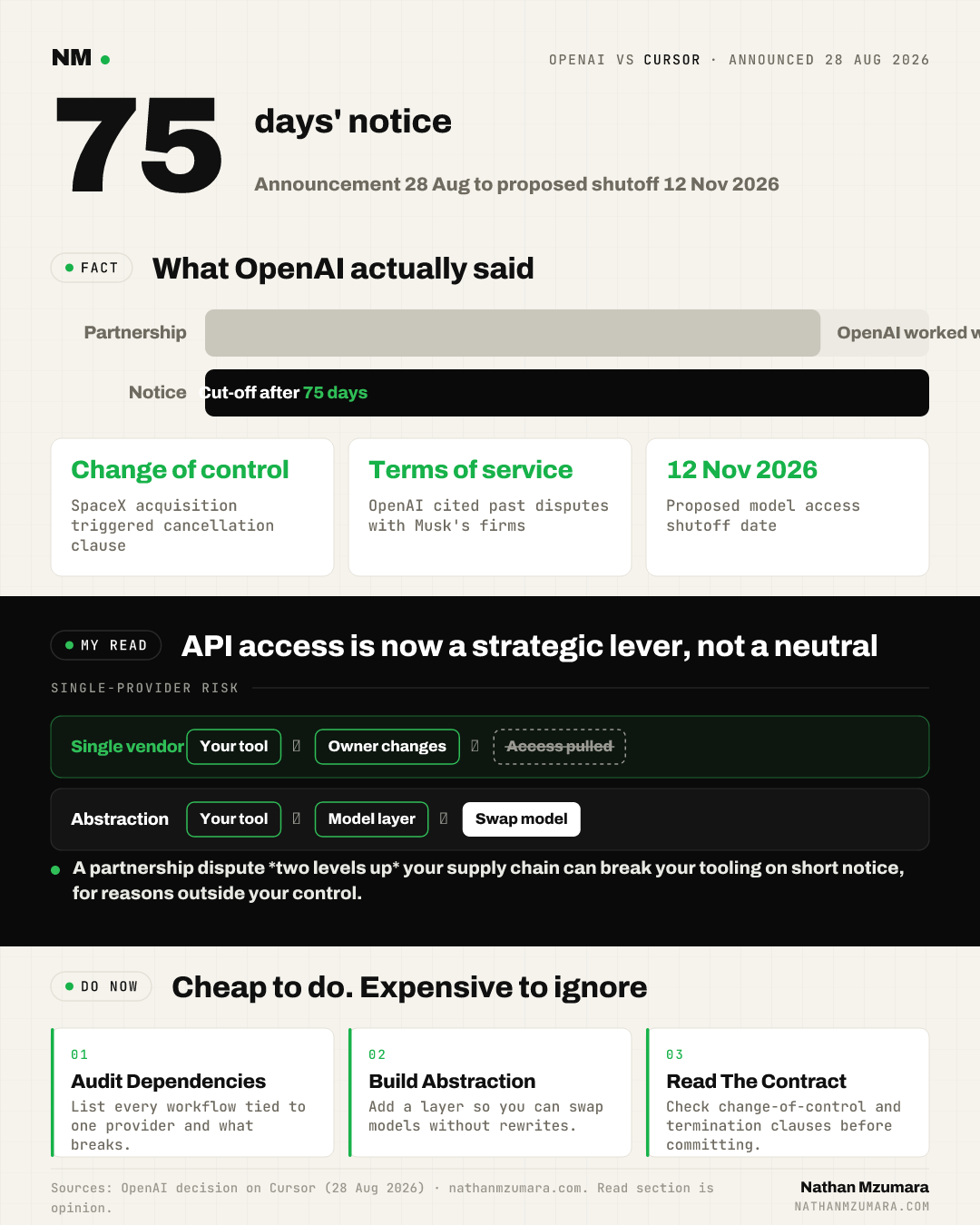
OpenAI worked with Cursor for nearly four years. That did not stop the wind-down once ownership changed. If your marketing or dev workflow runs on a single LLM provider, you carry counterparty risk that can vanish on short notice for reasons outside your control.
What this means for your AI stack
Treat model access like a supplier contract, not a permanent feature. Three moves help:
- Audit dependencies: list every tool and workflow that relies on one provider, and note what breaks if access ends on 75 days' notice.
- Build abstraction: add a layer that lets you swap models without rewriting your product, so a single wind-down does not stop work.
- Read the contract: understand change-of-control and termination clauses before you commit a core workflow to one model.
Does Cursor support the OpenAI o1 model, and how do you use OpenAI Codex in Cursor?
Historically, Cursor let developers pick models, which is why people ask whether Cursor supports the OpenAI o1 model and how to use OpenAI Codex in Cursor. The concern raised by the wind-down (the topic behind searches like cursor 与 openai anthropic 合作) is that any specific model can be pulled once a provider decides access no longer fits its terms.
The practical answer is to not build a workflow that only works with one provider's models. Design so you can move if access changes.
What OpenAI Codex vs Cursor really teaches growth leaders
The OpenAI Codex vs Cursor story is less about which tool codes better and more about who controls the access underneath it. Audit your AI dependencies this week, add an abstraction layer, and treat every model contract like a supplier relationship with real switching costs. For more on this pattern, see the single-provider risk in the Cursor cut-off and where OpenAI stands in 2026.
Tags