OpenAI API Response Cut Off for Cursor: The Single-Provider Risk
An OpenAI API response cut off is exactly what happened to Cursor, and it is a warning for anyone running AI in their stack. On 28 August 2026, OpenAI announced it will wind down the contract that provides OpenAI models to Cursor, with a proposed shutoff date of 12 November 2026. The trigger was not a technical fault. It was Cursor's acquisition by SpaceX.
What happened between OpenAI, Cursor and SpaceX
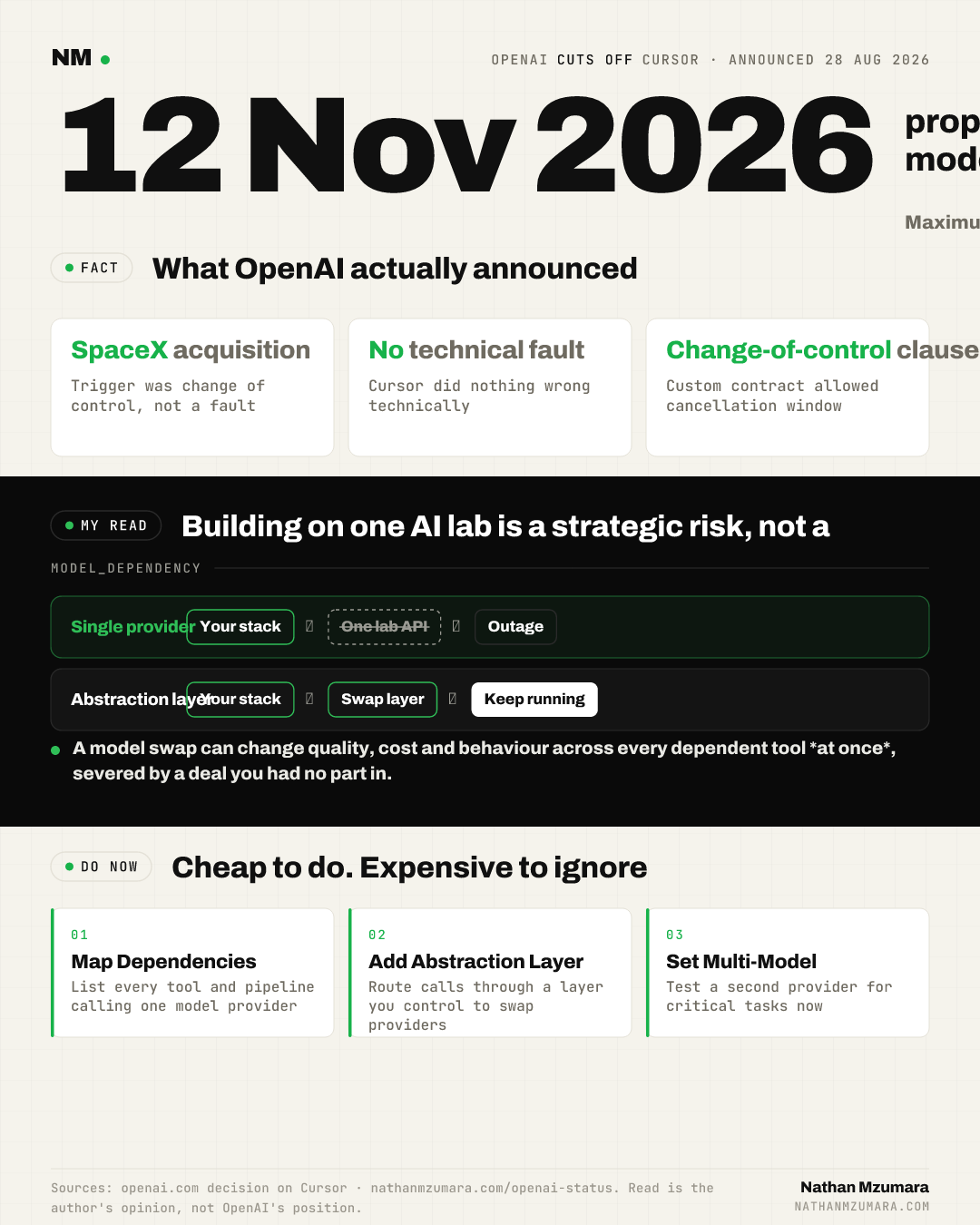
OpenAI notified SpaceX on 28 August 2026 that it intends to stop providing OpenAI models to Cursor, the code editor. The proposed shutoff date is 12 November 2026, which OpenAI says is the maximum notice its contract allows.
OpenAI stated its custom agreement with Cursor gives it a limited window to cancel after a change of control. SpaceX acquired Cursor, and SpaceX also now includes xAI and the former Twitter. OpenAI said it cannot be confident SpaceX will use its technology within its terms of service.
OpenAI cited past conduct as the reason. You can read the full statement in OpenAI's decision on Cursor following its acquisition by SpaceX.
Why an OpenAI response cut off matters for growth leaders
An OpenAI response cut off means a tool you rely on can lose its underlying model overnight because of a deal you had no part in. Cursor did nothing wrong technically. It was acquired, and a supplier contract clause did the rest.
For CMOs, VPs and founders, this is the clearest signal yet that building on a single AI provider is a strategic risk, not a convenience. Any workflow, content pipeline or GEO stack tied to one lab's API can be severed by a corporate decision you do not control.
Where the single-provider risk sits in your stack
Most marketing teams underestimate how many parts of their operation depend on one model. The exposure is rarely in one obvious place. It is spread across tools you bought, not just code you wrote.
- Content generation: drafting, briefs and summaries that run through one provider's API behind a third-party tool.
- Analytics and reporting: automated insights, tagging and classification built on a single model.
- Automation and agents: workflows that call one lab's models to route, reply or enrich data.
The precedent: platform dependency is an old lesson
This is the same lesson search marketers learned from Google algorithm updates and from platforms cutting off API access. Businesses that built entirely on one channel found their operations at the mercy of decisions made elsewhere. The AI layer just moves that risk closer to the core of how you work.
The difference now is speed and reach. A model swap can change quality, cost and behaviour across every tool that depends on it, all at once.
What to do this week
Start with an audit, then build the fallbacks. The goal is to survive a supplier relationship breaking, not just a technical failure.
- Map your dependencies. List every tool, workflow and pipeline that calls a single model provider, including tools where the model is hidden behind a vendor.
- Add an abstraction layer. Route model calls through a layer you control so you can swap providers without rebuilding the workflow.
- Set multi-model fallbacks. Test a second provider for your critical tasks now, so a shutoff is an inconvenience, not an outage.
If you want the wider context on the company at the centre of this, read our OpenAI status explainer, and for how model dependence affects visibility, see why your AI visibility tool may be blind to most of the web.
The bottom line on the OpenAI API response cut off
The OpenAI API response cut off for Cursor proves that model access can end for reasons that have nothing to do with your product or performance. Audit your single-provider exposure, build abstraction layers and set multi-model fallbacks before a contract decision, not a bug, breaks your operations.
Tags