Google Data Manager in GA Launches: What Changes Now

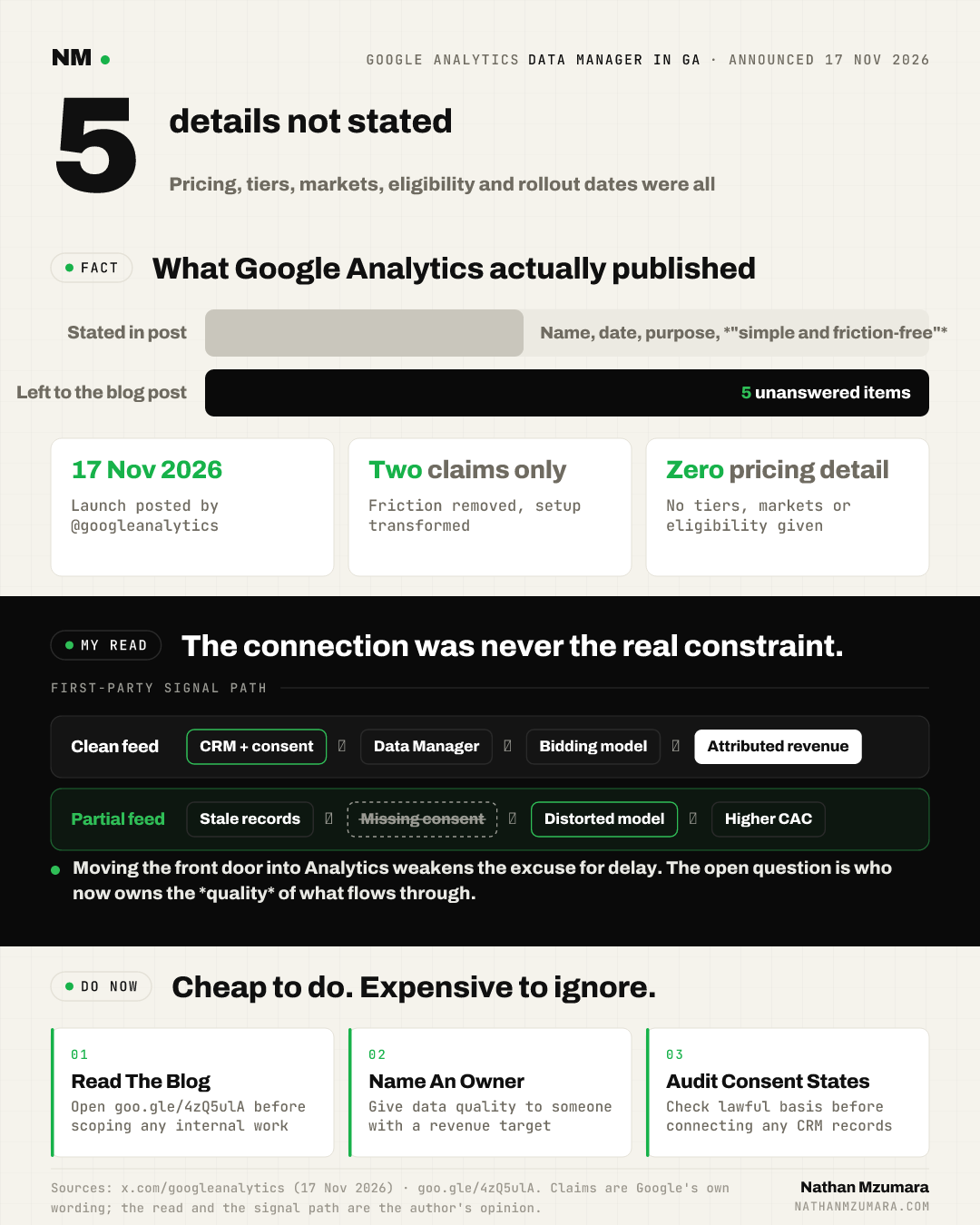
Google Analytics launched Data Manager in GA on 17 November 2026. The Google Data Manager post, from the official @googleanalytics account, says it "makes connecting first-party data simple and friction-free" and "transforms your first-party data setup". No pricing, markets, eligibility or rollout dates were stated.
That is a short announcement with a long tail. Connecting first-party data has been an engineering ticket for most marketing teams. Google has just moved the front door for that work into the Analytics interface.
What exactly did Google Analytics announce on 17 November 2026?
The announcement was made by the official @googleanalytics account on Nov 17, 2026. It came as a single post, and refers to a "Data Manager launch" and to "Data Manager in GA". The post opens with "Ready to level up your measurement?" and points readers to the newest blog post for the detail, linked as goo.gle/4zQ5ulA.
Two claims are made directly. Data Manager in GA "makes connecting first-party data simple and friction-free". The launch "transforms your first-party data setup". You can read the original Google Analytics announcement post on X for the full wording.
Everything else is absent. The table below separates what the post states from what it does not.
| Stated in the post | Not stated in the post |
|---|---|
| Official name: Data Manager in GA | Pricing |
| Announced 17 November 2026 by @googleanalytics | Plan names or tiers |
| Purpose: connecting first-party data | Markets or regions |
| Framing: "simple and friction-free" | Eligibility criteria |
| Detail lives in the linked blog post (goo.gle/4zQ5ulA) | Rollout dates or timing |
What the 17 November 2026 Data Manager in GA announcement confirms, and the five things it leaves to the linked blog post.
What is google data manager, in plain English?
Data Manager in GA is a connection point inside Google Analytics for bringing your own first-party data into the platform. First-party data means the data you own: CRM records, offline conversions, customer lists, consent states. Previously that connection sat outside the Analytics interface. Google Analytics now positions it inside.
The practical scope is still in the Google Analytics blog post on the Data Manager launch. Until you read that, treat the announcement as a statement of direction rather than a feature spec. The Data Manager Google Analytics described is framed around removing friction, not around a published list of capabilities.
Why friction in first-party data setup is a budget problem
Friction is not a user experience complaint. Friction is why first-party data projects sit in the engineering backlog for two quarters while paid media runs on thinner signal.
Here is the chain. Google's automated bidding learns from the conversions you send it. The conversions you send it come from your first-party data. If that pipe is partial, late or badly consented, the model optimises against a distorted picture of who is valuable.
You do not see that as a measurement error. You see it as a higher cost per acquisition, and you usually blame the auction.
My read is that this is the real story in a 40-word post. When the connection step moves into the Analytics UI, the excuse for delay weakens. The constraint stops being access and starts being whether anyone owns the quality of what flows through.
The precedent: every time signal moves, ownership moves with it
Marketing teams have been here before. The GA4 migration turned a reporting change into a tagging and governance programme, and the teams that treated it as an IT task lost historical comparability. Consent management followed the same curve, landing on legal and engineering desks before marketing accepted that consent rates set the ceiling on measurable conversions.
The pattern repeats on the discovery side too. When referral data degrades, attribution quietly degrades with it, which is what happened when ChatGPT referrals started arriving as direct traffic. Nobody filed a ticket. The number just got less true.
Data Manager in GA sits in that lineage. The interface change is modest. The ownership question it forces is not.
What the Data Manager in GA launch changes for marketing leaders
Different roles should read this announcement differently.
- CMOs and VPs of Marketing: the quality of your CRM and offline conversion data now sets the ceiling on what you can report as attributed revenue. If that data is owned by a team with no revenue target, your board number inherits their priorities.
- Growth and performance leads: AI bidding performance is downstream of signal completeness. Fixing the feed is usually cheaper than another round of creative testing, and it compounds across every campaign rather than one.
- Search marketing professionals: first-party data connection is no longer a specialism you hand off. If connecting data moves into Google Analytics, the skill becomes knowing which events, identifiers and consent states deserve to go in.
- Founders and CEOs: this is a CAC question. Two companies with the same product and budget will pay different acquisition costs purely because one feeds the models better data.
The decision in front of you is narrow. Either you move first-party data onboarding, ownership and quality assurance into marketing's remit and fund it, or you keep waiting on engineering and accept degraded signal in Google's bidding and reporting. There is no third option where you wait and the signal stays clean.
What could go wrong
Ease of connection is not the same as correctness of connection. Three risks follow a launch like this.
- Consent debt: a simpler path to connecting customer data makes it easier to send records you have no lawful basis to send. The interface will not adjudicate your privacy notices.
- Garbage at speed: duplicate records, stale CRM stages and mislabelled offline conversions now reach the bidding models faster. Bad data arriving quickly is worse than bad data arriving slowly.
- False confidence: a connected source looks authoritative in a report. Leaders stop asking how the number was built, which is exactly when attribution starts drifting from reality.
Note the limits of the announcement itself. Google Analytics published no pricing, no plan names, no markets, no eligibility rules and no rollout dates on 17 November 2026. Any plan you build before reading the linked blog post is a plan built on a headline.
The counter-view: reasons to leave this alone for now
A fair objection: this is one post, with one link, and no stated timing. Treating it as a trigger for a funded governance programme may be an overreaction to a marketing message.
If your business runs on simple online conversions with clean checkout tracking, the incremental value of richer first-party data connection may be small. If your CRM is genuinely unreliable, connecting it faster makes your measurement worse, not better. And teams without a data owner often buy tooling instead of hiring judgement, which is how measurement stacks get expensive and stay wrong.
The counter-view holds for roughly a quarter. It stops holding the moment a competitor in your category starts bidding on better signal than yours, which you will notice as rising costs with no obvious cause. The same lag shows up in discovery, as we saw when Google shifted Play Store discovery towards AI surfaces.
What to do about Data Manager in GA this week
Five concrete actions, in order:
- Read the linked Google Analytics blog post at goo.gle/4zQ5ulA and write down the eligibility, pricing and availability facts the 17 November post omitted.
- List every first-party data source you would connect: CRM, offline conversions, customer lists, consent states. Mark each one as trusted, partial or unverified.
- Name one person in marketing who owns first-party data quality. Not a committee, and not a request queue into engineering.
- Run a consent review before you connect anything. Confirm you can lawfully send each field.
- Set a baseline now: current cost per acquisition, conversion volume reported in Google Analytics, and the gap between platform-reported and CRM-confirmed revenue. Without it you cannot prove the change worked.
Data Manager in GA does not solve your data problem. It removes the setup friction you have been hiding behind, and that is enough to make the ownership question urgent. Decide who owns first-party data quality in your organisation before the connection becomes easy enough that someone else decides for you.
Published 17 November 2026. Last updated 17 November 2026.
