Tooling
Shopify
Also known as: Shopify Plus
Shopify is a hosted ecommerce platform used by merchants to run online stores, with Shopify Plus as its enterprise tier. It provides the storefront, checkout, product catalogue, payments and an app ecosystem, and exposes product data through APIs and structured feeds. Those feeds and the structured data on product pages are what shopping tools and AI assistants read when describing a merchant's products.
What it is
Shopify supplies the full commerce stack as a service, so merchants manage products, inventory, orders and content rather than servers. Themes are built with the Liquid templating language, and headless builds are possible using the Storefront API or the Hydrogen framework. Metafields and metaobjects let merchants store custom product attributes beyond the default fields.
Why it matters
Product data quality on Shopify directly affects whether a product can be retrieved, compared and recommended by search engines, marketplaces and AI shopping assistants. Missing attributes such as material, dimensions, compatibility or stock status mean an assistant either skips the product or answers vaguely. Theme decisions also affect how much of a page is visible to crawlers that do not execute JavaScript.
How it works
Practitioners tidy the catalogue at source, using metafields for the attributes buyers actually ask about, then make sure those attributes render in page HTML and in Product schema markup. They keep the Google Merchant Center feed accurate, check that variant, price and availability data match the page, and audit key templates for content that only appears after JavaScript runs. Plus merchants often add checkout customisation and B2B catalogues on top.
When it applies
It applies to any merchant running a storefront on Shopify or Shopify Plus, and to agencies advising them on product discovery. It is particularly relevant during a replatform, a catalogue clean up or a move to a headless storefront.
Examples
- A homeware brand adds dimensions and care instructions as metafields, surfaces them in the theme and sees them picked up in Product schema.
- A parts retailer publishes vehicle compatibility tables in HTML rather than in an app widget, so crawlers and assistants can read them.
- A Plus merchant audits its Merchant Center feed and finds price mismatches on 300 variants caused by a stale currency rule.
How it is measured
- Share of products with complete structured attributes, measured against an agreed required field list
- Product schema validity and error count across the catalogue
- Merchant Center feed disapproval and warning rate over time
- Organic and assistant referred sessions to product pages, and their conversion rate
Related terms in Tooling
- Ahrefs Brand RadarAhrefs' AI-visibility module tracking brand mentions and impressions inside AI answers. Surfaces shifts in how brands appear across ChatGPT, Gemini, and other LLM surfaces.
- AI content detectionAI content detection is the use of software to estimate whether a piece of text, image, audio or video was generated by an AI model. Detectors return a probability or classification rather than proof, and accuracy varies with length, language, editing and model used. Because of that uncertainty, results are treated as a signal for review, not a verdict.
- AI watermarkingAI watermarking is the practice of embedding a signal into AI generated text, images, audio or video so the output can later be identified as machine produced. The signal is usually designed to be imperceptible to people but detectable by software that holds the matching key or detector. It is one of several provenance approaches used alongside metadata standards and content credentials.
- Bot detectionBot detection is the practice of identifying automated traffic to a website or API and separating it from human visitors. It distinguishes wanted automation, such as search engine and AI crawlers, from unwanted activity like scraping, credential stuffing and click fraud. Detection results feed decisions about what to allow, challenge, rate limit or block.
- Brave BrowserBrave is a Chromium based web browser from Brave Software that blocks third party trackers and most ads by default. It bundles privacy controls, Brave Search as the default engine, and an AI assistant called Leo. Because it strips tracking scripts, visits from Brave users are often harder to attribute in analytics.
- Brave SearchBrave Search is a search engine from Brave Software that serves results from its own web index rather than reselling another engine's results. It is the default engine in the Brave browser, offers AI generated answer summaries, and is sold to developers as the Brave Search API. That API makes it a grounding source for other search and AI products.
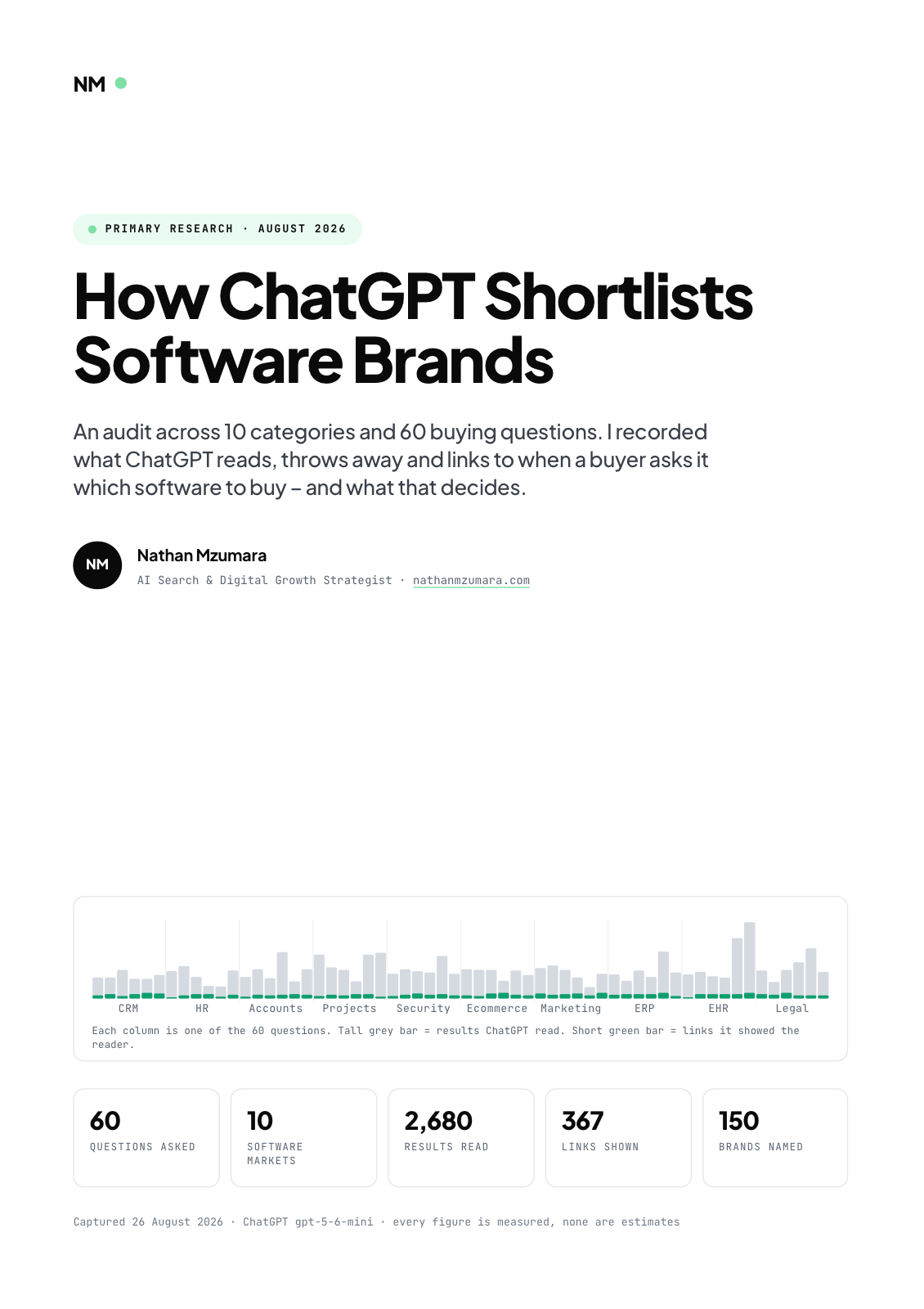
Primary research · August 2026
How ChatGPT Shortlists Software Brands
An audit across 10 categories and 60 buying questions. I recorded what ChatGPT reads, throws away and links to when a buyer asks it which software to buy, and what that decides.
- 60
- Questions asked
- 10
- Software markets
- 2,680
- Results read
- 367
- Links shown
Free download
Get the full report
35 pages · PDF · 536 KB. Enter your details and it downloads straight away.