Tooling
Roblox
Also known as: Roblox Corporation
Roblox is an online platform where users play, create and publish interactive experiences built by other users, with reported daily active users in the tens of millions. Creators build experiences in Roblox Studio and monetise through the platform's Robux currency. Brands use it to build playable experiences and run in platform advertising, mainly for reach among younger audiences.
What it is
Roblox combines a creation toolset, a hosting platform and a social network, with experiences discovered through search, charts and recommendation feeds inside the client. Content is made by independent creators and studios rather than by Roblox itself. The economy runs on Robux, which users buy and creators can earn from.
Why it matters
For brands aiming at younger audiences, a large share of attention and discovery happens inside platforms like Roblox rather than on the open web. Experiences and events can generate significant playtime and social sharing, and they often spill over into search demand, YouTube and TikTok content. It is also a reminder that discovery is fragmenting across closed platforms that external search engines index only partially.
How it works
Brands either commission a development studio to build a branded experience or partner with an existing popular experience for in game items and events. Discovery inside the platform depends on the experience title, thumbnails, description, genre and early engagement signals, so teams treat in platform listings much like app store optimisation. Advertising options and brand partnerships are handled through Roblox's own ad and partnership programmes, and any activity aimed at younger users has to respect platform policy and advertising rules for children.
When it applies
It applies when your audience skews young, when you are testing virtual goods or interactive brand experiences, or when you need reach beyond web and social channels. It is less relevant for narrow B2B audiences or products with older customer bases.
Examples
- A sportswear brand launches a branded obstacle course experience with wearable virtual trainers and a limited event weekend.
- A music label promotes a release with an in experience listening event inside a partner developer's world.
- A toy company tests demand for a new character by releasing a virtual avatar item and tracking take up before retail launch.
How it is measured
- Visits and unique visitors to the branded experience over the campaign period
- Average session length and return visit rate
- Virtual item take up, such as units claimed or equipped
- Off platform lift, including branded search volume, social mentions and creator video coverage during the activation
Insights on Roblox
Related terms in Tooling
- Ahrefs Brand RadarAhrefs' AI-visibility module tracking brand mentions and impressions inside AI answers. Surfaces shifts in how brands appear across ChatGPT, Gemini, and other LLM surfaces.
- AI content detectionAI content detection is the use of software to estimate whether a piece of text, image, audio or video was generated by an AI model. Detectors return a probability or classification rather than proof, and accuracy varies with length, language, editing and model used. Because of that uncertainty, results are treated as a signal for review, not a verdict.
- AI watermarkingAI watermarking is the practice of embedding a signal into AI generated text, images, audio or video so the output can later be identified as machine produced. The signal is usually designed to be imperceptible to people but detectable by software that holds the matching key or detector. It is one of several provenance approaches used alongside metadata standards and content credentials.
- Bot detectionBot detection is the practice of identifying automated traffic to a website or API and separating it from human visitors. It distinguishes wanted automation, such as search engine and AI crawlers, from unwanted activity like scraping, credential stuffing and click fraud. Detection results feed decisions about what to allow, challenge, rate limit or block.
- Brave BrowserBrave is a Chromium based web browser from Brave Software that blocks third party trackers and most ads by default. It bundles privacy controls, Brave Search as the default engine, and an AI assistant called Leo. Because it strips tracking scripts, visits from Brave users are often harder to attribute in analytics.
- Brave SearchBrave Search is a search engine from Brave Software that serves results from its own web index rather than reselling another engine's results. It is the default engine in the Brave browser, offers AI generated answer summaries, and is sold to developers as the Brave Search API. That API makes it a grounding source for other search and AI products.
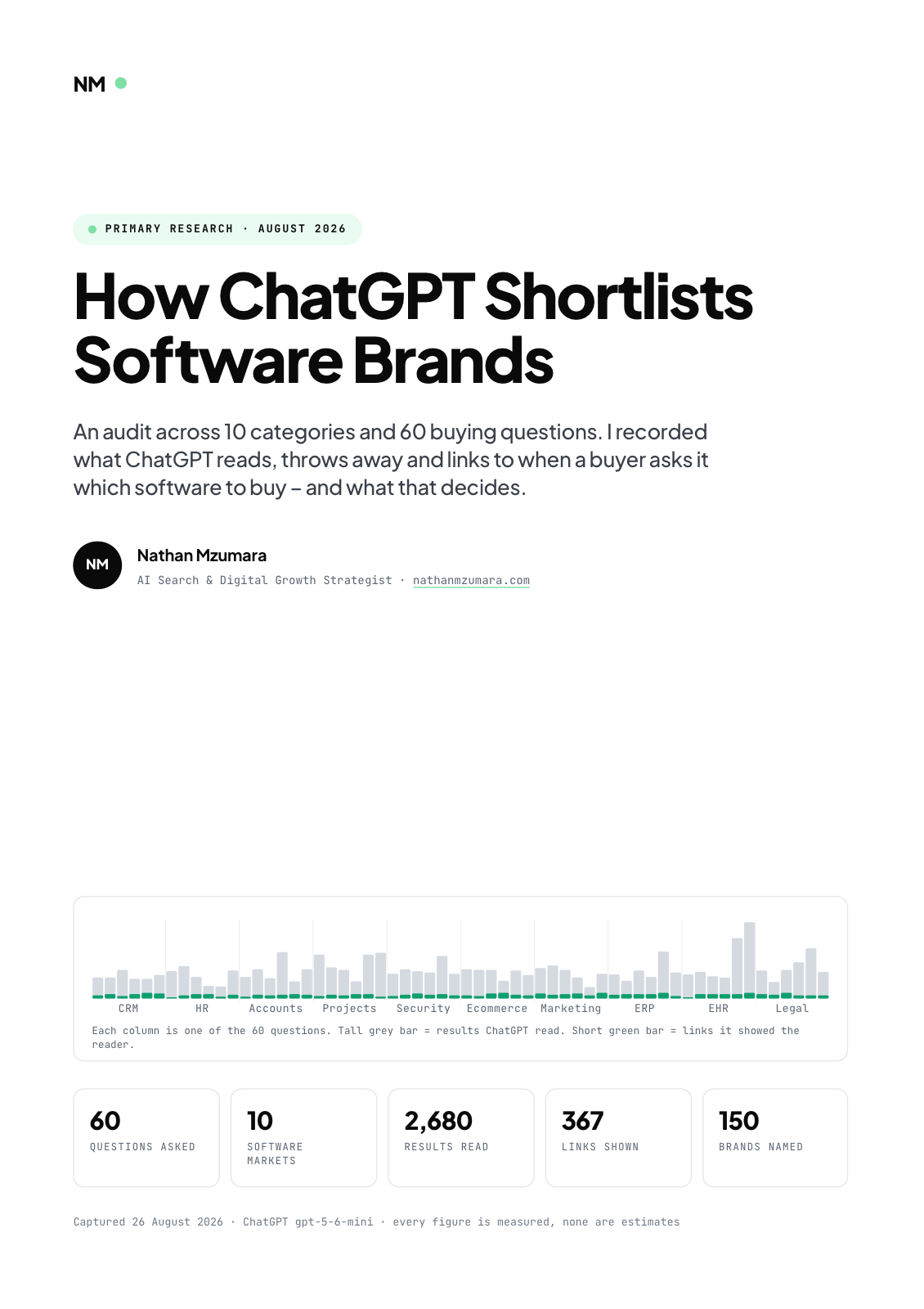
Primary research · August 2026
How ChatGPT Shortlists Software Brands
An audit across 10 categories and 60 buying questions. I recorded what ChatGPT reads, throws away and links to when a buyer asks it which software to buy, and what that decides.
- 60
- Questions asked
- 10
- Software markets
- 2,680
- Results read
- 367
- Links shown
Free download
Get the full report
35 pages · PDF · 536 KB. Enter your details and it downloads straight away.