Advertising & Paid Media
Return on ad spend
Also known as: ROAS, return on advertising spend, target ROAS
Return on ad spend, or ROAS, is the revenue attributed to advertising divided by the cost of that advertising. It is usually expressed as a ratio, such as 4:1, or as a multiple or percentage. ROAS measures top line efficiency of media rather than profit, so it needs to be read alongside margin and other costs.
What it is
ROAS is a simple efficiency ratio: attributed revenue over media spend for a chosen campaign, channel and period. Most ad platforms calculate it automatically from conversion values passed back by tracking, and several offer target ROAS bidding, where the system adjusts bids to hit a value you set. The figure depends entirely on the attribution model and conversion window behind it.
Why it matters
ROAS is the common language for judging whether paid media is worth funding and for deciding how to split budget across campaigns, products and channels. Because it uses revenue rather than conversion counts, it suits ecommerce and any business with varying order values, where cost per acquisition hides the difference between a small and a large basket. It also feeds automated bidding, so an unrealistic target can starve campaigns of volume while a loose one can spend into unprofitable territory.
How it works
Teams calculate a breakeven ROAS from gross margin, then set targets above it to leave room for overheads and profit. They pass accurate conversion values back to the platform, ideally net of returns and discounts, and review ROAS at campaign or product group level rather than only at account level, since averages hide losers. Many pair platform ROAS with a blended figure, total revenue over total media spend, to sanity check against the accounts.
When it applies
It applies to any revenue generating paid media where order or contract value can be measured, and is less useful for brand campaigns, lead generation without value estimates, or businesses with long subscription payback.
Examples
- A shopping campaign returns £5 of attributed revenue for every £1 spent, reported as 5:1 ROAS.
- A retailer with a 40 per cent gross margin calculates breakeven at 2.5:1 and sets targets above that to cover fulfilment and overheads.
- A team switches a campaign to target ROAS bidding, sets the goal too high, and sees spend and conversions drop while the ratio improves.
How it is measured
- Platform reported ROAS by campaign, product group and audience
- Blended ROAS, total revenue over total media spend across all channels
- Breakeven ROAS derived from gross margin, and the gap between actual and breakeven
- Profit on ad spend or contribution after returns, discounts and variable costs
Insights on Return on ad spend
Related terms in Advertising & Paid Media
- AI-generated creativeAI-generated creative is ad and marketing creative produced or adapted using generative models, including images, video, voiceover, headlines and body copy. Teams use it to produce more variants, localise faster and test concepts that would be too costly to shoot. It still needs human direction, brand review and legal checks before it runs.
- Asset groupsAn asset group is the creative container inside a Google Performance Max or Demand Gen campaign, holding headlines, descriptions, images, logos, videos and audience signals. Google assembles ads from these assets and serves them across Search, Shopping, YouTube, Display, Discover, Gmail and Maps. Retail campaigns can tie an asset group to a specific set of products through listing groups.
- Brand safetyBrand safety is the practice of preventing advertising and brand content from appearing next to material that could damage reputation, such as violent, illegal or misleading content. Brand suitability is the related, narrower idea of matching placements to a specific brand's tolerance and values rather than a universal baseline. Both rely on exclusion lists, content classification and verification reporting.
- ChatGPT AdsChatGPT Ads refers to advertising placements inside OpenAI's ChatGPT. OpenAI has publicly signalled that advertising is part of its commercial plans and has been testing and building out ad capabilities, so the format details continue to change. For marketers it represents a possible new paid surface alongside organic visibility in AI assistants.
- ChatGPT Sponsored AgentsChatGPT Sponsored Agents is the name given to a paid placement format in which a brand's agent or assistant can be surfaced inside a ChatGPT conversation to help complete a task, such as booking, quoting or buying. It sits alongside other advertising formats OpenAI has discussed for ChatGPT, where commercial results are marked as sponsored rather than blended invisibly into answers. Availability, naming and mechanics are still moving, so treat any specification as provisional and check current OpenAI documentation before planning spend.
- Conversational advertisingConversational advertising is paid placement inside a dialogue, whether that is an AI assistant, a chatbot, a messaging app or a voice interface. Instead of a static creative next to content, the ad appears as a response, suggestion or handover at the point where the user has expressed intent. The defining features are turn-by-turn context, a disclosure label, and the option for the user to keep talking rather than click away.
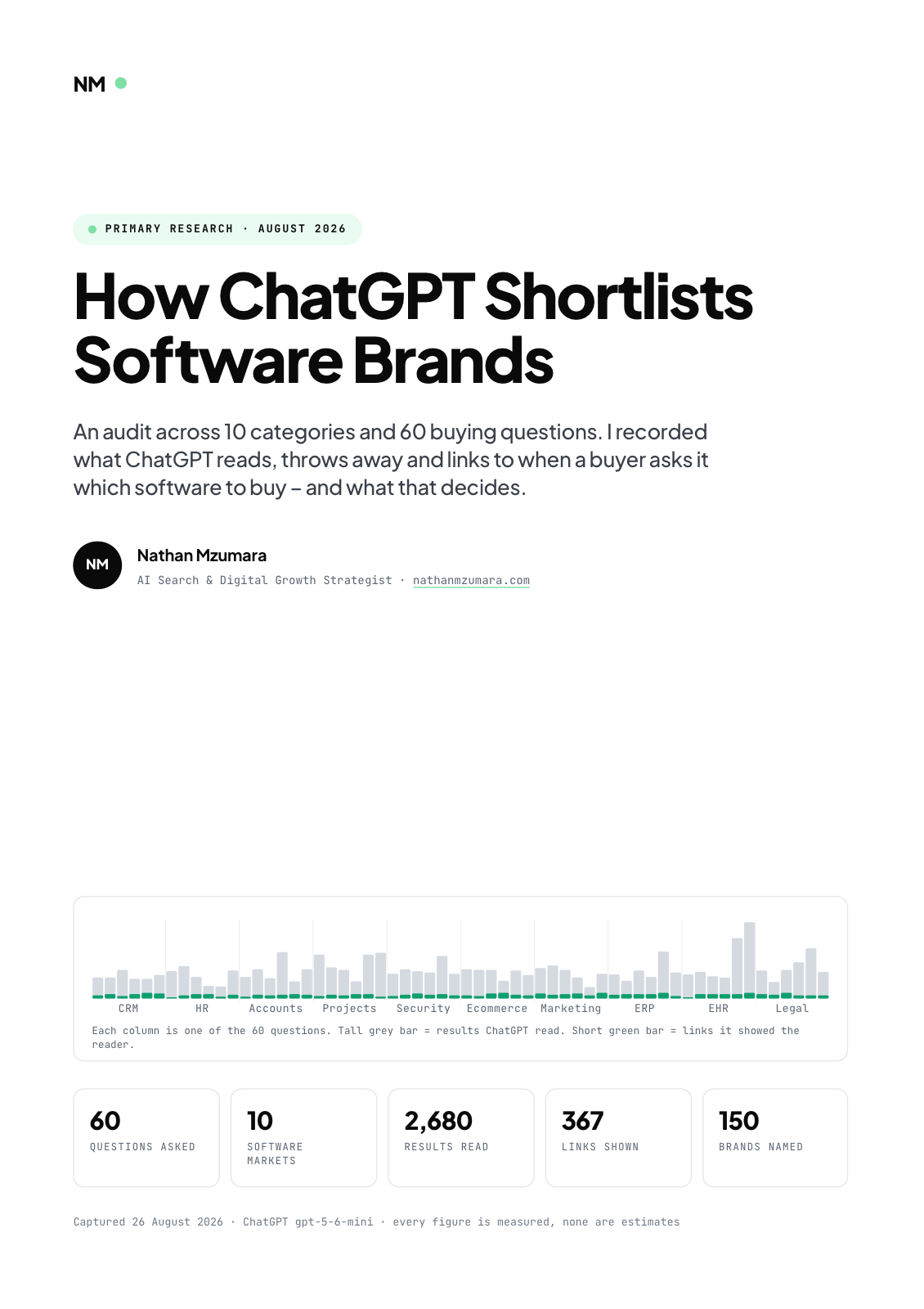
Primary research · August 2026
How ChatGPT Shortlists Software Brands
An audit across 10 categories and 60 buying questions. I recorded what ChatGPT reads, throws away and links to when a buyer asks it which software to buy, and what that decides.
- 60
- Questions asked
- 10
- Software markets
- 2,680
- Results read
- 367
- Links shown
Free download
Get the full report
35 pages · PDF · 536 KB. Enter your details and it downloads straight away.